
An ancient sea, a childhood adventure and twelve little WuHoo's that changed the way I look at this remarkable town.
I reckon I was about nine when Dad took me exploring some of Ōamaru's old limestone warehouses. One room has stayed with me: enormous wooden floors, stone walls, pigeons flapping around the rafters... and pigeon poo. Everywhere!
Dad was there with other Timaru Civic Trust members, being shown buildings that the locals were trying to save. I remember him crouching down and explaining the stone was about 35 million years old. The blocks I was staring at were once an ancient seabed... now we were standing inside a warehouse made from it.
The adults were talking about conservation. I was watching the pigeons. More than 30 years later, I returned with Mum, Dad and my own children. The warehouses were still there, but the streets had changed beyond recognition...
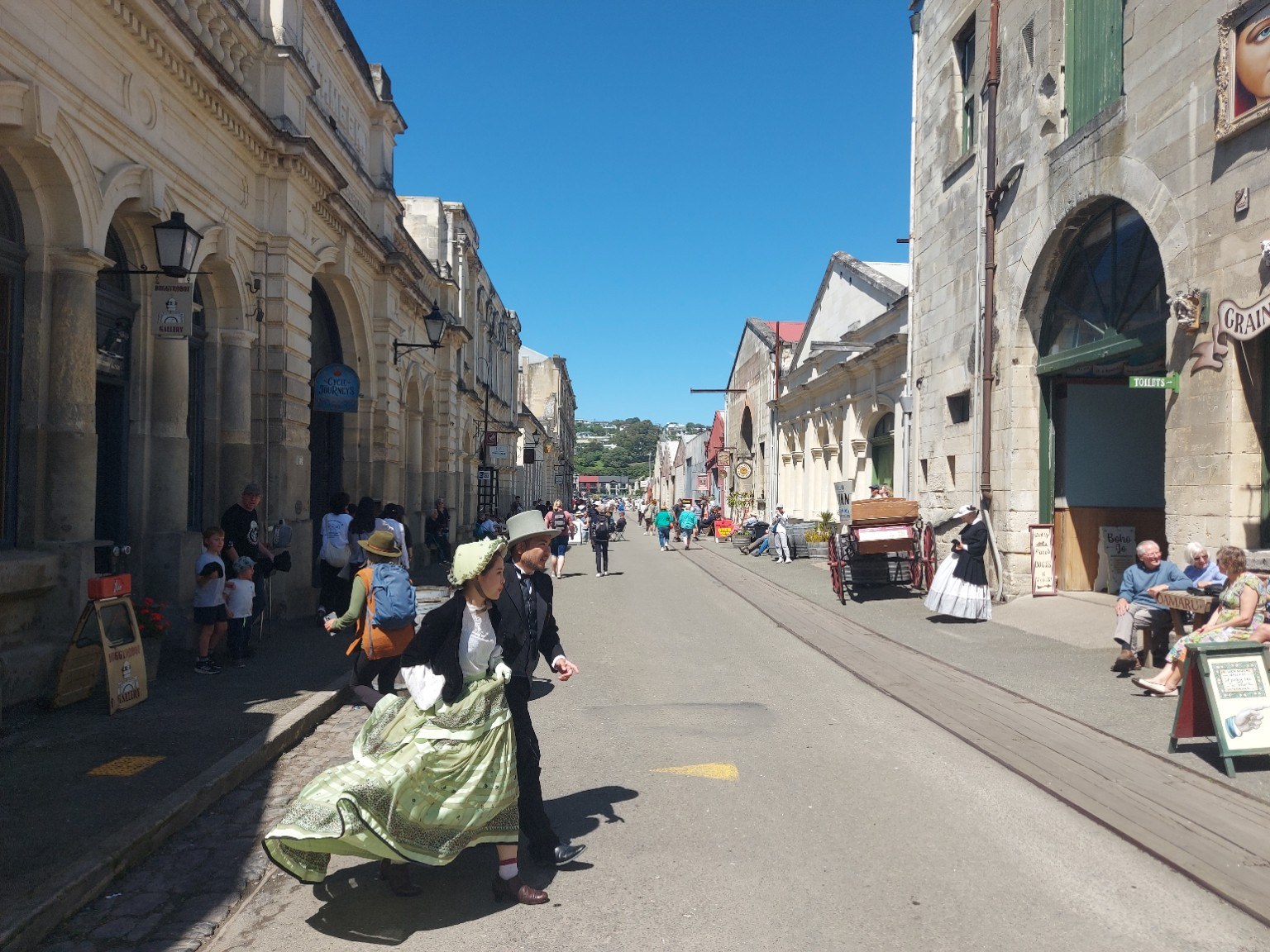 Harbour Street during the Victorian Heritage Celebrations, Ōamaru. Photograph: Roselyn Fauth, 2026.
WuHoo No1 for the day... The warehouses once full of pigeons are bustling again
Harbour Street was alive with magnificent frocks, waistcoats, top hats, dancers, bagpipes and penny-farthings. The music bounced between the limestone buildings. Where I remembered dust and pigeons, there were now people enjoying the streets.
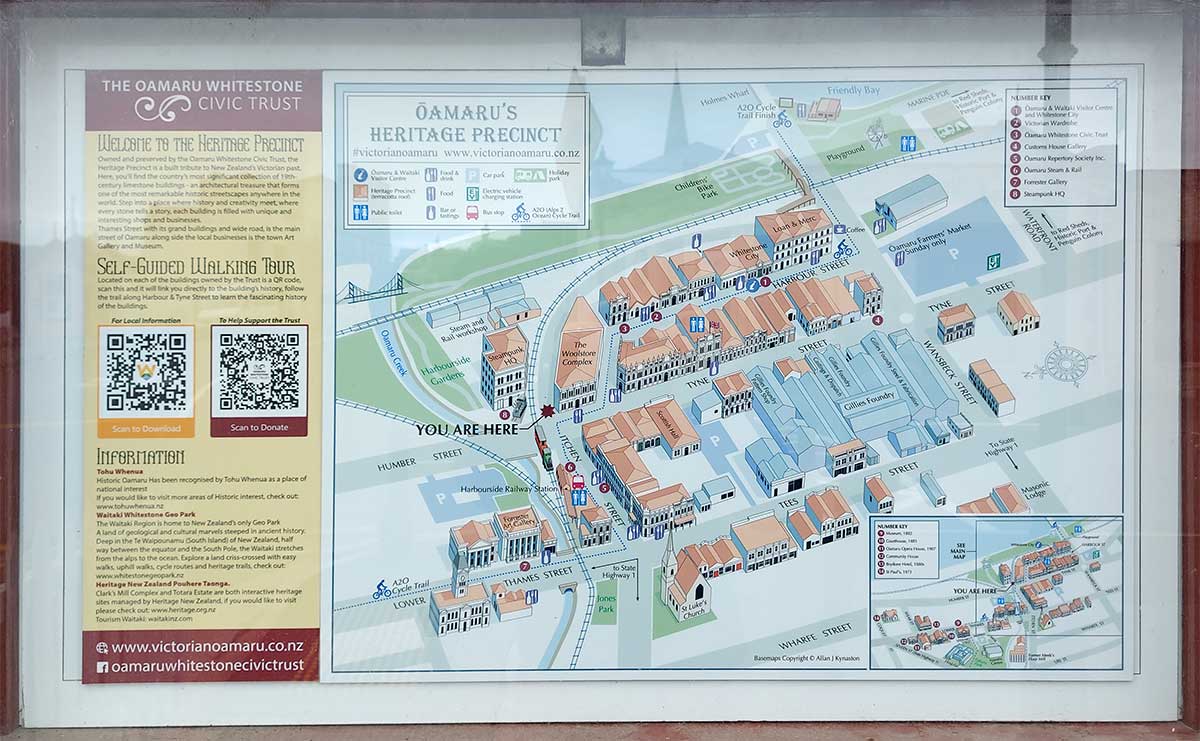
We had come to Ōamaru for the annual Victorian Heritage Celebrations, a festival that brings the town's past to life with costumes, music, performances, parades and activities throughout the historic precinct.
I'd been invited to deliver the 2026 Forrester & Lemon Lecture, hosted by the Ōamaru Whitestone Civic Trust and Waitaki Whitestone UNESCO Global Geopark. I was there to share how WuHoo Timaru uses curiosity, creative storytelling and social media to get people excited about the history on their own doorstep, including those who might never have considered themselves interested in history.
It was a wonderful excuse to make a weekend of it with my family, revisit some childhood memories and see what new discoveries Ōamaru had waiting for us.
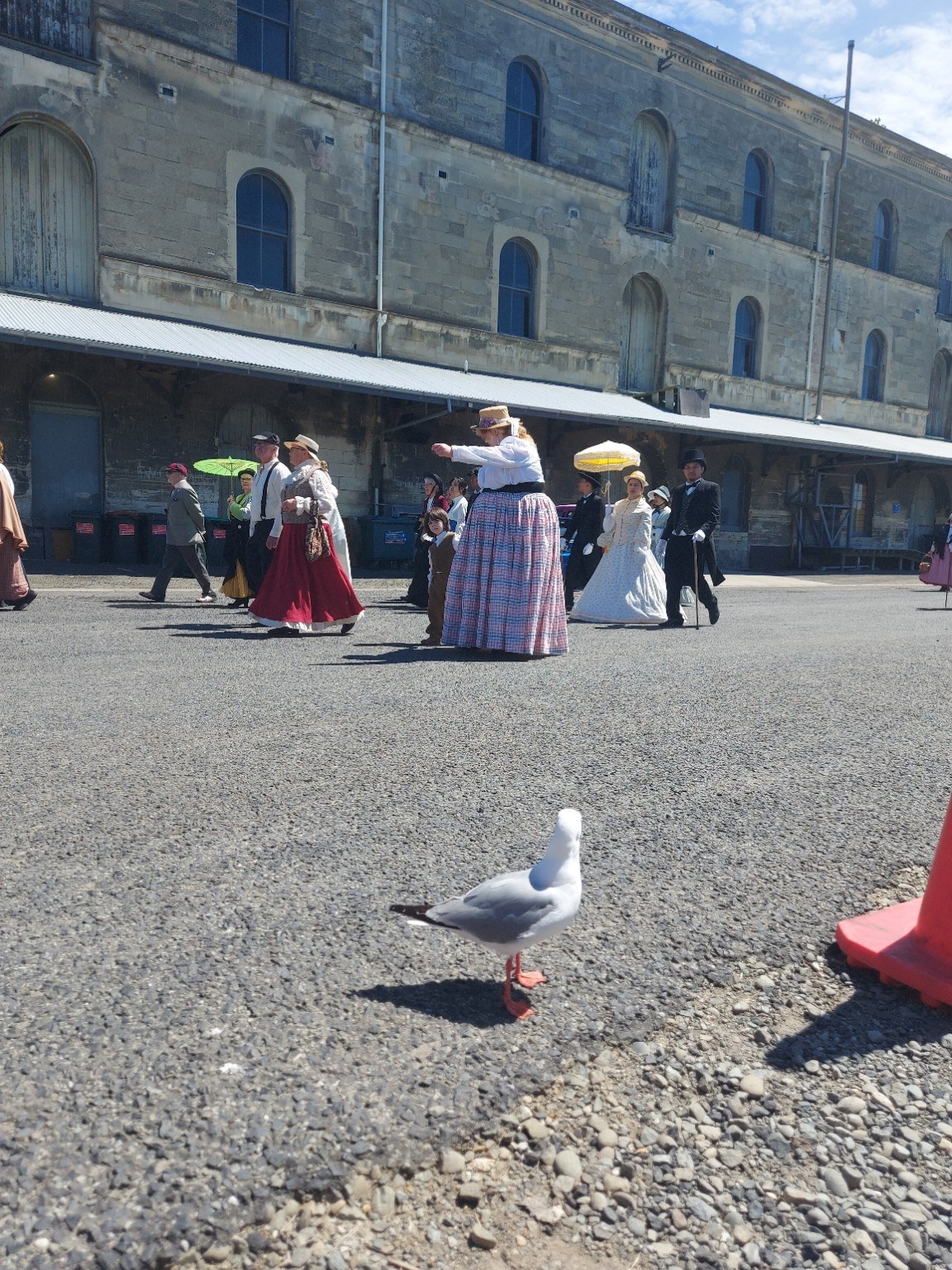 Costumed participants enjoying the Victorian Heritage Celebrations. Photograph: Roselyn Fauth, 2026.
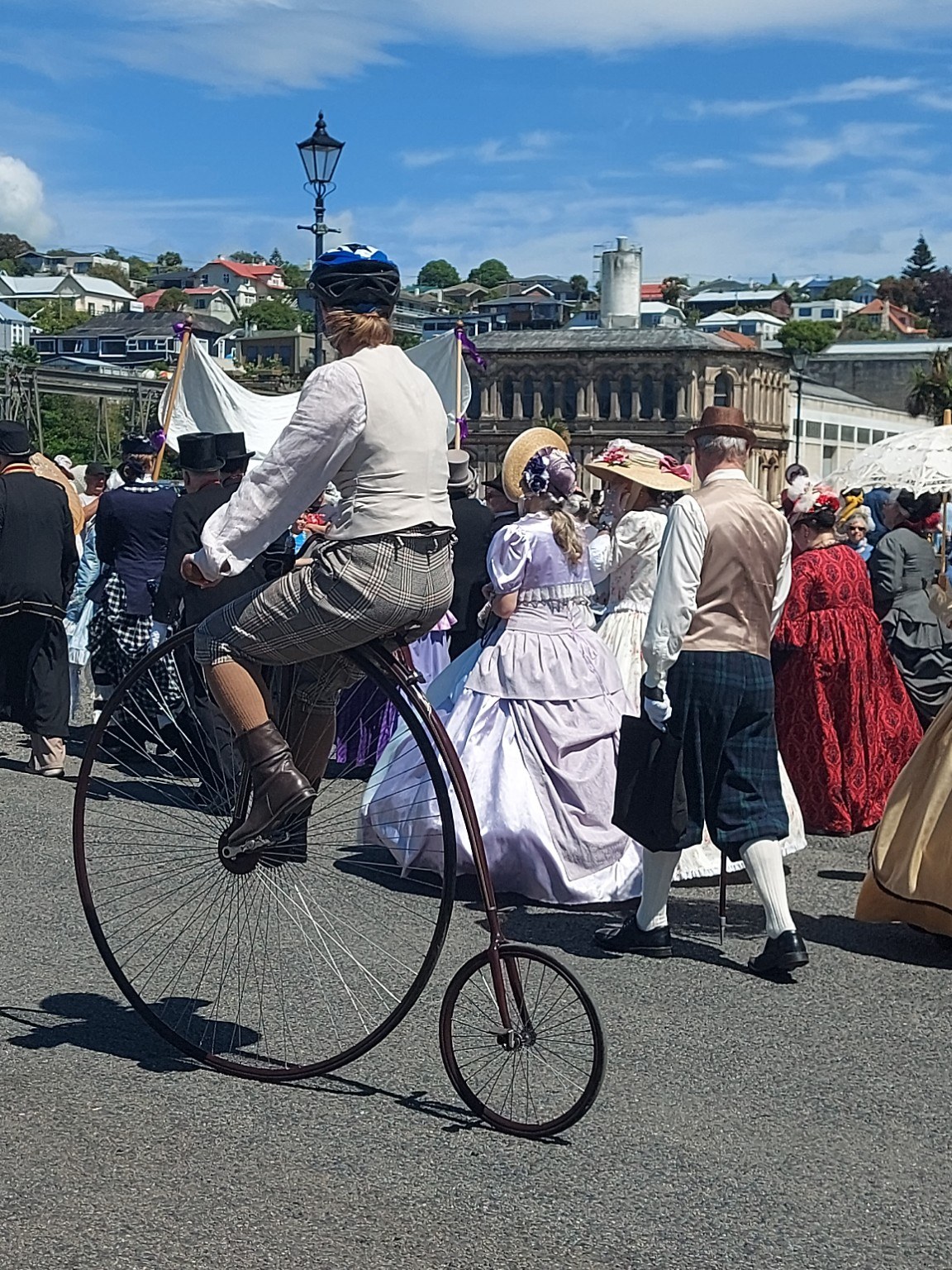 A penny-farthing adds to the spectacle of the Victorian Heritage Celebrations. Photograph: Roselyn Fauth, 2026.
Then an old truck came rumbling along. Hang on a minute. Dad knew that truck! I can't remember it, but apparently we had been given a ride on it decades ago when we had been in Oamaru. I bet back then dad never thought he would be at the edge of a parade admiring it again with his grandchildren!
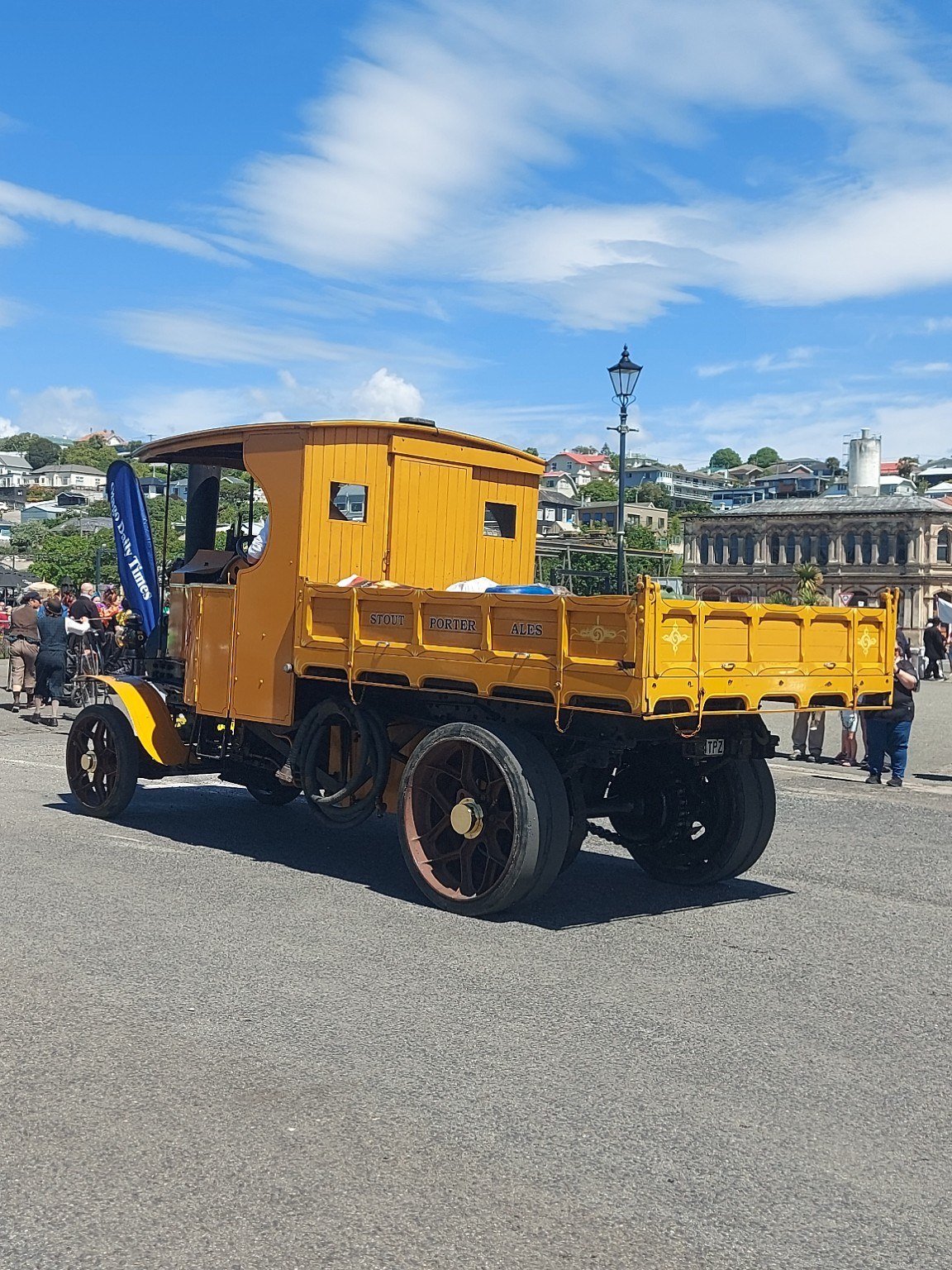 An old truck in the parade, like one I remember riding in as a child, it is probably the same truck. Photograph: Roselyn Fauth, 2026.
Three generations of us stood watching a possible piece of my childhood drive past. How extraordinary is that?
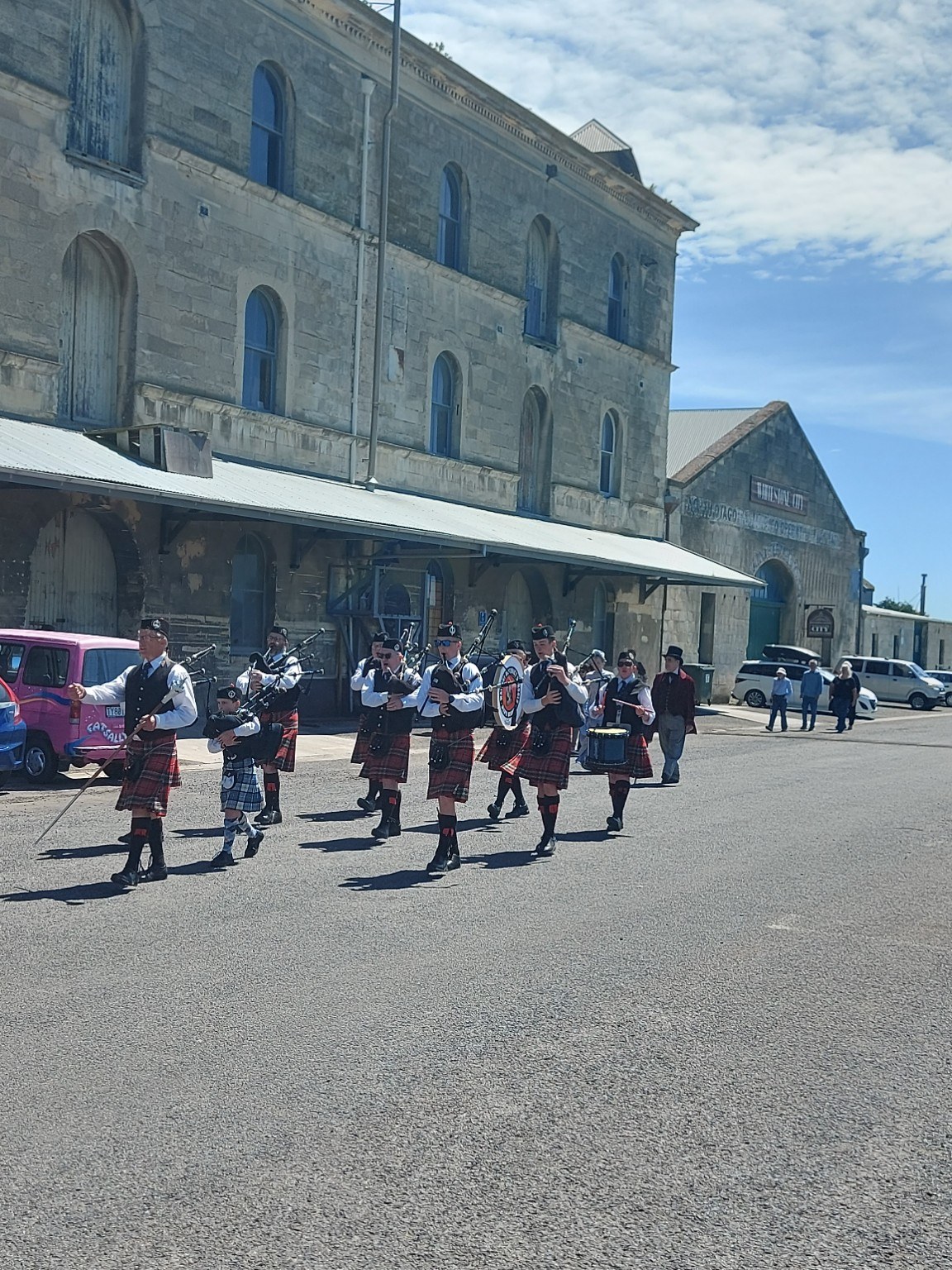 People bringing another chapter of life to Ōamaru's historic streets. Photograph: Roselyn Fauth, 2026.
WuHoo No2: Ōamaru's character began with the land and an ancient sea
Dad's story about the stone has stayed with me. Long before the warehouses, the harbour works or even the town, marine sediments accumulated here. Over millions of years, material including the remains of sea creatures became limestone. Different formations have different ages, but around 35 million years is a useful way to picture the age of the stone Dad was describing.
That local limestone was workable enough for stonemasons to carve into arches, columns, window surrounds and elaborate ornament. The grand façades tell us something about the aspirations of the people who commissioned them, the future that they saw and were building for. The stone itself tells a story millions of years older.
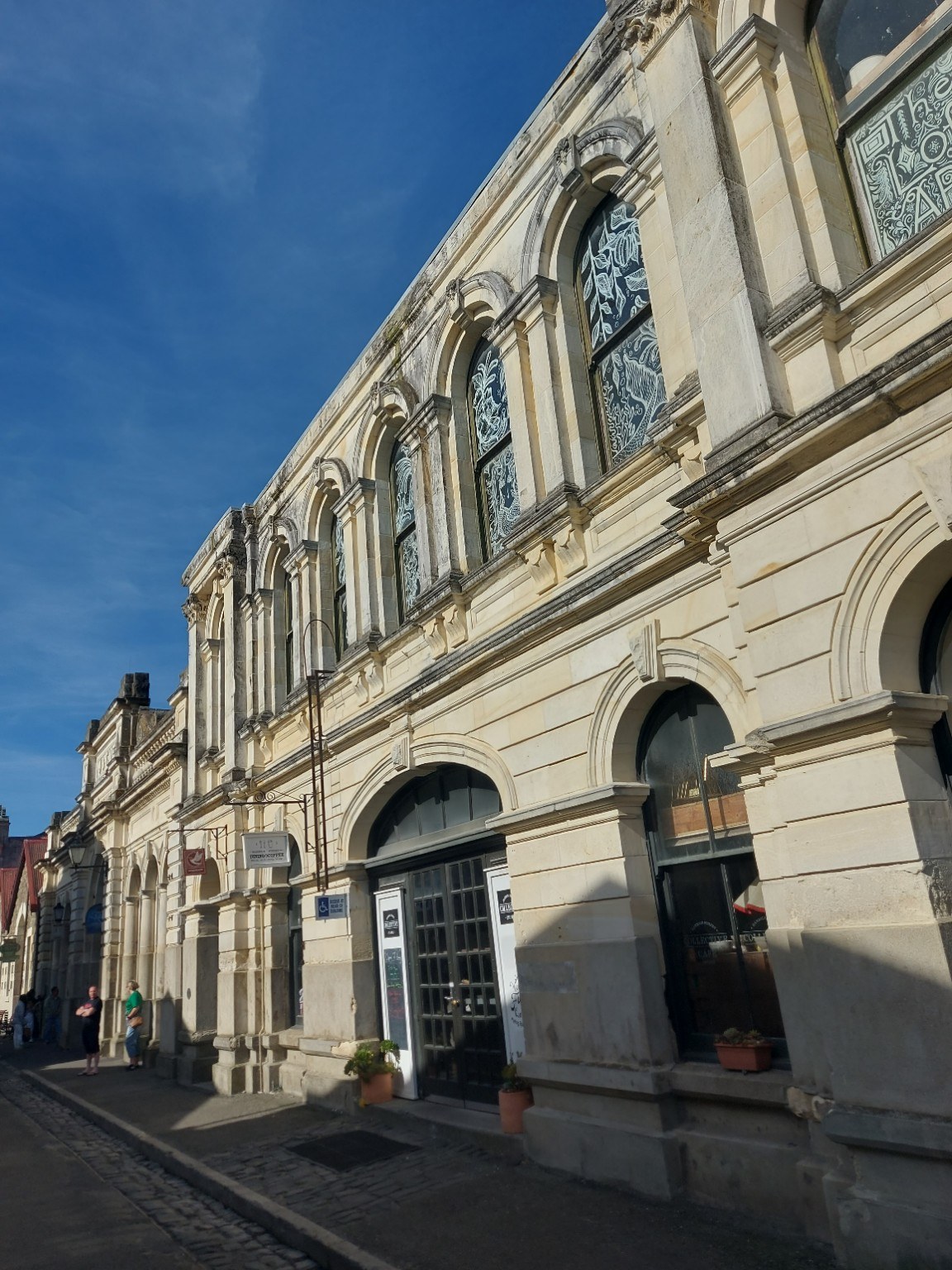 Elaborately carved Ōamaru limestone: a building material with origins in an ancient marine environment. An ancient seabed had become the walls of Ōamaru! Photograph: Roselyn Fauth, 2026.
But the land and sea shaped more than the architecture. They influenced travel, food gathering, settlement and trade. Long before the Victorian commercial town, this coastline was part of the rohe of Kāi Tahu, with settlements and traditional food-gathering places. Te Rūnanga o Moeraki continues to hold mana whenua here. The Victorian streetscape is an important chapter, not the beginning of Ōamaru's history.
WuHoo No3: The backs of the buildings tell a different story
It is easy to admire the grand frontages and forget to look down ally ways and around the back. On an earlier WuHoo visit I photographed scratches and inscriptions in the limestone, the sort of small marks that invite a dozen questions. Who made them? When? What was happening here at the time?
Some marks relate to working buildings; others may be informal inscriptions. It is dissapointing to see people damage these heritage buildings, some marks etched many decades ago. But they remind me that a place has a public face and an everyday working life, and people of all walks of life were making their mark, whether it was in the grand face or a few scratches down below. Read The Carvers and the Scratchers for the full side quest.
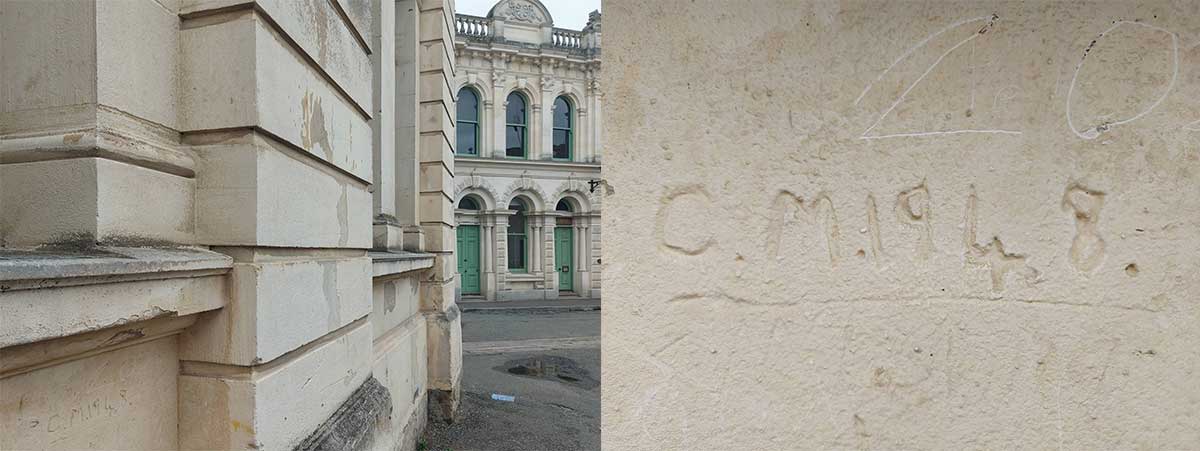 Scratches and inscriptions on Ōamaru limestone, from my earlier WuHoo exploration. Photograph: Roselyn Fauth, January 2026.
WuHoo No4: Why build grain warehouses that look like palaces?
Walking along Harbour Street, I couldn't help wondering why anyone would go to so much trouble decorating a grain store. Columns, carved stonework, elegant windows and grand entrances. Surely a practical shed would have done the job?
But these buildings tell us just how prosperous and ambitious Ōamaru had become during the 1860s and 1870s.
North Otago's farms were producing enormous quantities of wheat, oats and wool. Merchants needed somewhere to store, sell and ship their produce, and Ōamaru was developing into a busy commercial port. The grand warehouses were built to accommodate that trade, but their elaborate architecture also advertised the success of the businesses behind them.
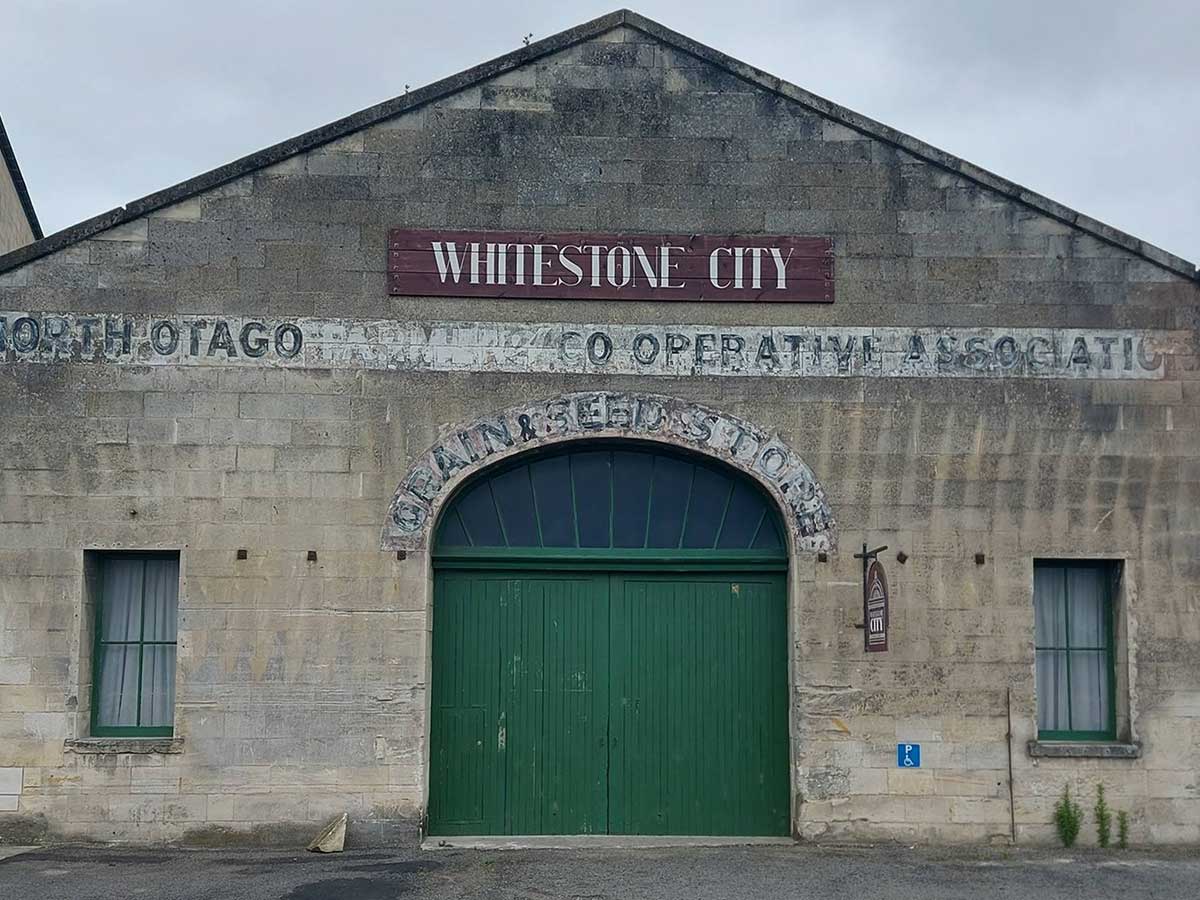
One of my favourite discoveries was Smith's Grain Store on Tyne Street. When it opened in 1882, it was described as resembling a temple of art rather than a grain store. Designed by architect James Johnston, it could accommodate around 30,000 sacks of grain. Imagine the weight of all that wheat!
And there was Sumpter's Store on Harbour Street, with its magnificent Venetian-style frontage designed by Thomas Forrester. Behind the elegant façade was a substantial grain-storage operation. These weren't ordinary farm sheds. They were statements of commercial confidence, built from limestone quarried nearby.
Of course, all that produce needed a way out to market.
Ōamaru's exposed coastline was notoriously dangerous for shipping. Storms and shipwrecks were frequent, and loading vessels offshore was hazardous. In 1871, construction began on a massive concrete breakwater to create a sheltered harbour. By the mid-1870s, it was already offering ships greater protection, and work continued into the 1880s.
The railway helped connect inland farms with the warehouses and wharves. Grain and wool could travel from the countryside to the port, where ships carried them to markets elsewhere in New Zealand and overseas. Frozen meat later joined the export trade.
Suddenly, those grand limestone buildings made much more sense. They were part of an extraordinary network of farms, railways, warehouses, merchants and ships.
And behind the impressive architecture were the people who made it all work: farmers, quarrymen, stonemasons, carters, railway workers, storemen and wharf labourers.
The next time you walk along Harbour Street, try imagining it piled high with sacks of grain, horse-drawn carts rattling past and ships waiting in the harbour.
Those beautiful old buildings weren't simply designed to impress. They were built for business, and they help explain how Ōamaru became one of New Zealand's most remarkable Victorian towns.
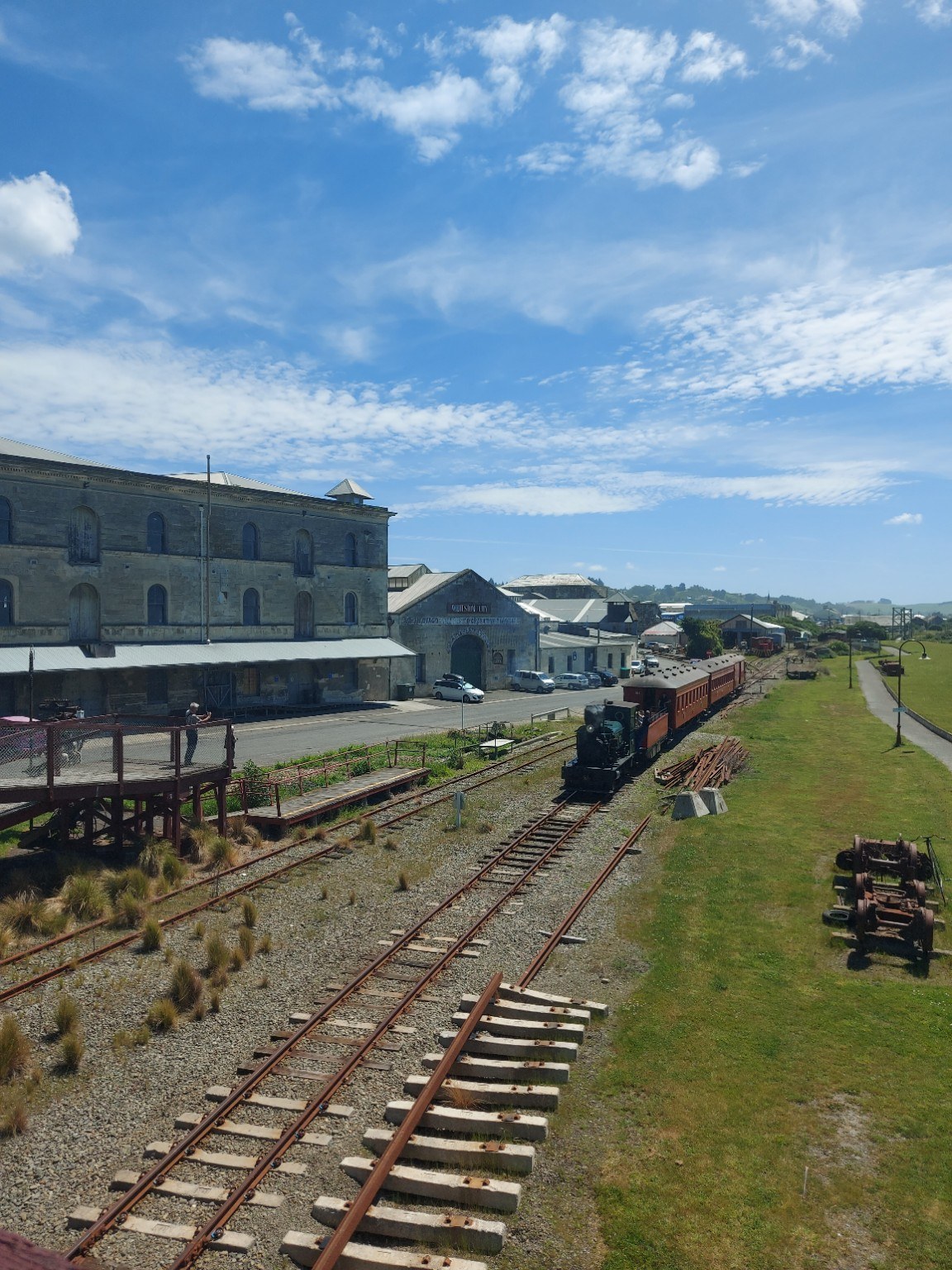 Railway and warehouse buildings, clues to how goods moved between farms, stores and the harbour. Photograph: Roselyn Fauth, 2026.
Look past the merchants' names on the façades and imagine the people doing the work: quarrymen, stonemasons, builders, carters, railway workers, wharf workers, storekeepers and the families who depended on the town's fortunes. The buildings tell us about ambition, certainly, but also labour.
WuHoo No5: Where are the women in the picture?
The parade's splendid hats and dresses got me wondering about something less theatrical: what did an ordinary day look like for women in nineteenth-century Ōamaru? Women worked in businesses and homes, taught, nursed, made clothing, raised families and helped organise community life. Their names are not always carved above the doors.
The Ōamaru Whitestone Civic Trust has also helped keep historic dress visible through its Victorian Wardrobe in Harbour Street. It is a terrific invitation to ask about clothing and social customs, provided we remember that a costume parade is not the whole story of women's lives.
Here's a fun fact I learned later. In 1921, women were racing boats on Ōamaru Harbour! According to the North Otago Times, four crews competed in a ladies' pair-oar race at the Easter regatta. The final was a nail-biter. Misses I. Paterson and E. Day beat the Misses Todd by just two feet! Even better, the newspaper reported that the result had been reversed when the crews raced previously at the boating club's Ladies' Day. A rematch, a sporting rivalry and a victory by two feet. I love it! The following year, another Ladies' Day reportedly drew spectators six deep along parts of the wharf. So next time you're admiring Ōamaru's historic harbour, imagine those women pulling hard on their oars while the crowd cheered them towards the finish line. I wonder whether their descendants know about their sporting achievements? Source: National Library of New Zealand, Papers Past: https://paperspast.natlib.govt.nz/newspapers/NOT19210311.2.36
WuHoo No6: Ōamaru's economic setback helped preserve its Victorian streets
Here's a rather extraordinary twist in Ōamaru's story... because those grand limestone warehouses were built when business was booming. Grain and wool were flowing through the port, merchants were investing in impressive premises, and architects and stonemasons were creating some of the country's finest commercial buildings. Then the good times ran out and an the economic depression of the 1880s, falling wool prices and changes in transport and trade hit Ōamaru hard. According to Heritage New Zealand, by 1885 virtually all new building construction had stopped. Imagine the optimism of those merchants who had invested in enormous grain stores, only to find the town's fortunes changing so quickly.
Fun fact I learned later: Some of Ōamaru's most beautiful buildings survived because nobody could afford to replace them! In growing towns, old buildings are often demolished to make way for newer, bigger developments. But in Ōamaru, the economic slowdown meant many of the Victorian warehouses and commercial buildings remained standing. They weren't necessarily being treasured as heritage. Some became neglected, changed uses or fell into disrepair. Others disappeared altogether. But enough survived to leave something remarkable: whole streets where you can still appreciate the scale and ambition of nineteenth-century Ōamaru. You can see the evidence on Harbour Street today by taking a wander through the Ōamaru Victorian Precinct, particularly Harbour Street and Tyne Street. Look at the enormous grain stores, the elaborate limestone façades and the way neighbouring buildings create an almost continuous historic streetscape.
One of my favourite things is to look beyond the grand frontages. Around the backs of the buildings, you'll find plainer working walls, old openings and marks in the stone that offer clues to how these places were actually used. Smith's Grain Store which was completed in 1882, was one of the grand buildings constructed just before the economic downturn. Its sheer size and elaborate architecture make the contrast between the boom and the bust particularly striking.
The recession didn't save Ōamaru's heritage by itself, of course. The buildings survived long enough for later generations to recognise their value, but they still needed considerable work to bring them back to life. And that's what makes this story especially interesting to me. The buildings survived partly because the money ran out. They flourished again because people cared enough to save them... which brings me back to Dad, those pigeons and the conservationists I met when I was nine.
WuHoo No7: The conservationists saw possibility where I saw pigeons
Here's something I didn't appreciate when Dad took me through those old warehouses as a nine-year-old... the adults weren't simply admiring the buildings. They were learning how Ōamaru was bringing them back to life.
The Ōamaru Whitestone Civic Trust was established in 1987, and in 1989, with support from the Alexander McMillan Trust, it acquired eight historic buildings. Eight! Imagine taking responsibility for eight enormous old limestone buildings. Buying them was one thing. Repairing them, finding tenants and making them useful again was quite another. It took people with vision, practical skills, patience and money. The Trust was an important part of the story, alongside property owners, craftspeople, businesses, volunteers and supporters who helped revive the wider precinct.
Fun fact: You can explore the old warehouses from the inside! Today, Harbour Street isn't just somewhere to admire beautiful architecture. You can wander into buildings that once stored grain and other goods, now occupied by shops, studios and galleries. Look up at the timber beams. Notice the thickness of the limestone walls. Compare the decorative street frontages with the plainer working walls around the back.
The buildings are still doing a job. It's just a rather different one from the job they were built for. And that, to me, is one of the cleverest things about the conservation effort. The buildings weren't simply saved to be looked at. They were given a reason to be used.
And what became of that little girl watching the pigeons? More than 30 years later, I found myself back in Ōamaru, this time to give a lecture about bringing local history to life. Dad and those other Civic Trust members had been interested in the buildings. I was interested in the adventure. Turns out I was paying more attention than I realised.
WuHoo No8: What has a woolshed got to do with the Ōamaru Opera House?
I turned up to the venue for my lecture a little early so I had time to get organised. And was suprised with a quick tour of the Opera House. Before we'd even stepped inside the magnificent Ōamaru Opera House, a side quest was pointed out... a little plaque on the street joined the dots of a woolshed and a sermon in 1860.
We nearly walked straight past it... a little plaque outside the magnificent Ōamaru Opera House. But hang on. What's this about a woolshed? Well, apparently, in February 1860, the Reverend William Johnstone, a Presbyterian minister from Port Chalmers, preached to a small gathering of settlers in a woolshed on the Ōamaru Run. A woolshed! I looked up at the beautiful limestone theatre. What a contrast. And then I started wondering. Who owned the woolshed? What happened to it? When did the theatre arrive? And how did this little settlement go from wool bales to such elaborate architecture in less than fifty years? Well, that little plaque turned out to be quite a rabbit hole.
Fun fact: The congregation sat on wool bales! According to historical accounts I later found, around 20 to 30 people attended the sermon. Some reportedly sat on wool bales while others stood. The woolshed was associated with James Hassell, one of the early figures in Ōamaru's wool trade. The plaque, dedicated on 28 February 1960, commemorates the sermon and records that the woolshed stood adjacent to where the Opera House is today. Imagine standing there in 1860. No grand theatre, no ornate plasterwork or velvet seats. Just a working woolshed, a travelling minister and a handful of people gathering to worship.
And here's another discovery. In August 1860, just months after the sermon, Hassell and his business partners were advertising a new wool store with room for 1,500 bales. The little settlement was growing and I later learnt that the sermon was part of the early history of St Paul's Presbyterian Church. The congregation had its own church by 1865, and in 1876 a magnificent limestone church designed by Thomas Forrester followed. You can still see it on Coquet Street today.
And that got me thinking about the stone... Millions of years before there was a church, a theatre or even a town, this part of the world was beneath the sea. Marine sediments accumulated and eventually became the limestone that quarrymen and stonemasons would transform into Ōamaru's distinctive buildings. An ancient seabed had become the walls of a town. It's one of the things I particularly enjoyed discovering through the Waitaki Whitestone UNESCO Global Geopark. The geology isn't just something you find in the surrounding landscape. It's right there in the streets.
Hang on. Another Forrester! Inside the Opera House, another plaque caught my attention. The theatre opened in 1907, designed by architect John Meggett Forrester. Forrester? I later discovered in Heritage New Zealand's history of the building that John was the son of Thomas Forrester, who designed St Paul's. Father and son. Two magnificent limestone buildings. And there I was preparing to deliver the Forrester & Lemon Lecture!
John had taken over the Forrester and Lemon architectural practice in 1890, following John Lemon's death.
But there was another twist... Fun fact: The architect became mayor!
I learnt that Ōamaru's mayor, Robert Milligan, helped advance plans for the new Town Hall and Opera House in 1905. The Council held an architectural competition, which John Meggett Forrester won with a design entered under the name Scotia. The resulting building combined municipal offices and council chambers with a grand theatre for public entertainment.
Not everyone was enthusiastic... Heritage New Zealand records that disagreements over the project were serious enough for four councillors to resign! Imagine that! Even in 1907, decisions about investing in major public buildings could generate considerable debate. And here's another surprise. John Meggett Forrester later became Mayor of Ōamaru himself, serving from 1931 to 1933. His contribution didn't end there. When he died in 1965, he left a bequest that helped establish the Forrester Gallery, which opened in 1983.
So the architect whose name I'd spotted on the plaque had helped shape Ōamaru's cultural life in more ways than one. You can still visit both the Opera House and the Forrester Gallery today.
Another WuHoo! Timaru's Theatre Royal was once a wool and grain store for a local merchant.
All this talk of woolsheds and theatres reminded me of another wonderful connection back home. Did you know Timaru's Theatre Royal began life as Richard Turnbull's grain store? Built in 1869–70, it later became Turnbull's Hall, a venue for public meetings and entertainment. In 1877, architect Maurice Duval converted it into a theatre. The building has changed enormously since then, but I love knowing that one of Timaru's best-known cultural landmarks began as somewhere to store grain. Ōamaru built a grand new theatre. Timaru found one inside an old warehouse.
I wonder how many other familiar buildings began life doing something entirely different. Saving the Opera House was another adventure... and during our guided tour, we learnt about the enormous effort involved in restoring the Opera House and making it suitable for modern performances. And it wasn't without controversy. Our guide told us that a mayor who supported the restoration subsequently lost his bid for re-election.
That caught my attention, so I looked into it afterwards. Contemporary newspaper reports confirm that the redevelopment generated considerable community debate, particularly around costs and the potential burden on ratepayers. I haven't established whether the Opera House influenced the election result, but it certainly wasn't a project everyone agreed on. The original theatre had prompted arguments, and a hundred years later people were debating its future all over again!
Fun fact: The Opera House had a $10 million-plus makeover!
Waitaki District Council, which owns the building, undertook a major conservation and redevelopment project supported by Council funding, grants, charitable trusts, sponsorship and community fundraising. The Opera House reopened in February 2009, with its historic auditorium conserved and modern facilities for performances, conferences and community events. The project subsequently received national recognition for its heritage conservation.
And keeping a historic building going isn't a one-off job. In 2023, I read that Council had undertaken further repairs to the timber supporting the auditorium dome. And here's a detail that made me laugh. Workers had removed hundreds of kilograms of pigeon poo and debris from above the ceiling! Pigeons again!
What I particularly admire is that the Opera House hasn't simply been preserved as something beautiful to look at, it's still being used. People come here for performances, meetings, celebrations and community events, just as earlier generations did. And in November 2026, I had the privilege of standing on its stage to deliver the Forrester & Lemon Lecture, hosted by the Ōamaru Whitestone Civic Trust and the Waitaki Whitestone UNESCO Global Geopark.
It felt rather fitting... The Geopark helps us understand the ancient landscape that provided Ōamaru's limestone. The Civic Trust and other conservationists have shown what can happen when people recognise the potential of old buildings and find new ways to use them. And the Opera House is a wonderful example of the community and Council investing in a historic building's future.
I'd arrived to give a lecture about curiosity, storytelling and the unexpected discoveries waiting in our own backyard. And before I'd even stepped through the theatre doors, I'd found one myself.
A little plaque. A woolshed. A sermon. Two generations of architects. A mayor. A controversial restoration. And pigeons! All connected to the place where I was standing.
Next time you're in Ōamaru, have a look for that plaque outside the Opera House. Then wander along to St Paul's and see if you can spot the family resemblance in the limestone architecture.
You never know where a little curiosity might take you.
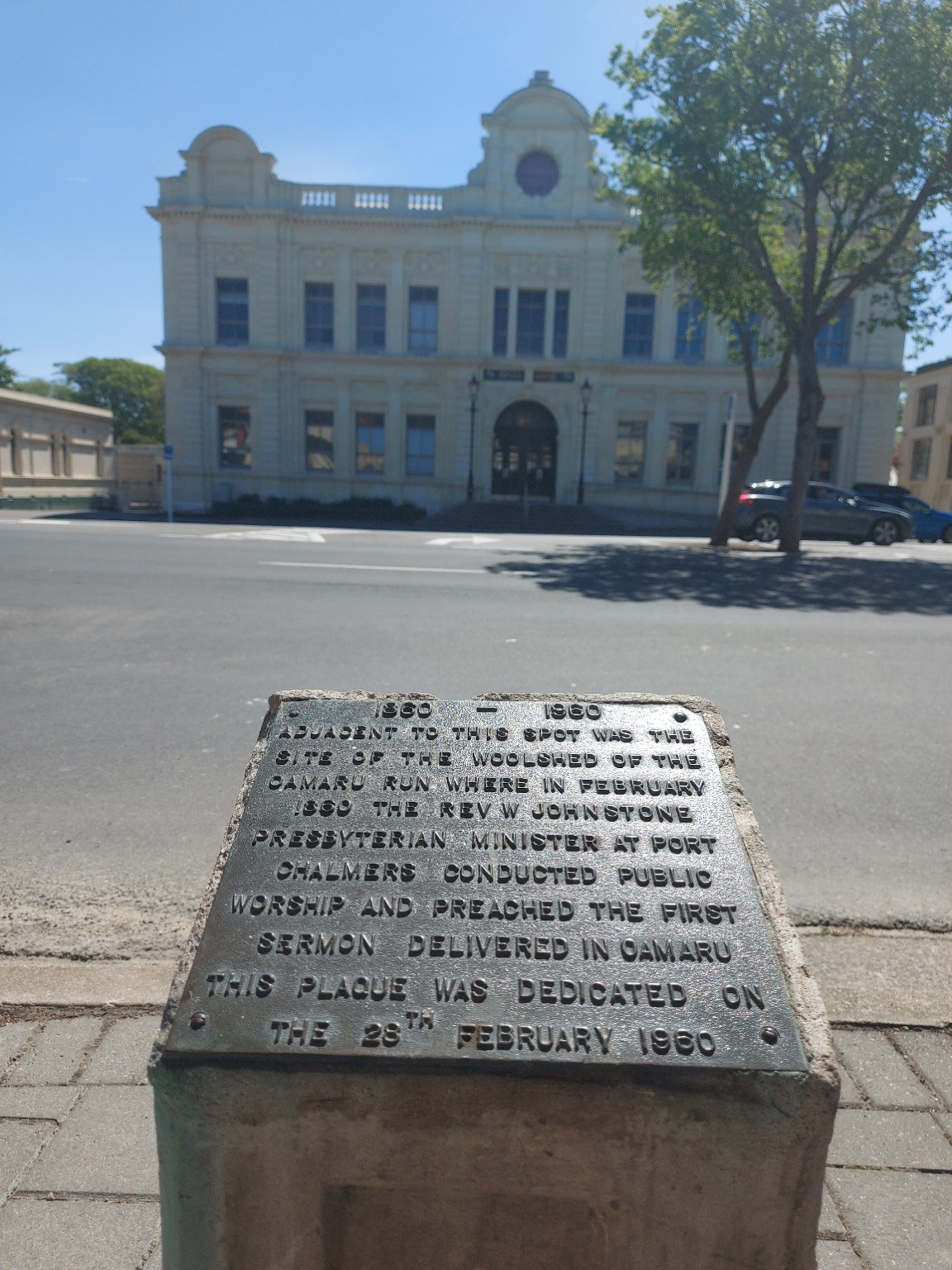 Plaque recording the Ōamaru Run woolshed and an early sermon in February 1860. Photograph: Roselyn Fauth, 2026.
Inside, another plaque recorded the Opera House opening in 1907 and named architect J. M. Forrester. There I was to deliver the Forrester & Lemon Lecture, and his name was right there on the building. What a connection.
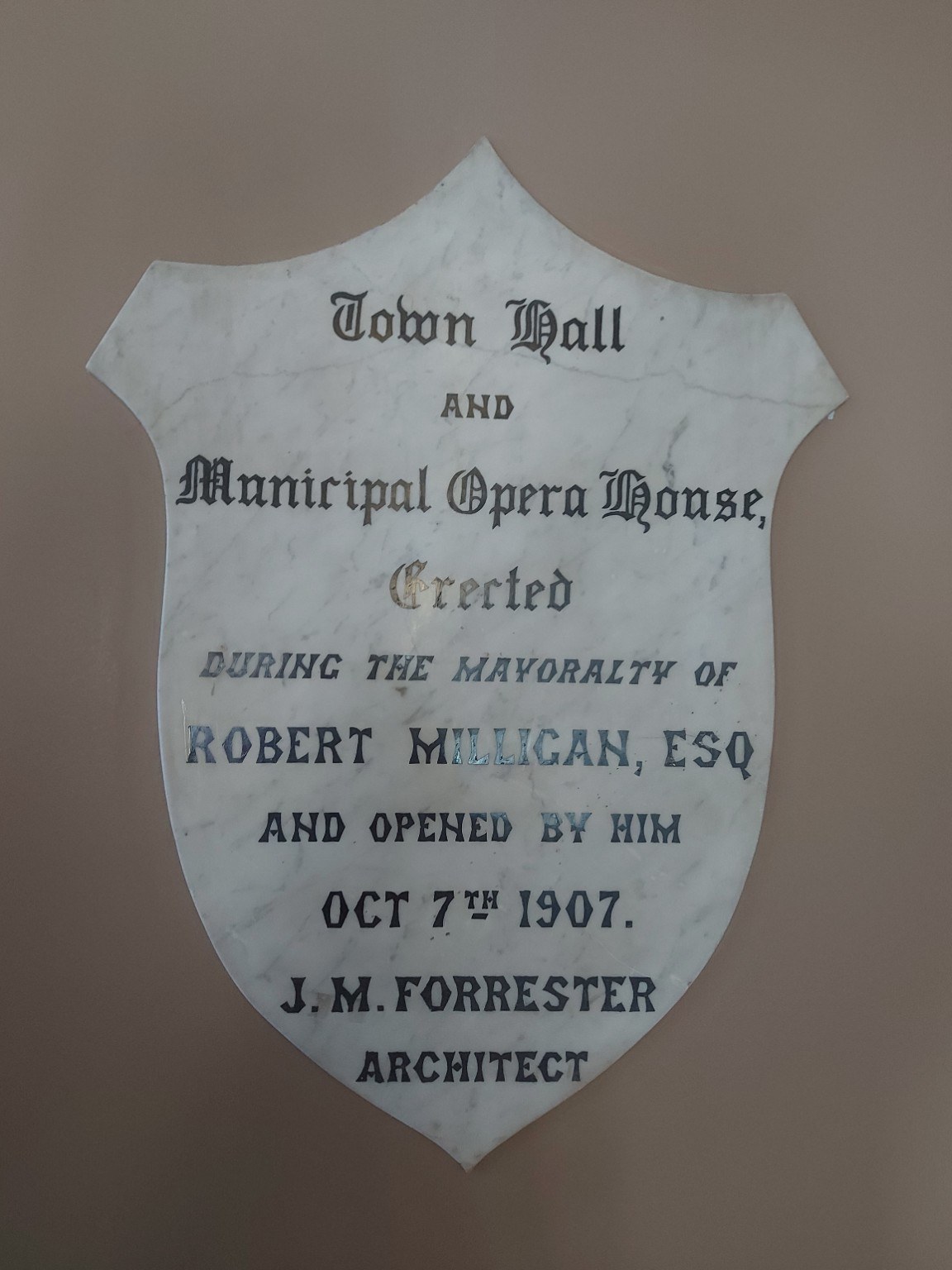
Opera House commemorative plaque naming architect J. M. Forrester and the 1907 opening. Photograph: Roselyn Fauth, 2026.
Enter Robert Milligan, Mayor of Ōamaru
Fast-forward to 1905. Ōamaru had grown from a small settlement into a prosperous town with impressive limestone buildings and ambitions for a grand new Town Hall and Opera House.
One of the people advancing the project was Robert Milligan, Mayor of Ōamaru. I discovered that he approached Premier Richard Seddon in 1905 about securing land for the proposed building. The Council organised an architectural competition, although disagreements over the project became so heated that four councillors resigned.
Despite the controversy, construction went ahead, and on 7 October 1907, Milligan officially opened the magnificent new Town Hall and Opera House. I later found an account of the ceremony in the Evening Star of 8 October 1907, published the following day.
But who designed the building? Hang on. Another Forrester!
Inside the Opera House, I spotted a commemorative plaque naming the architect: J. M. Forrester.
I discovered that John Megget Forrester was Thomas Forrester's son! Born in Dunedin in 1865, he moved to Ōamaru with his family when he was about six. He followed his father into architecture and took over the Forrester and Lemon practice in 1890, following John Lemon's death.
John won the architectural competition for the new Town Hall and Opera House with a design submitted under the name Scotia. And here I was, more than a hundred years later, preparing to deliver the Forrester & Lemon Lecture in the very theatre he had designed!
But architecture wasn't his only contribution to Ōamaru. John served as mayor from 1931 to 1933 during the Great Depression and reportedly donated his mayoral payment to help people experiencing hardship. A keen tramper, musician, gardener and craftsman, he lived to 99 and left a bequest that helped establish the Forrester Gallery, which opened in 1983.
So Robert Milligan was the mayor who opened the Opera House, while John Megget Forrester was the architect who later became mayor.
And now, standing inside his theatre, we were about to discover how much work had gone into keeping it alive for another generation.
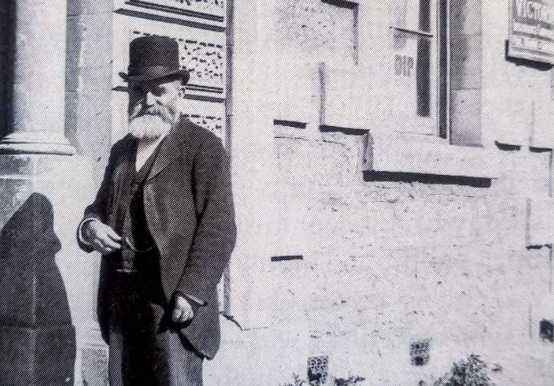
Thomas Forrester - https://www.victorianoamaru.co.nz/thomas-forrester
WuHoo 9: The Opera House hid a place for your hat
The auditorium was magnificent. But a curious little fitting beneath a seat caught my attention. Any guesses?
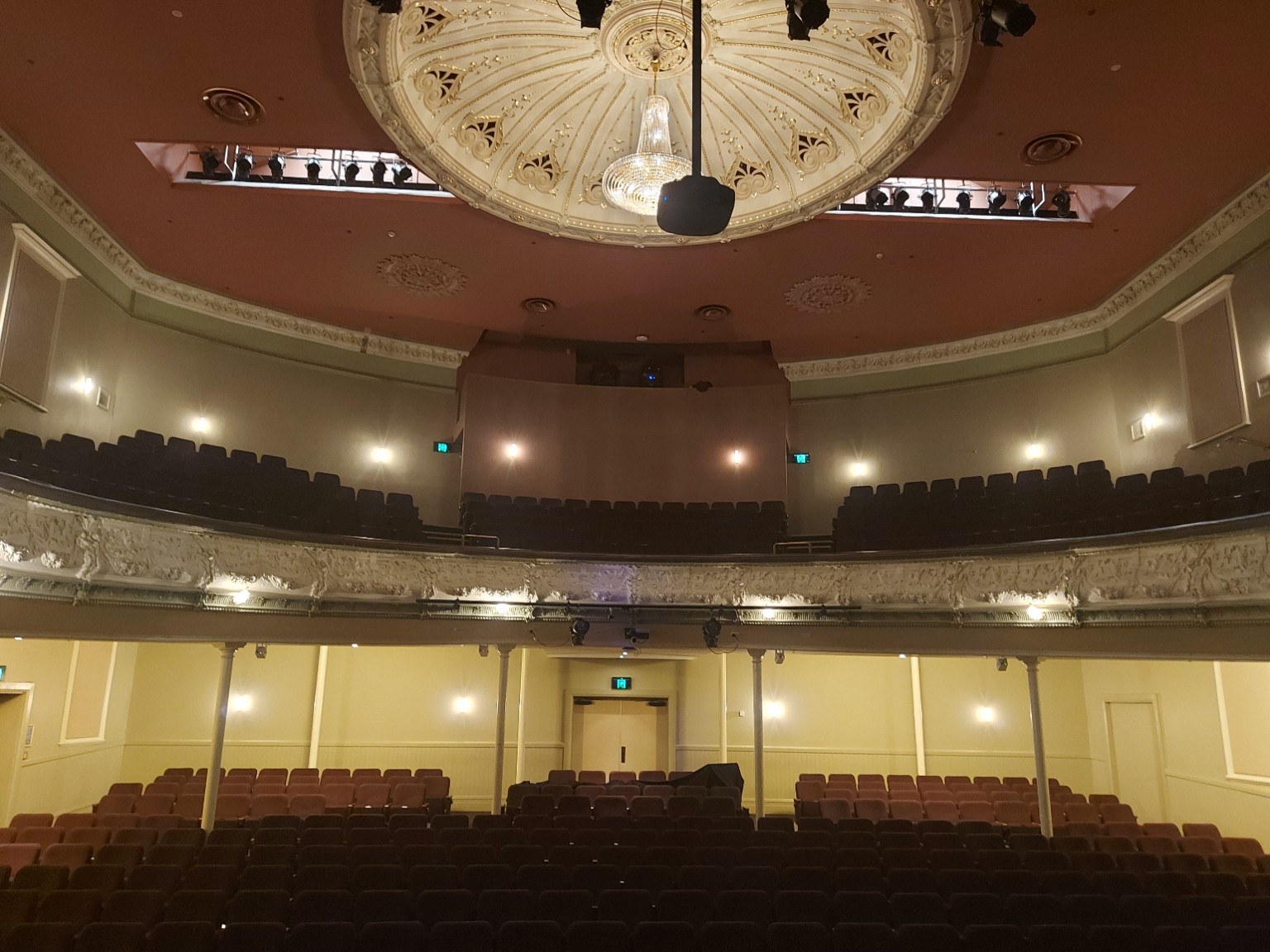 The Ōamaru Opera House auditorium, where even the seating has a story. Photograph: Roselyn Fauth, 2026.
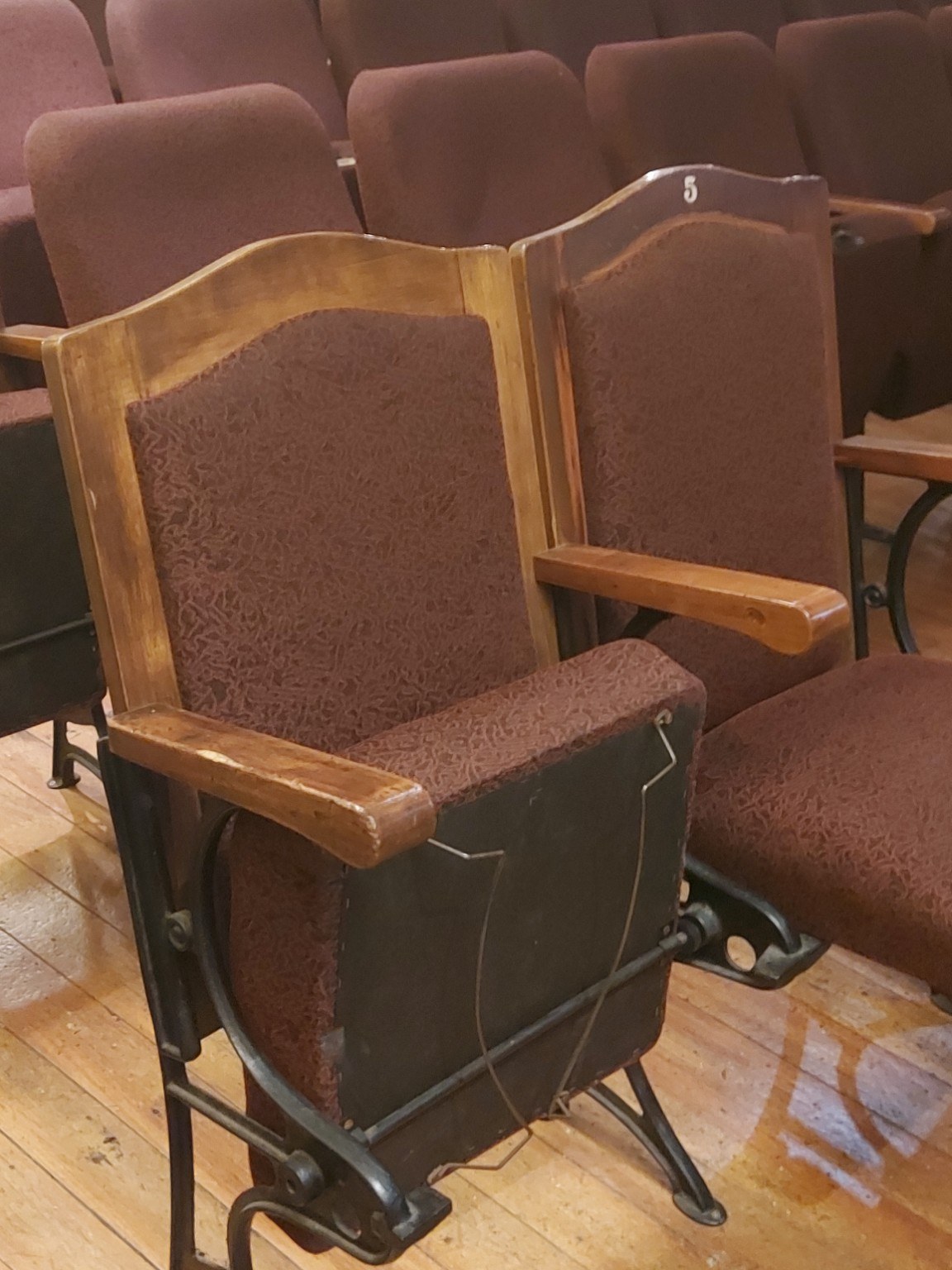 A fitting beneath an Opera House seat. Can you guess its original purpose? Photograph: Roselyn Fauth, 2026.
A place for your hat! A small, practical solution for an audience arriving in their finery. It tells us something about the people who used the theatre without needing a lengthy explanation.
Backstage we saw ropes, counterweights and working theatre equipment. Our guide pointed out marks in the stone wall that are the reminants of the original raked stage. While performers and audiences found it handy it was a nightmare for a ballerina and so the sloped stage was replaced for and level surface. The timber from the stage was repurposed and used in the lecture theatre.
2008 Otago Daily Times article describing the sloping stage as one of the problems addressed during the theatre's major redevelopment. The stage was levelled as part of the modernisation, helping make the theatre more versatile for visiting productions.
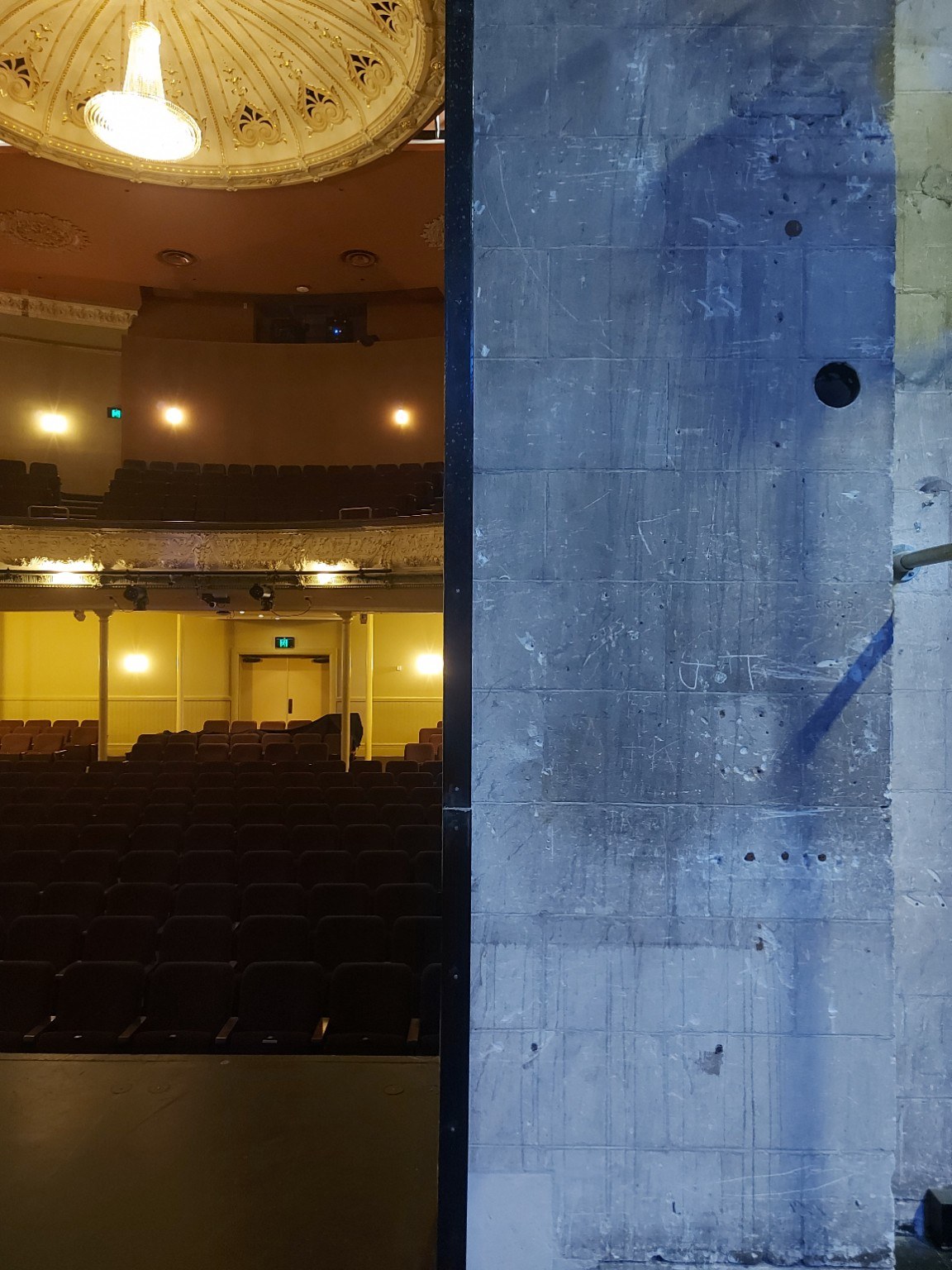 Marks backstage in the stone walls looking to the audiences seats. Photograph: Roselyn Fauth, 2026.
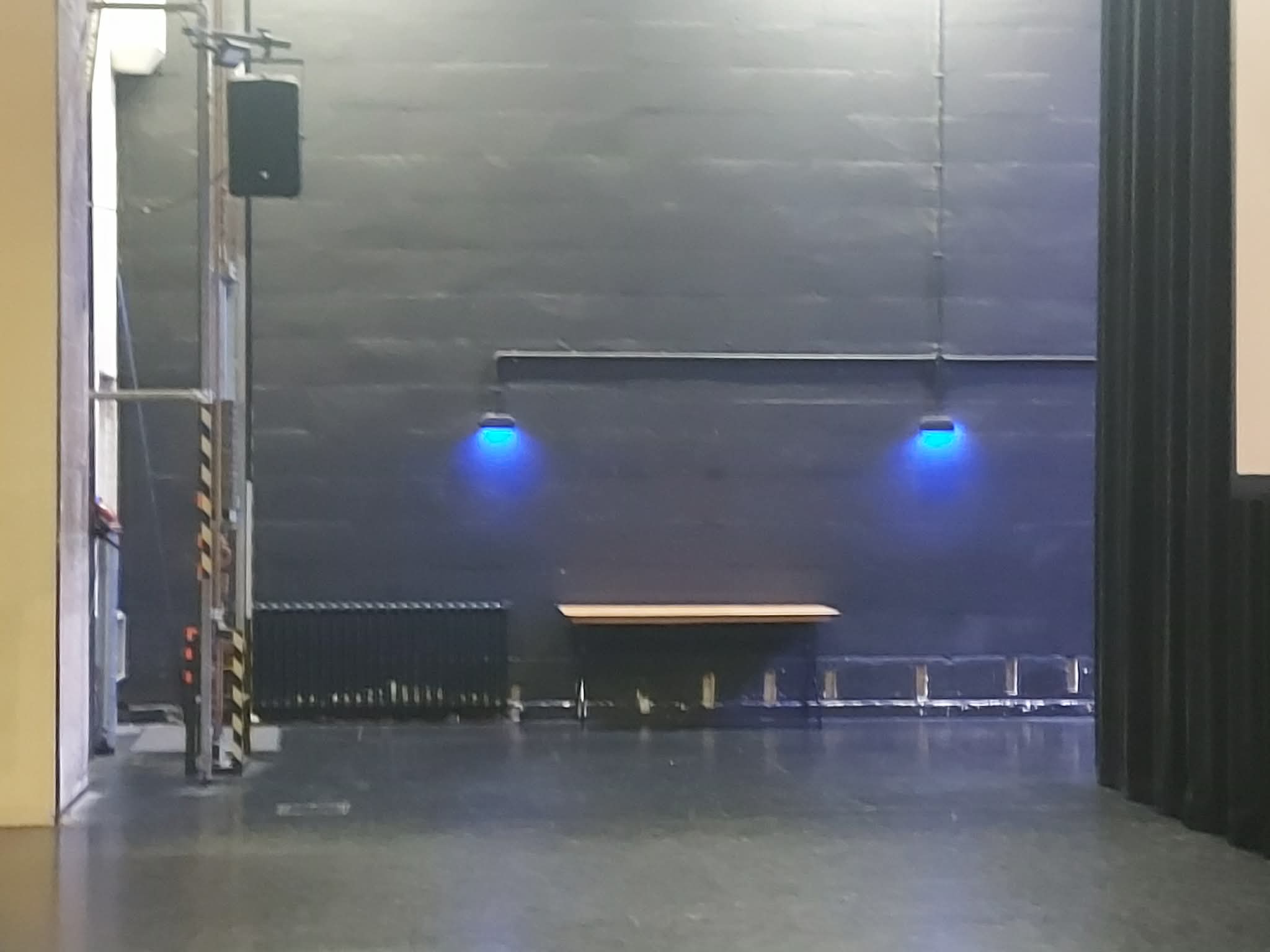
marks left in the wall showing the raking floor of the Town Hall and Opera House. Photograph: Roselyn Fauth, 2026.
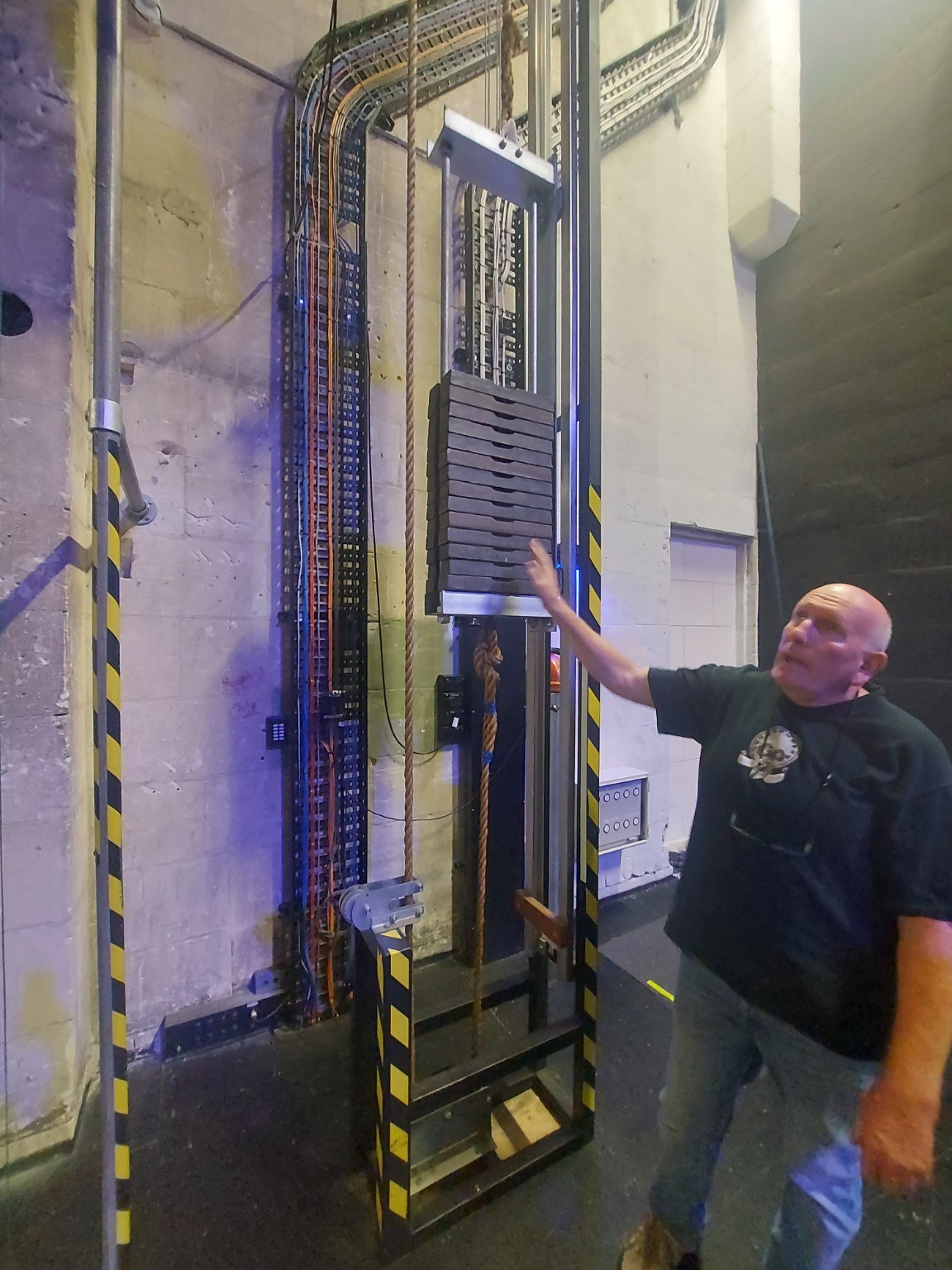 Backstage ropes and theatre machinery are clever systems to counterweight the stage curtains and move them up and down at the Ōamaru Opera House. Photograph: Roselyn Fauth, 2026.
WuHoo 10: A wizard turned up to hear about curiosity
I had come to Ōamaru for the Forrester & Lemon Lecture, hosted by the Ōamaru Whitestone Civic Trust and Waitaki Whitestone UNESCO Global Geopark. I spoke about how an ordinary observation can lead to an extraordinary story, and how sharing those discoveries can encourage people to look again at their own communities.
So it seemed perfectly appropriate that the Wizard of New Zealand himself should turn up!
I remember seeing him as a child, and how excited my parents were to introduce us to him. I've always found him fascinating and wondered what inspired his rather unusual approach to life.
For anyone unfamiliar with him, the Wizard was born Ian Brackenbury Channell in London in 1932. He studied psychology and sociology at the University of Leeds, became a university lecturer and, in 1969, was appointed Wizard of the University of New South Wales in Australia.
Yes, an actual university-appointed wizard!
Psychology explores how people think, feel and behave, while sociology examines how society, culture and traditions influence our lives. Together, these subjects investigate human behaviour, beliefs, social expectations and what happens when someone challenges conventional ways of thinking.
Which makes his chosen career rather interesting!
He later became a familiar character in Christchurch's Cathedral Square, delivering entertaining and sometimes provocative speeches from a stepladder, dressed in flowing robes and a pointed hat. In 1990, Prime Minister Mike Moore formally appointed him the Wizard of New Zealand, with duties that included cheering up the population, attracting tourists and promoting a better universe.
I later read a 2021 RNZ interview in which he described himself as a living work of art. His wizard identity wasn't simply a costume for public appearances. He had made it part of his everyday life, using performance, humour and unconventional ideas to challenge expectations.
Over the years, his public appearances have entertained generations of New Zealanders, attracted visitors and occasionally provoked disagreement. In 2009, he was awarded a Queen's Service Medal for services to the community. He had been visiting Ōamaru since the 1970s and eventually made the town his home.
In a place where people celebrate Victorian architecture, dress in period costume and enthusiastically bring history into the streets, perhaps a resident wizard isn't quite so surprising!
I loved that he'd come along to hear a talk about curiosity. After all, I've spent years experimenting with ways to get people interested in stories they might never have thought to investigate. Sometimes it starts with an octopus in a rock pool, an old photograph or a bumblebee on a flower. Something familiar catches our attention, and suddenly we're exploring a much bigger story.
The Wizard has taken a rather different approach. He uses theatrical performance and challenges convention, while I tend to start with a question, follow the evidence and invite others to share what they know.
It made me wonder what he thought of WuHoo... Did he recognise something familiar in the way I was trying to spark people's curiosity? I'd love to know!
I hadn't expected to meet a wizard in Ōamaru, especially one I remembered from childhood. But perhaps that's part of the fun of getting out and exploring.
You never know who you'll meet, or what you might discover!
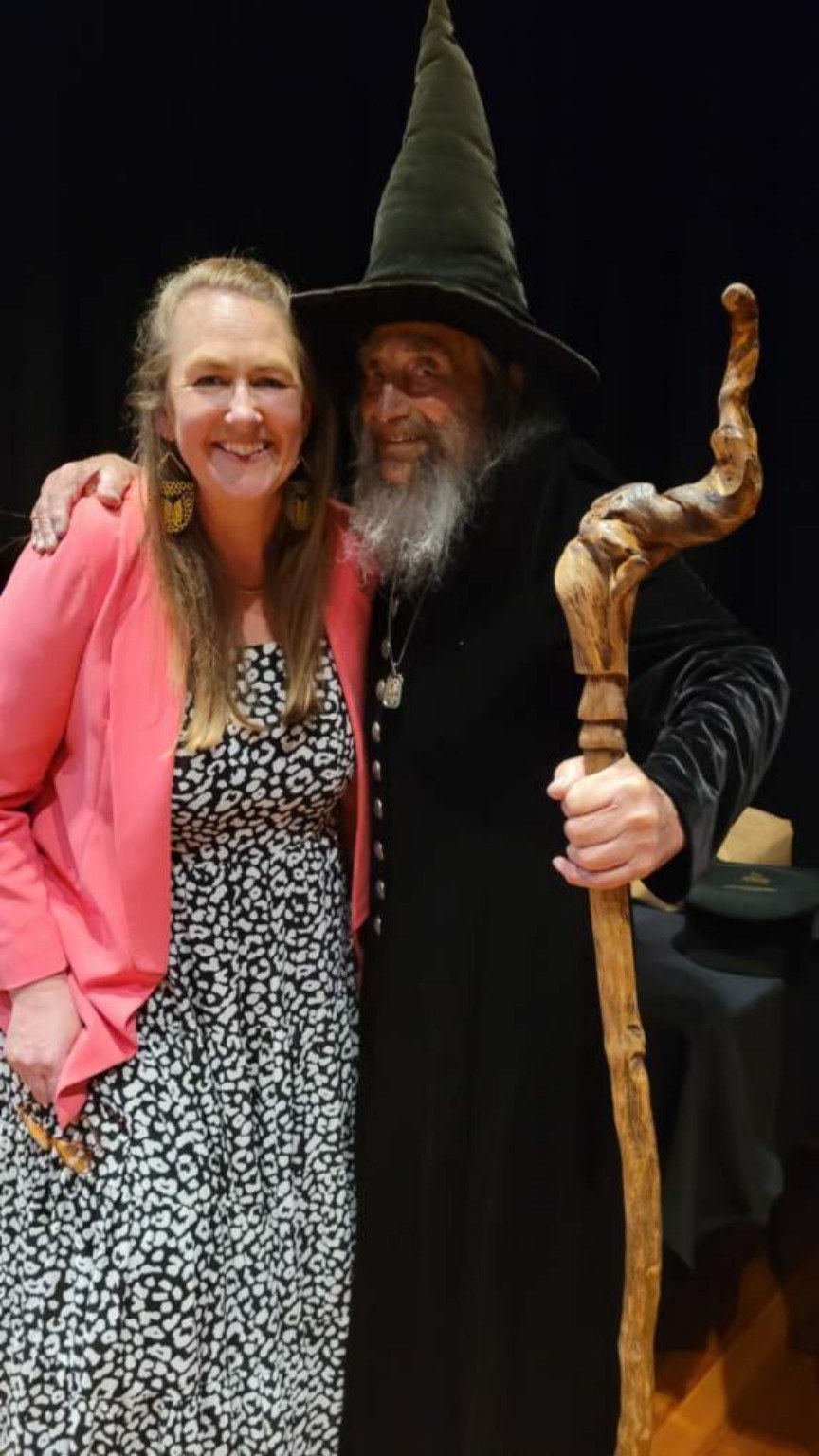 A wonderfully theatrical visitor at the Forrester & Lemon Lecture. Photograph: Roselyn Fauth, 2026.
I enjoyed the conversations afterwards as much as the lecture. Someone recognises a photograph, someone remembers a family connection, someone else produces a newspaper clipping. And sometimes someone corrects you. That's useful too. Stories improve when people contribute what they know.
WuHoo 11: After dinner, the beach offered another geological mystery
After dinner at Del Mar, beside Ōamaru's penguin colony, we wandered along the beach. I noticed what appeared to be layers of rock running at peculiar angles through the cliffs, along with an assortment of tiny fragments scattered across the shore. What was I looking at? Why were the layers tilted? And what were all those little pieces beneath my feet?
Another rabbit hole to investigate! We learned that we were at the foot of Cape Wanbrow, a headland with a really interesting volcanic history. According to the Waitaki Whitestone UNESCO Global Geopark, volcanic eruptions occurred beneath the sea here tens of millions of years ago.
Underwater volcanoes, right by our dinner table!
A scientific study published in 2015 in the Journal of Volcanology and Geothermal Research revealed that Cape Wanbrow contains the overlapping remains of as many as six ancient volcanoes, formed over at least three million years. Rather than one enormous eruption, the headland preserves evidence of repeated volcanic activity, with long intervals between eruptions. Marine sediments accumulated during these quieter periods, leaving layers of volcanic material, limestone and other sedimentary rocks that geologists can examine today.
Fun fact: There's ancient lava shaped like pillows!
At nearby Boatman's Harbour, the Geopark describes extraordinary formations known as pillow lava. These formed when molten lava erupted onto the seabed and cooled rapidly in seawater, creating rounded masses resembling pillows. Even more interestingly, pale limestone can be seen between some of the dark volcanic rocks. The Geopark dates this sequence to around 38 million years ago. Imagine that! Evidence of underwater eruptions and ancient marine sediments preserved together in the same cliffs.
Someone was investigating these rocks 140 years ago!
While researching the peculiar angles I'd noticed, I found an 1886 scientific paper by geologist Frederick Wollaston Hutton. He described the rocks along the shore between Ōamaru's breakwater and Cape Wanbrow, recording layers dipping northwards at approximately 25 degrees. Elsewhere along the coast, he documented changes in their direction and angle.
I also discovered that the geological story is even more complicated than those early researchers could have known. The 2015 study describes layers at Cape Wanbrow ranging from horizontal to approximately 30 degrees, with evidence of multiple volcanic episodes and later geological deformation.
Geologists call the angle at which a rock layer slopes its dip. Some layers can form at an angle when volcanic material or sediment accumulates, while others may be tilted by movements in the Earth's crust. Could this explain the unusual layers I'd noticed? Possibly, although I haven't yet identified the exact rocks behind Del Mar, so I can't confidently explain their particular arrangement.
As for those tiny fragments scattered along the beach.. well that's another mystery waiting for a closer look.

Millions of years of history, hiding in plain sight
What I particularly enjoyed was the connection to everything else we'd been discovering in Ōamaru. Earlier, we'd explored the magnificent limestone buildings that give the town its distinctive character. Now, after dinner, the coastline was revealing another chapter of the geological history that shaped this remarkable place.
The ancient marine environments that helped form Ōamaru's building stone also witnessed volcanic eruptions, the accumulation of sediments and extraordinary changes over millions of years.
And that's one of the wonderful things about having the Waitaki Whitestone UNESCO Global Geopark here. It helps us understand the landscape beneath our feet and encourages us to look a little closer at places we might otherwise wander past.
If you're visiting Ōamaru, the Cape Wanbrow walking track offers an opportunity to see the remarkable pillow-lava formations near Boatman's Harbour. The Department of Conservation provides information about access, tides and coastal hazards, and the Geopark asks visitors to leave the rocks undisturbed for others to enjoy.
WuHoo 12: Blast from the past in print... a threepenny newspaper, gold fever and 165 years of stories
I love the unexpected things you come home with after a heritage adventure! At the Ōamaru Heritage Celebrations over the weekend, I was handed a reproduction of the very first edition of the Otago Daily Times, published on 15 November 1861.
New Zealand's first daily newspaper. And this weekend marked its 165th anniversary! Of course, I couldn't resist having a closer look. What was happening in Otago in November 1861? Who was advertising? What were people buying, selling and talking about? And what was happening up the coast in Timaru? Well, one little newspaper sent me down quite a few rabbit holes!
There was gold fever, an ambitious young journalist who would become New Zealand's premier, a famous prospector admitting he hadn't struck gold again, and a shipping network bringing people and goods to our southern settlements.
And tucked among the notices was a rather interesting connection to one of the men who established the newspaper... what began as a souvenir from a heritage celebration turned into a fascinating glimpse of life 165 years ago.
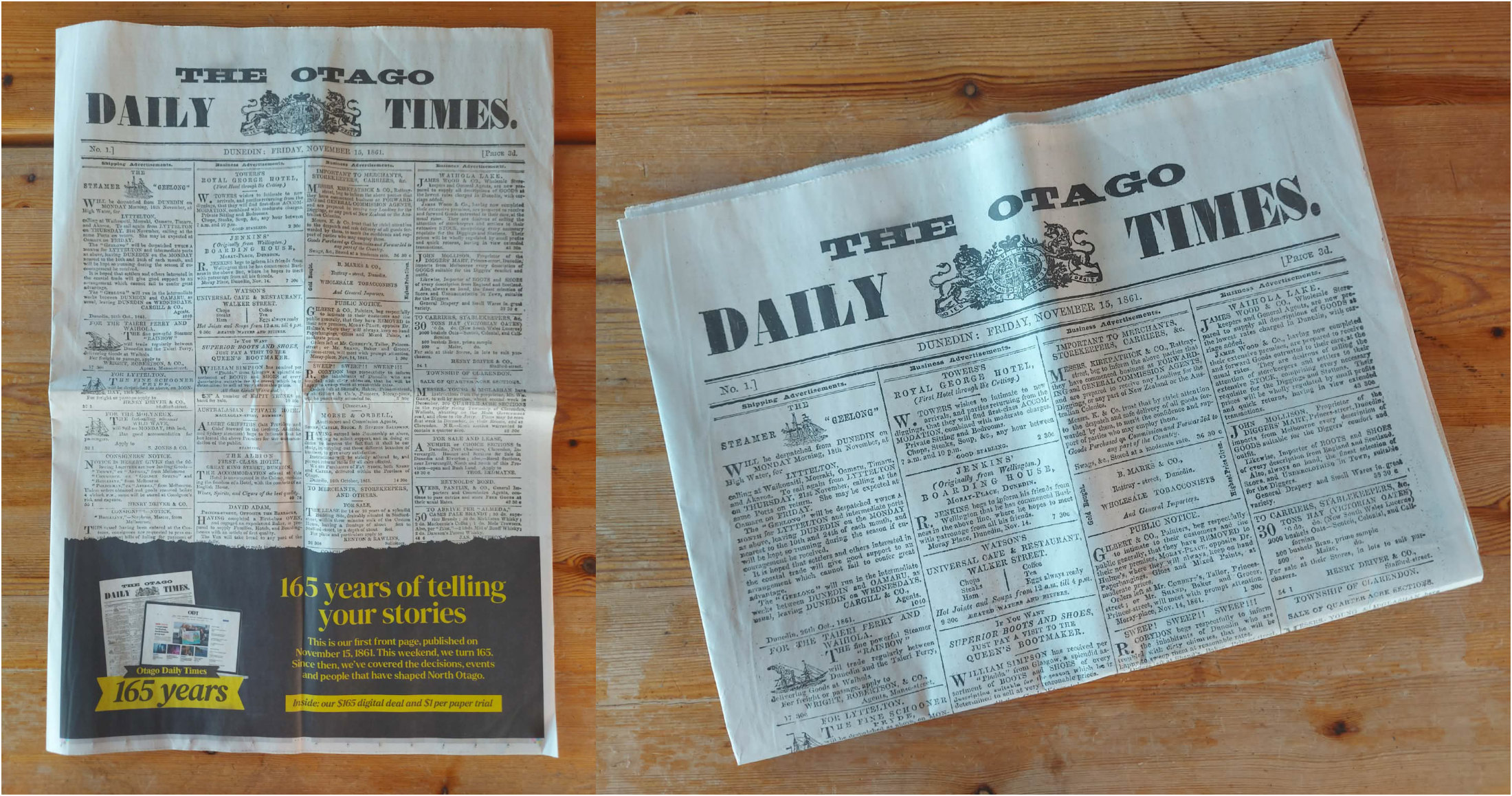
WuHoo 13: I think I've become one of the adults
I've been thinking about that enormous old warehouse, with its wooden floors, stone walls and pigeons flying through the rafters. Dad and the other adults were discussing how to save the buildings. I was nine years old and having the time of my life.
over 3 decades years later, I'm involved in heritage work myself, encouraging people to look closer at familiar places and discover their stories. And here I was, back in Ōamaru with my parents and my own children, giving a lecture about curiosity while the streets outside were full of people enjoying the town's history.
Somewhere along the way, I seem to have become one of the adults!
Although, thinking about it, I've spent the weekend exploring old buildings, investigating a vintage truck, wondering about the rocks on a beach and meeting a Wizard.
Perhaps I haven't changed all that much.
I wonder what my children will remember in another 35 years. The bagpipes? The costumes? That wonderful old truck? Or perhaps something I barely noticed... I certainly couldn't have predicted that a room full of pigeon poo would make such a lasting impression on me, let alone that I'd return all these years later to speak about bringing local history to life.
And goodness knows where their curiosity might take them.
Finding the extraordinary in the ordinary - finding fee fun - a WuHoo
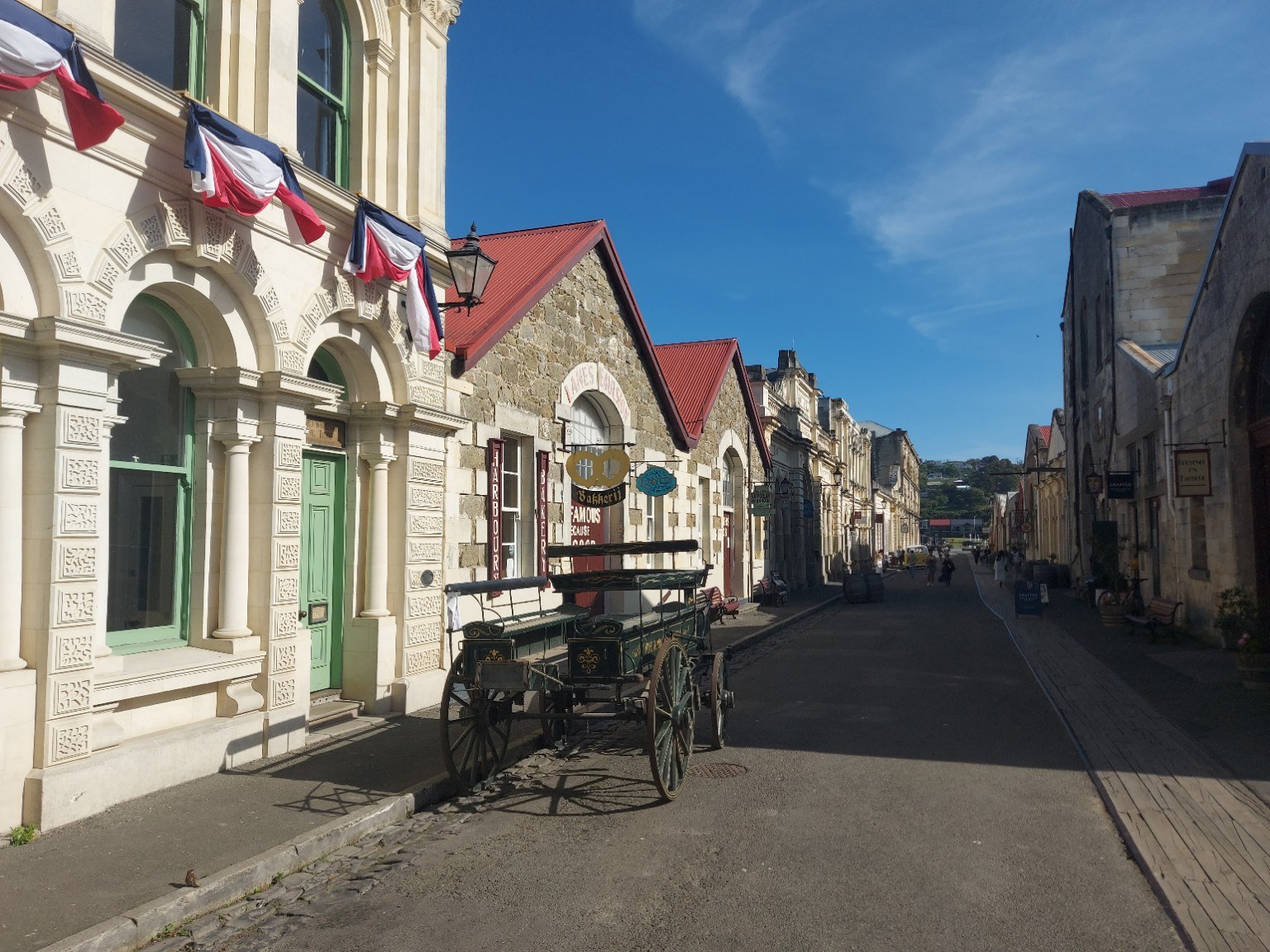
Harbour Street today, still gathering new stories within its historic limestone buildings. Photograph: Roselyn Fauth, 2026.
What a WuHoo!
More WuHoo side quests to follow
- The Carvers and the Scratchers of Ōamaru: the marks left on working buildings.
- Grain Giants, Part One: the grain economy and Ōamaru's changing fortunes.
- Stone, Brick and Grain, Part Two: what Ōamaru can teach us about Timaru.
- You Don't Have to Be Interested in History to Become Interested in a Story: the lecture behind this visit.
- Ōamaru Whitestone Civic Trust: conservation and the Victorian precinct.
- Ōamaru Opera House history: the theatre and its changing uses.
- Waitaki Whitestone UNESCO Global Geopark: the ancient landscape beneath the town.
Questions still on my list
Was it the same truck I rode in as a child? What exactly do the backstage marks record? And what were those intriguing rocks and layers on the beach? Those mysteries deserve proper checking rather than a confident guess.
With thanks to the Ōamaru Whitestone Civic Trust and Waitaki Whitestone UNESCO Global Geopark for inviting me to deliver the Forrester & Lemon Lecture, and to everyone who shared their knowledge and enthusiasm during our visit.