
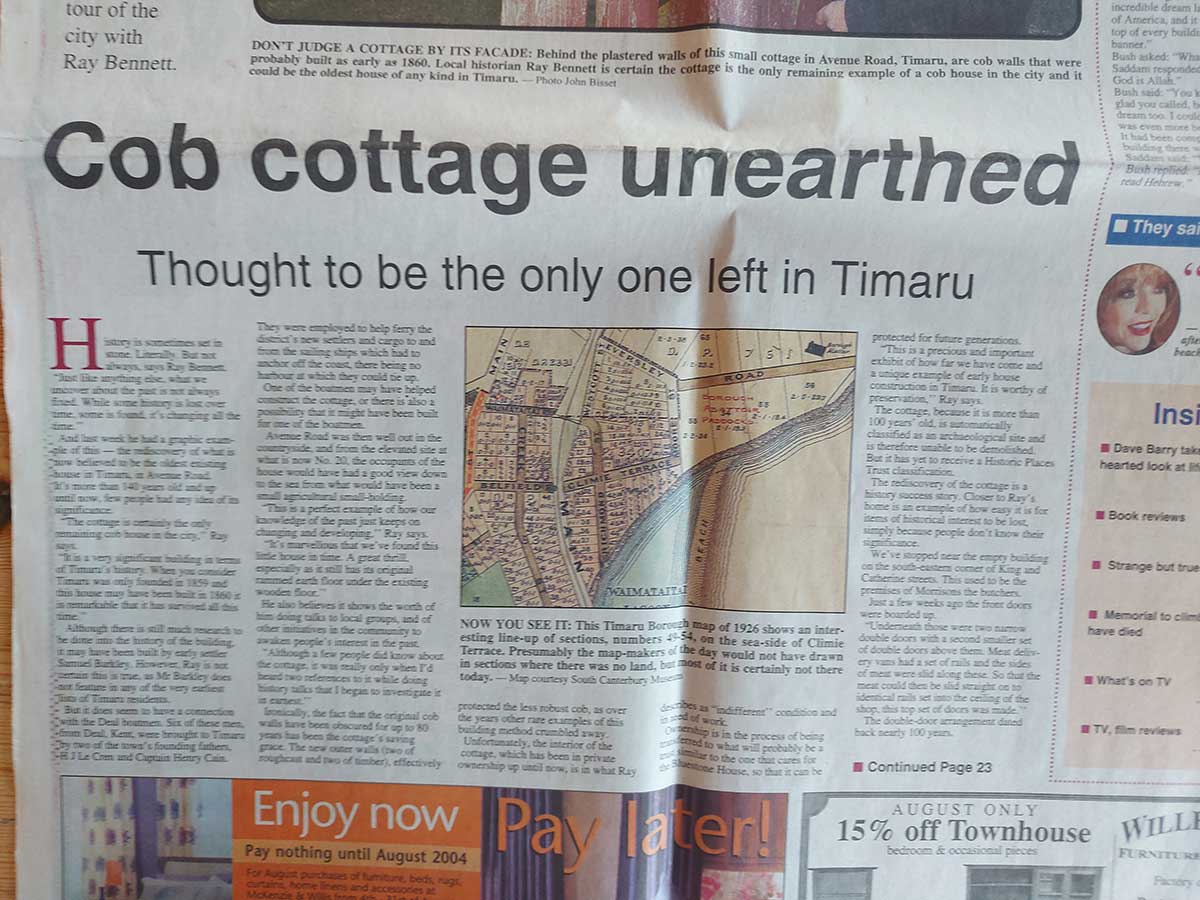
Going through one of Phil Brownie’s file boxes is a bit like opening a collection of historical trapdoors. You start with a folder, a photograph or an old newspaper clipping, and suddenly find yourself somewhere completely unexpected.
This time, it was a large newspaper article with the headline “Cob cottage unearthed”. Behind the roughcast and timber exterior of an ordinary-looking cottage in Avenue Road, local historian Ray Bennett had identified what he believed was Timaru’s only surviving cob house. He also wondered whether it might be the oldest surviving house of any kind in the city...
Do not judge a cottage by its façade
The article explained that the original walls had been concealed behind newer exterior cladding for perhaps 80 years. Two sides had been covered in roughcast and two in timber.
Usually, hiding a historic building behind later alterations makes it harder to understand. In this case, those alterations may have saved it. The outer walls protected the softer earth construction underneath while other examples of cob building gradually disappeared.
The cottage even retained what Bennett believed to be its original rammed-earth floor beneath the later wooden floor.
There is something wonderful about that. The most historically important parts of the house were not the details anyone could see from the road. They were the parts quietly surviving underneath.
What is cob?
Cob is a traditional building material made by combining earth, clay, sand and fibrous material such as straw. It could be shaped into thick walls using materials found close to the building site.
It was practical, inexpensive and well suited to settlers who needed shelter before established sawmills, brickworks and supply networks were available.
But cob needs protection from persistent water and weather. Once a roof fails or exterior plaster falls away, the walls can deteriorate quickly. That vulnerability may help explain why so few early cob buildings survived as towns such as Timaru developed.
The Avenue Road cottage was therefore not simply an old house. It was evidence of how people built during the earliest years of European settlement.
How old could it be?
The newspaper article reported that the house may have been built as early as 1860.
That date matters because Timaru’s organised European settlement was only beginning to take shape around that time. The house may have been constructed when much of what we now think of as the city was still open countryside.
Bennett was investigating a possible link with early settler Samuel Birdsey, although he was careful not to present that connection as proven.
There was also a possible association with the Deal boatmen. These men came from Deal in Kent and were brought to Timaru to help move passengers and cargo between ships anchored offshore and the beach.
Before Timaru had a functioning harbour, ships could not simply pull alongside a wharf. People and goods had to make the dangerous journey through the surf in specialised boats.
The article suggested that one of these boatmen may have helped construct the cottage, or that it may have been built for one of them. Again, it was a possibility rather than a settled fact, but it placed the building within the world of Timaru’s earliest maritime settlement.
From its elevated position in what is now Avenue Road, the smallholding would once have had views towards the sea.
Today it sits within the city. When it was built, it may have stood well beyond it.
What the article taught me
The first lesson was that buildings do not always reveal their age or importance from the street.
A plain cottage may contain some of the oldest surviving fabric in the district. A later façade may conceal an earlier structure. An alteration that appears to have damaged the historic character of a place may, unexpectedly, have protected it.
The second lesson was that historical knowledge is never completely finished.
Bennett reportedly began investigating the house after hearing it mentioned during talks with community groups. Some local people knew fragments of its story, but the significance of the building had not been widely recognised.
History had not suddenly appeared. People had simply begun asking better questions.
The third lesson was that preservation often depends on recognising something before it is lost. Once an old building has been demolished, its construction methods, materials and relationship with the surrounding landscape cannot be fully recovered from photographs or written descriptions.
A disappearing layer of Timaru
The same newspaper article also described another piece of built history that was already vanishing.
At the former Morrison’s butcher shop on the corner of King and Catherine streets, old delivery doors had been covered over. The unusual arrangement included narrow double doors and another smaller set above them.
According to the article, meat delivery vehicles carried rails from which carcasses were suspended. The doors allowed the meat to be transferred directly onto matching rails inside the shop.
Without someone explaining what those doors were for, they might have looked like an awkward old alteration.
Once you understand their purpose, they become evidence of how the building worked, how meat was handled and how an ordinary neighbourhood business operated nearly a century ago.
That is the thing about built heritage. Sometimes the clues are grand façades, towers and carved stone. Sometimes they are a hidden earth wall, a rail in a ceiling or a strangely placed door.
The file box lesson
Phil Brownie’s clipping reminded me that archives do not only preserve finished histories. They preserve leads.
An old newspaper article can point us towards a building, a person, a question or an unresolved theory. It can show what people knew at the time, what they suspected and what they were still trying to prove.
This article does not give us the final history of the Avenue Road cottage. It gives us a starting point.
The next part of the hunt is to identify the property records, establish the ownership history, look for early survey plans and rate books, and determine what happened after the newspaper story was published.
Most importantly, we need to find out whether the cottage is still there.
I have learned from this wee read that sometimes the oldest building in the city does not look like a monument... sometimes it looks like an ordinary little house that everyone has driven past.
Source and acknowledgement
This blog was prompted by a newspaper clipping found in Phil Brownie’s research files. The original article, “Cob cottage unearthed: Thought to be the only one left in Timaru,” contains the reporting, interviews and historical research on which this reflection is based. Local historian Ray Bennett was the principal historical source quoted in the article. Photograph: John Bisset. Map: Courtesy of the South Canterbury Museum. The newspaper title, publication date, page number and journalist’s byline are not visible in the supplied clipping.