By Roselyn Fauth
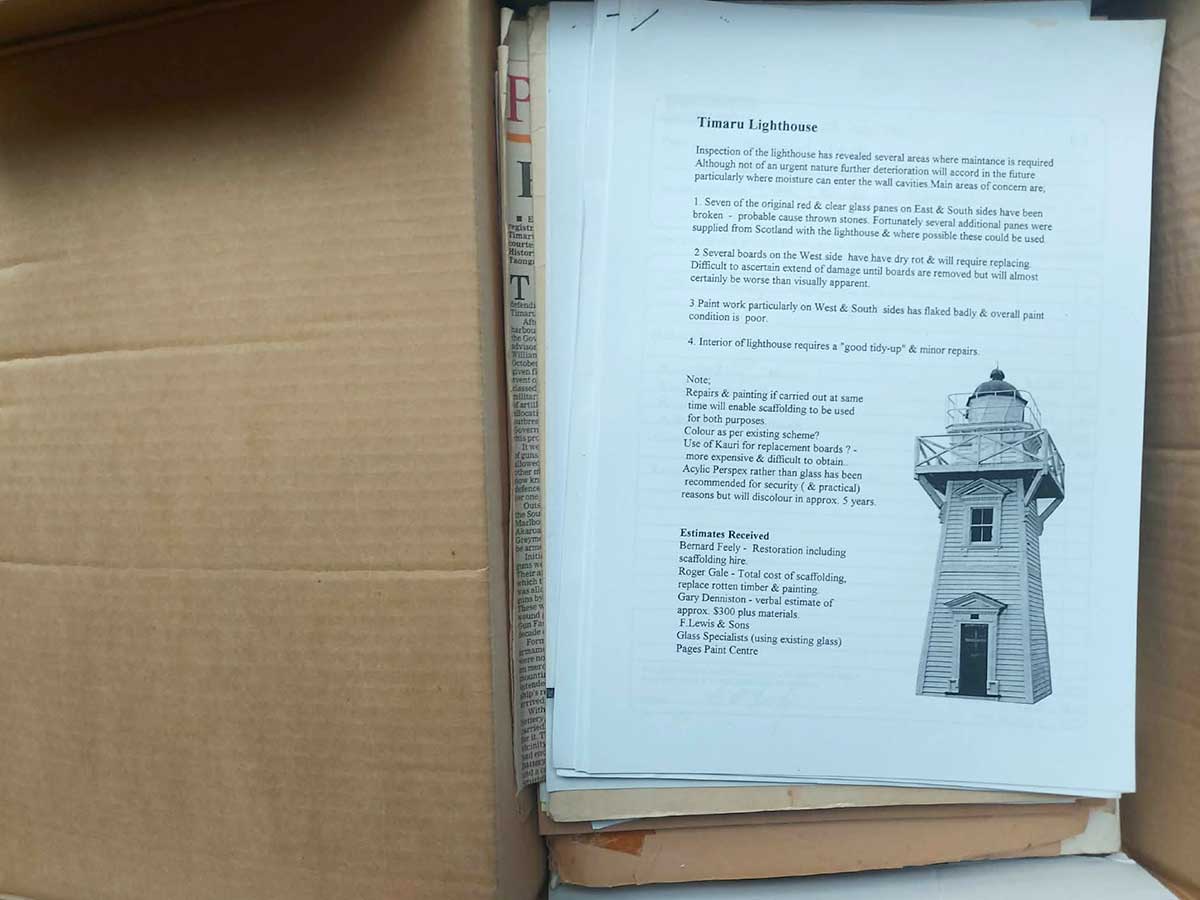
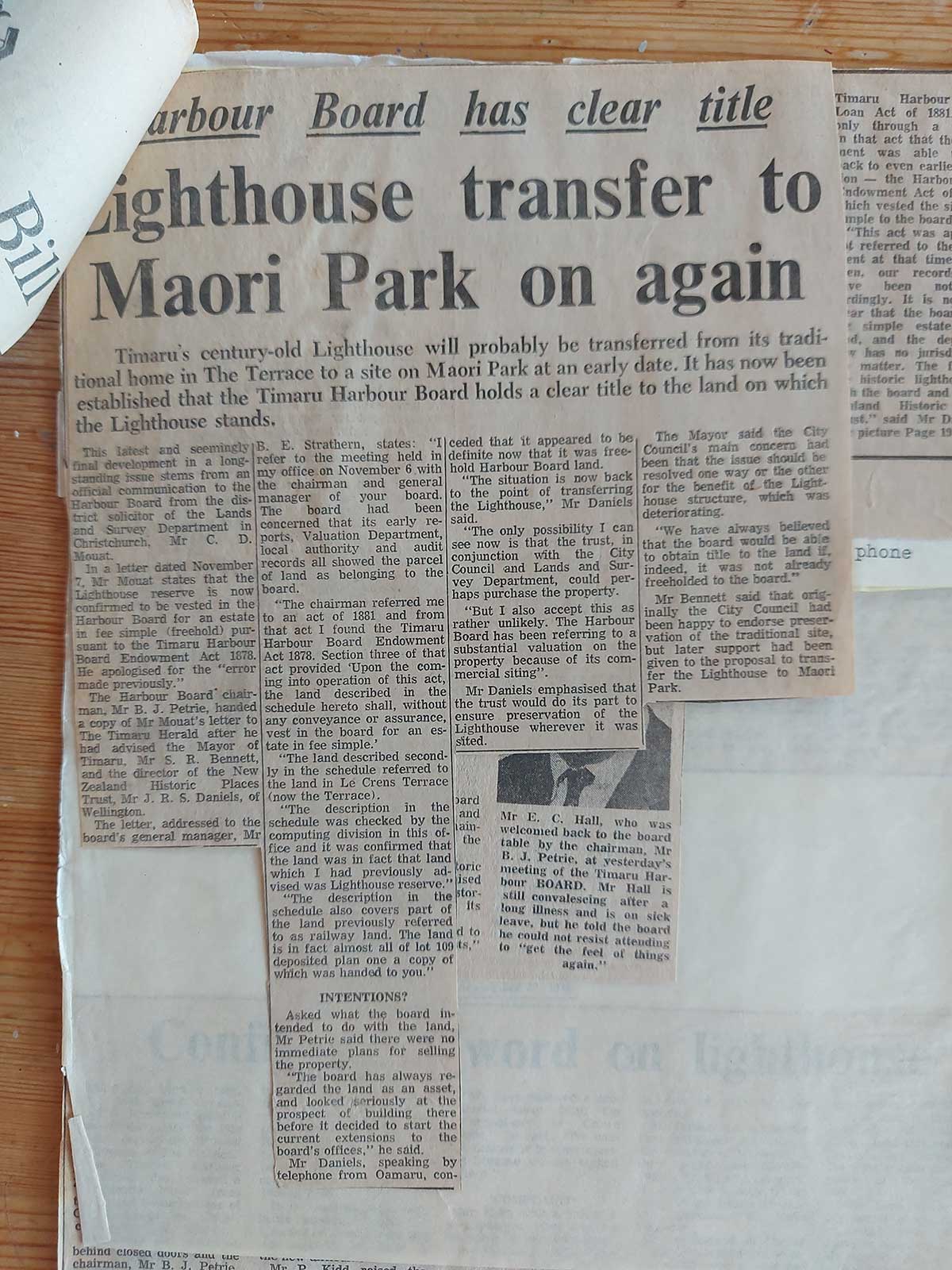
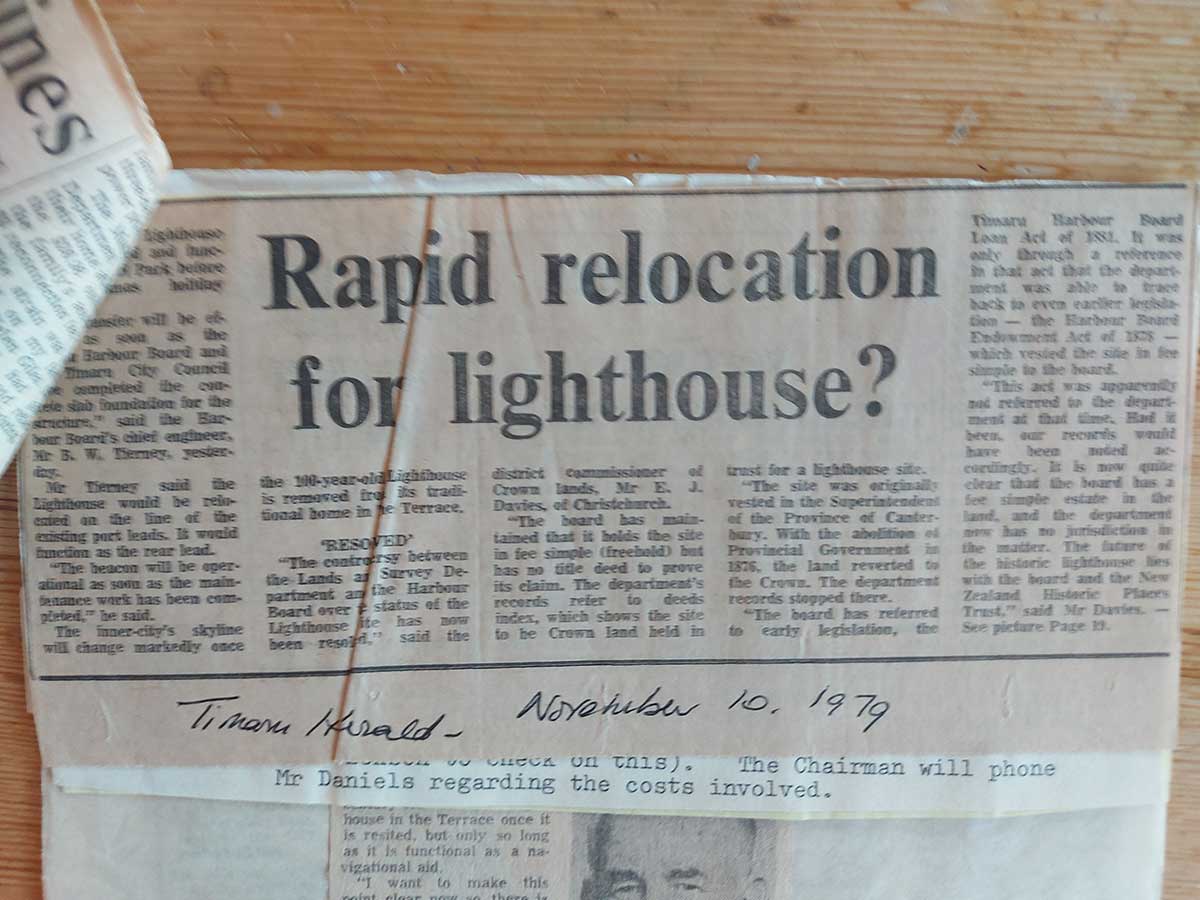
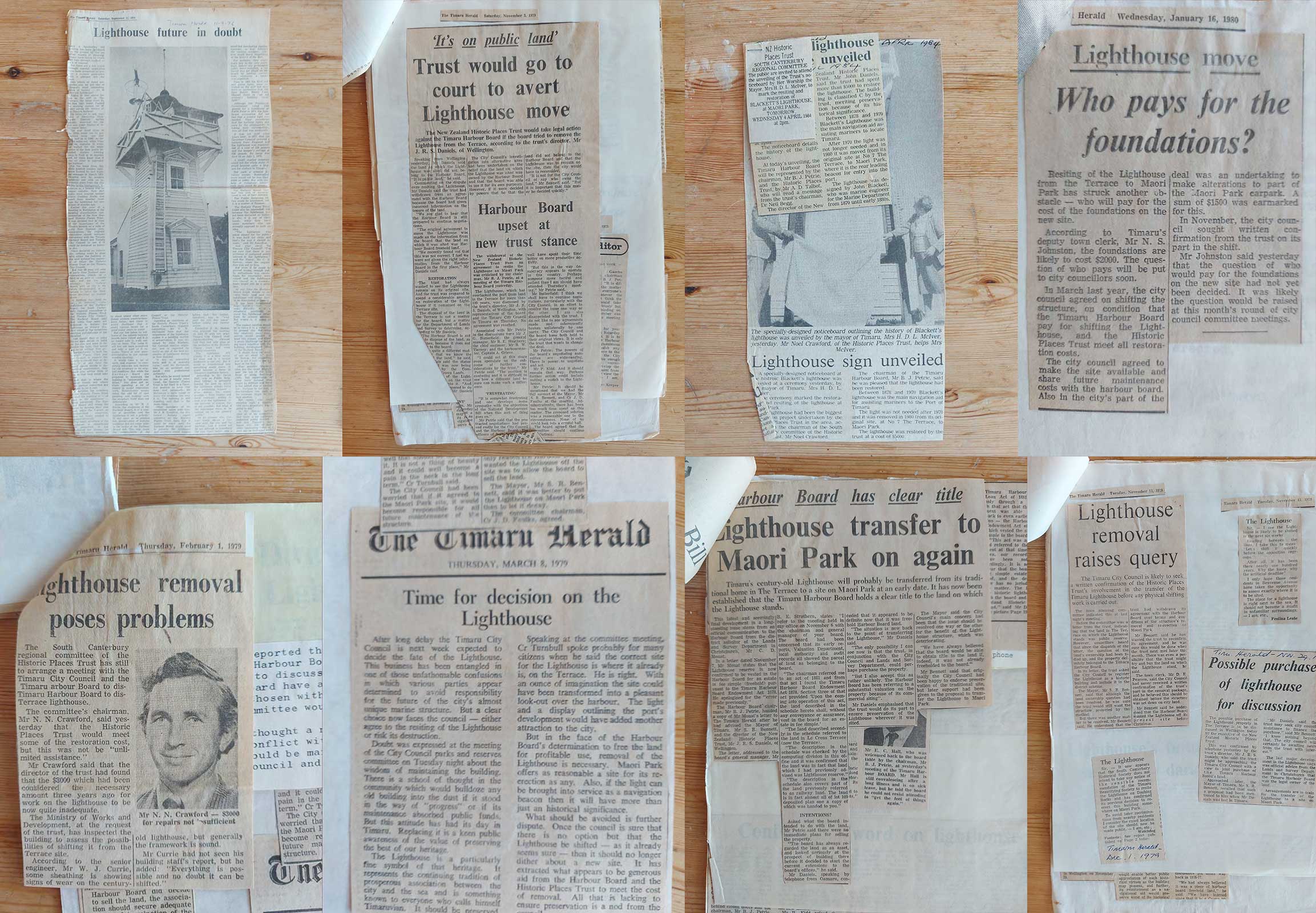
A file box labelled simply “H.P.T.” might not sound especially promising... Inside Phil Brownie’s box, however, was the story of how one of Timaru’s most recognisable historic structures was argued over, threatened, shifted, damaged, repaired and eventually celebrated.
The papers—newspaper clippings, committee minutes, correspondence extracts and photographs—cover much of the struggle to preserve Blackett’s Lighthouse. They also reveal that its survival was not the result of one organisation making a simple decision. It took years of disagreement between the Timaru Harbour Board, Timaru City Council, the New Zealand Historic Places Trust and government departments.
This is what the box tells us so far...
The lighthouse had already outlived its original job
Blackett’s Lighthouse was designed by colonial marine engineer John Blackett and erected in the late 1870s. The documents variously refer to 1877 and 1878, probably because construction occurred in one year and the light began operating in the next.
From 1878 until 1970, it served as Timaru’s principal navigational light. The old records describe a lamp divided into coloured sectors, helping ships identify their position as they approached the port.
By 1970, increasing city lights made the lighthouse less effective, and new harbour lights had been installed. The old structure remained at its traditional site at No. 7 The Terrace, but its future became uncertain.

Section of the HMS Ringarooma cruiser in Timaru Harbour where you can see the Blackett Lighthouse up on Le Cren Terrace 1895-02-23 - Auckland Libraries Heritage Collections NZG-18950223-0180-01
Preservation was discussed long before anything happened
A 1976 clipping records the Historic Places Trust expressing concern for the lighthouse. The Trust regarded it as an important surviving example of early New Zealand maritime history and wanted the Harbour Board and City Council to discuss its preservation.
Relocation was already being considered. The difficulty was finding a site that preserved the building’s significance without interfering with harbour development.
Over the following years, various possible locations were discussed, including sites near Caroline Bay, Benvenue Avenue, Virtue Avenue and the museum. The eventual Māori Park site was attractive because the lighthouse could remain connected to the harbour and could still perform a useful navigational function.
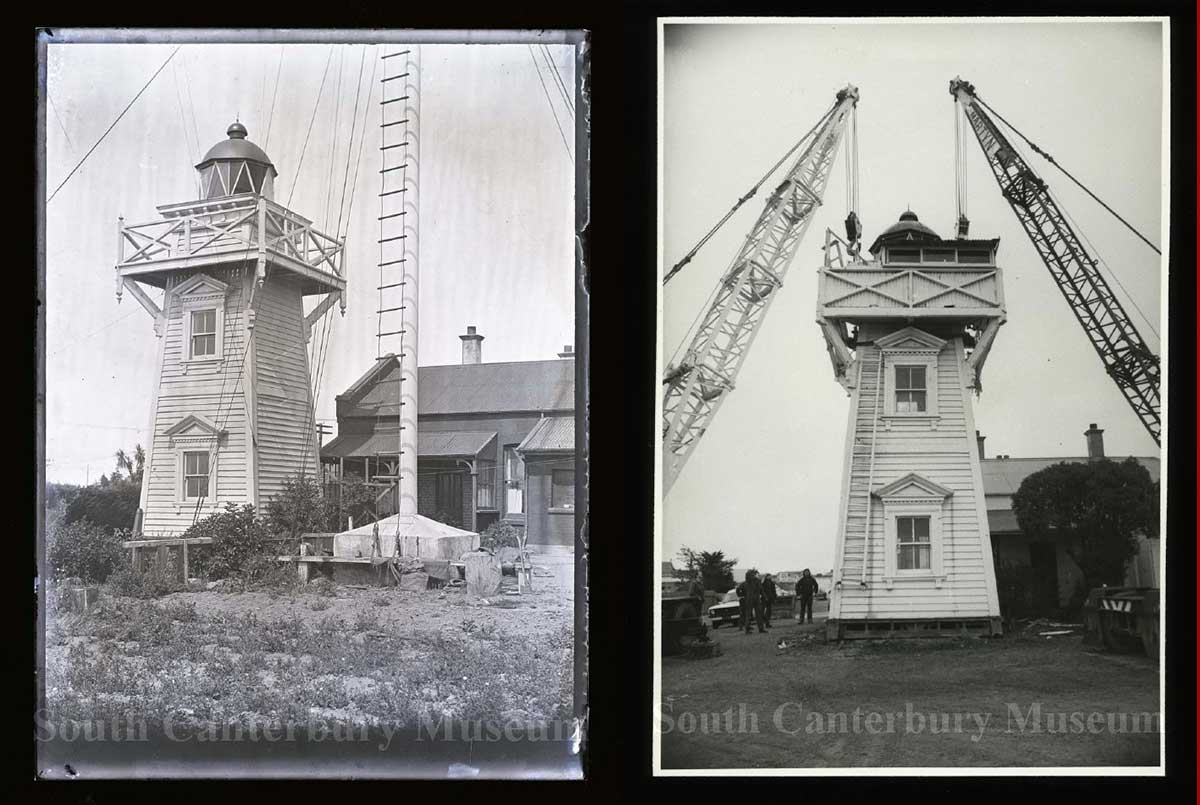
LEFT: The Timaru Harbour Board lighthouse and flagstaff, on the site of the Harbourmaster's house (in the background) on the Terrace, Timaru, circa 1920? South Canterbury Museum. 2021/057.04
RIGHT Timaru's Lighthouse, about to be relocated from the Terrace to it's 'new' location off Benvenue Avenue in 1980. The lighthouse was kept as a historic building but moved to stand adjacent to the South Canterbury Tennis Centre, after the Harbour Board sold the land it originally stood on. Stamped on the verso "Kinghams Photo Services Ltd" with the reference number "124x-5" South Canterbury Museum 2014/107.73.
Nobody could agree who should pay
The documents repeatedly return to the same question: who was responsible for the cost?
The Historic Places Trust indicated that it would contribute to restoration, but its assistance was not unlimited. In February 1979, the Trust’s South Canterbury chairman, Noel Crawford, said an earlier estimate of $3,000 was no longer sufficient.
By June 1979, one figure given for restoration was $4,500, but that did not necessarily include relocation and reassembly. Another discussion put the total project cost at about $10,000.
These figures should not be treated as contradictory totals. They appear to cover different stages or different parts of the work. The box shows estimates changing as the condition of the building became better understood.
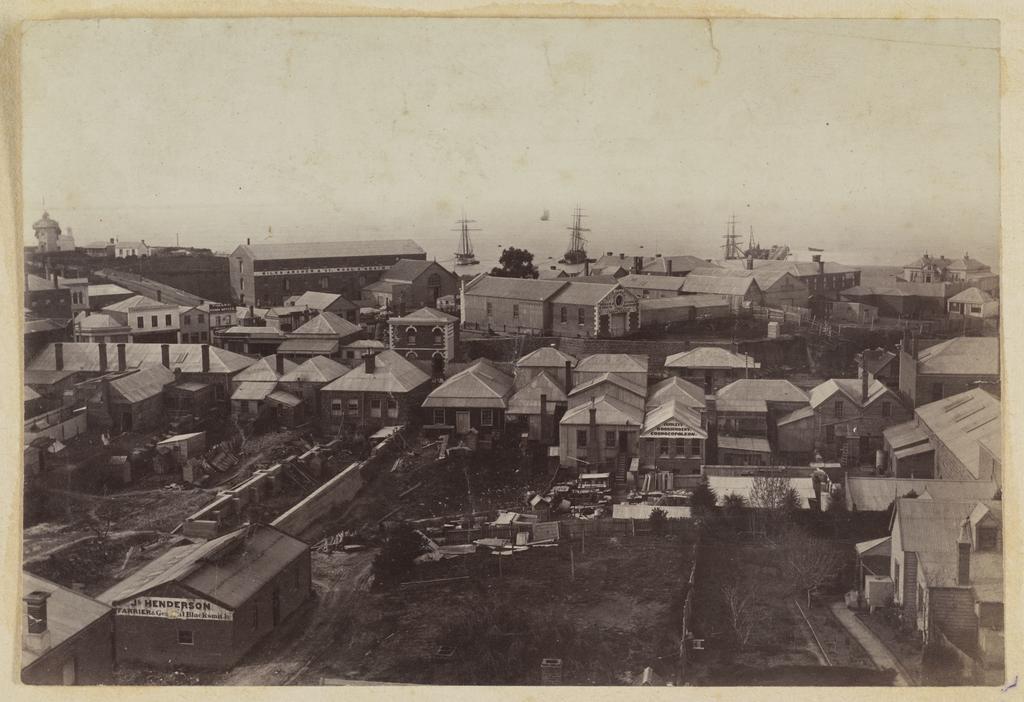
Unknown, Timaru (c.1880s). Hocken Digital Collections, accessed 23/07/2026, https://hocken.recollect.co.nz/nodes/view/58448
There was also a dispute over the land
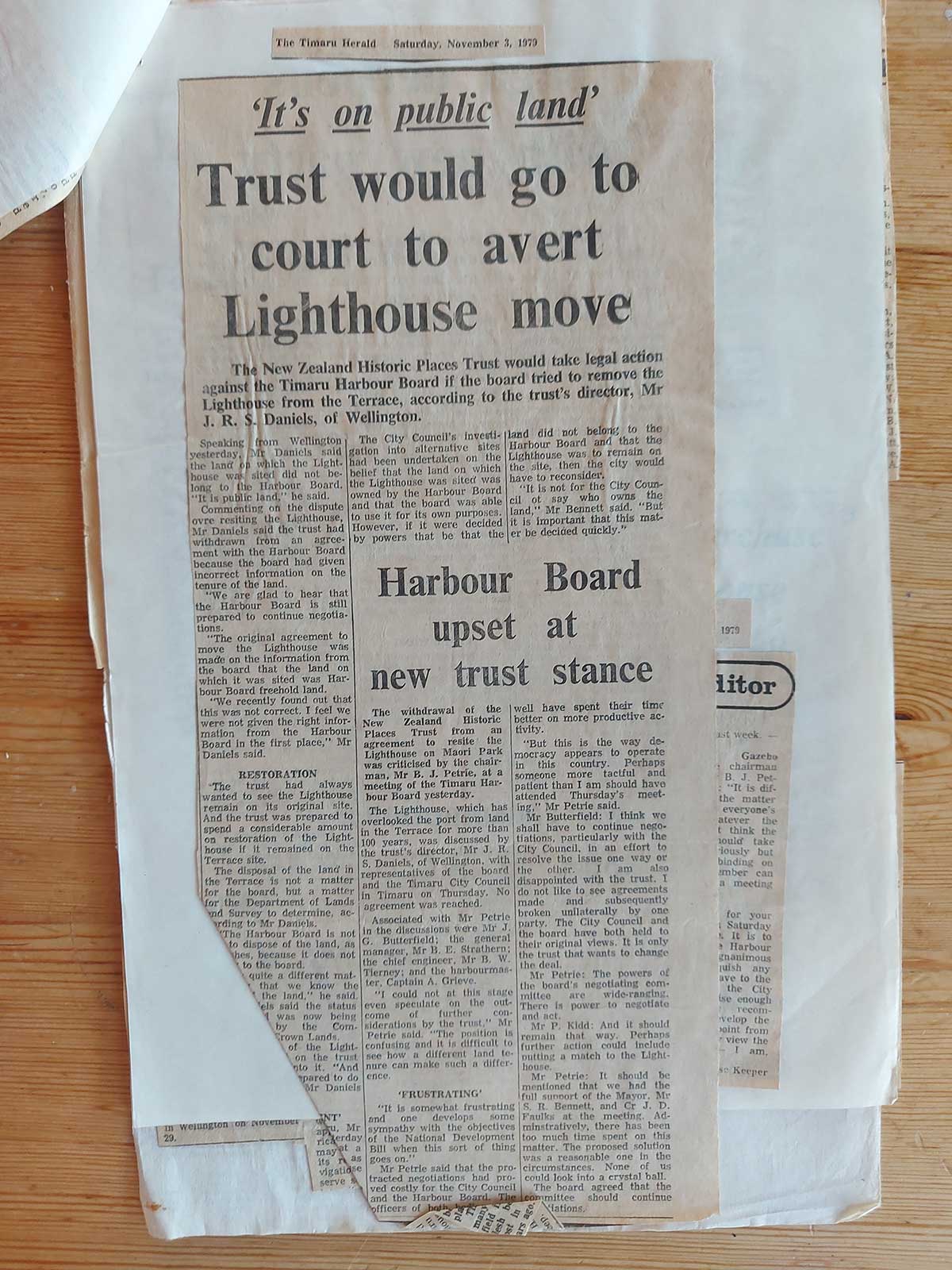
The Lighthouse stood on land that the Harbour Board wanted available for other purposes. But for a time, it was unclear whether the Board actually owned the site.
Government records appeared to show that the land was Crown land reserved for a lighthouse. The Harbour Board maintained that it held the land in fee simple but initially lacked a clear title deed.
Earlier legislation was eventually located. According to a November 1979 newspaper report, the relevant provisions showed that the land had been vested in the Harbour Board. Lands and Survey then accepted that it had no jurisdiction over the property.
Before that conclusion was reached, the Historic Places Trust had taken a strong position. Its director, J. R. S. Daniels, reportedly said the Trust would consider legal action if the Harbour Board attempted to remove the lighthouse from what the Trust then believed was public land.
The Trust was therefore not simply offering money for paint. It was actively intervening to prevent the lighthouse from disappearing while questions of ownership and responsibility remained unresolved.
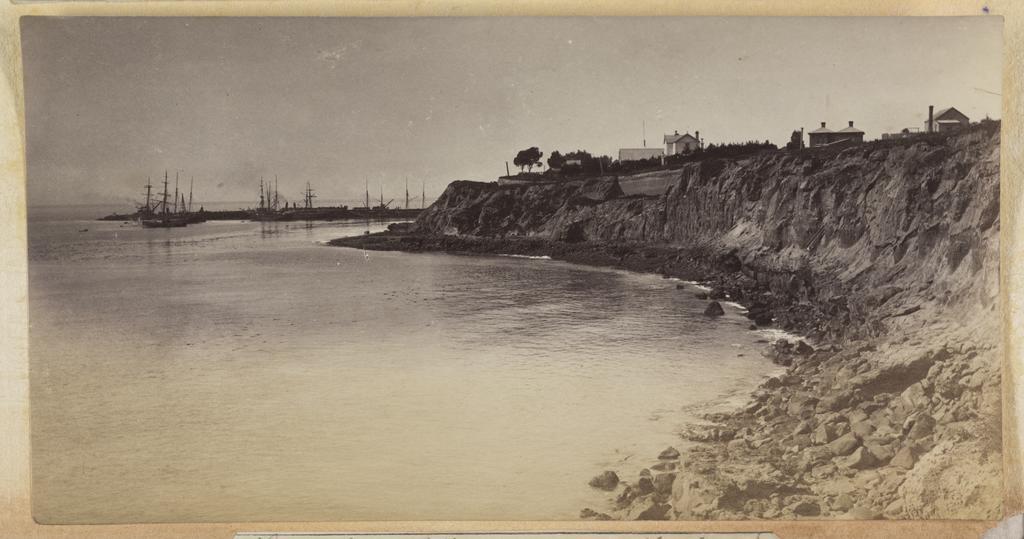
Timaru Caroline Bay rocky cliff area of coastline with the harbour and sailing ships in the distance 14797
This photograph shows a rocky cliff area of coastline with the harbour and sailing ships in the distance. Unknown, Timaru coast (c.1880s). Hocken Digital Collections, accessed 23/07/2026, https://hocken.recollect.co.nz/nodes/view/58441

Caroline Bay in 1890. Crowd on the beach at Caroline Bay, Timaru, circa 1890. Bathing machines are by the surf. Perhaps this is the stream at the left. Photograph taken by William Ferrier. - National Library. Tiaki Reference Number: PAColl-4746-02

Blackett Lighthouse inside - pigeon holes - photo Roselyn Fauth 2025
The public argument became heated
Newspaper editorials and letters show that the controversy mattered to Timaru residents.
Some believed the lighthouse should remain on The Terrace, where it had always stood. An editorial argued that the site could have become a lookout over the harbour, accompanied by a display explaining Timaru’s maritime development.
Others accepted that Harbour Board development made relocation inevitable, but they wanted a firm preservation plan before the building was disturbed.
The debate lasted about four years. One newspaper later described it as a “four-year wrangle.”
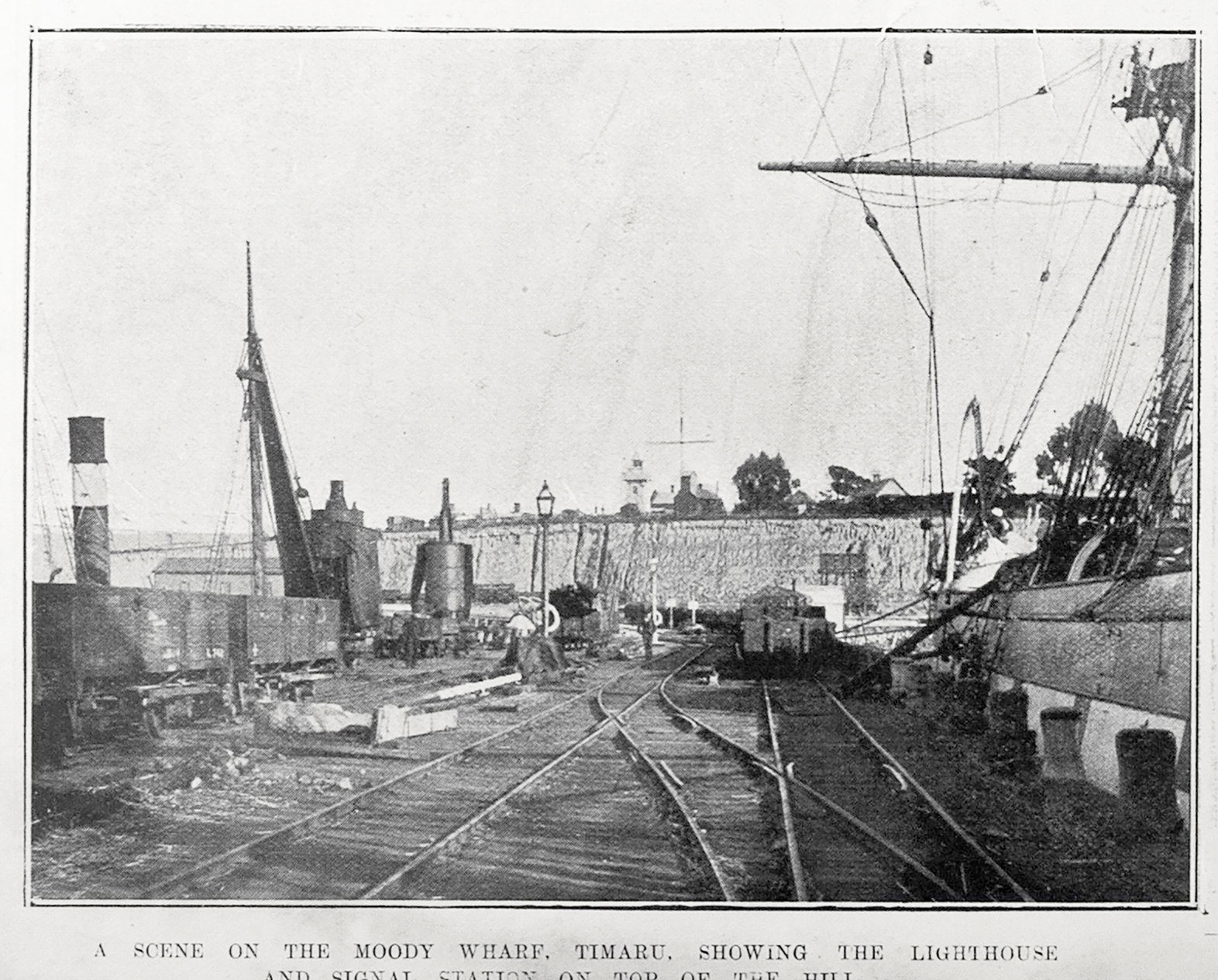
1904 A scewne on the moody wharf, Timaru, showing the lighthouse and signal station on the top of the hill. Auckland Weekly News, 7 July 1904, p.2. Auckland Libraries Heritage Collections AWNS-19040707-02-04
- kura.aucklandlibraries.govt.nz/digital/collection/photos/id/183795/rec/27
Māori Park offered a compromise
Māori Park provided a solution that was both historic and practical.
The lighthouse could be preserved as a landmark while also becoming the rear leading beacon for ships entering the port. It would not merely sit in a park as an exhibit; it would continue to have a relationship with the harbour.
The emerging division of responsibility appears to have been:
the Harbour Board would meet the direct cost of shifting the structure;
the City Council and Harbour Board would share the cost of the new foundations;
the Historic Places Trust would meet or contribute substantially to restoration costs;
local bodies would assist with later maintenance.
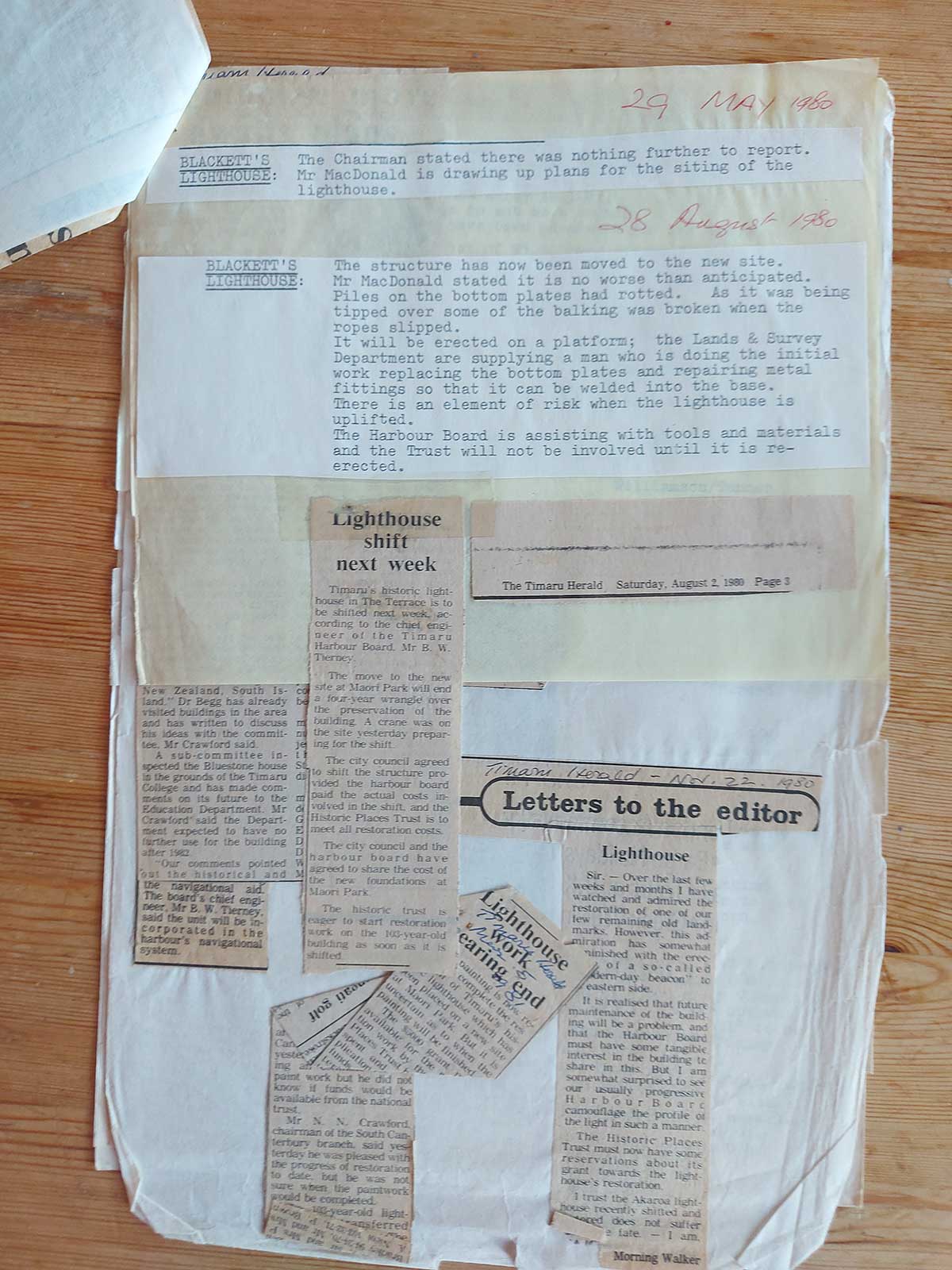
In February 1980, the City Council and Harbour Board agreed on financing for the foundation pad. The Council’s share was reported as $500, with unemployed labour to be used in its construction and the two bodies sharing material costs.
The move did not go entirely smoothly
The lighthouse was shifted from The Terrace to Māori Park in August 1980. A newspaper report says a crane was used. Committee notes made after the move provide a less polished account of what happened. The structure was found to be in worse condition than expected. Piles or bottom plates had rotted. During the move, part of the balcony was broken when ropes slipped.
The notes record that:
Lands and Survey supplied a worker for initial repairs;
metal fittings were repaired so they could be welded into the new base;
the Harbour Board provided tools and materials;
the Historic Places Trust would not become directly involved until the building had been re-erected.
This is an important distinction. The Trust played a major role in saving and restoring the lighthouse, but the papers do not show that it physically carried out the relocation.
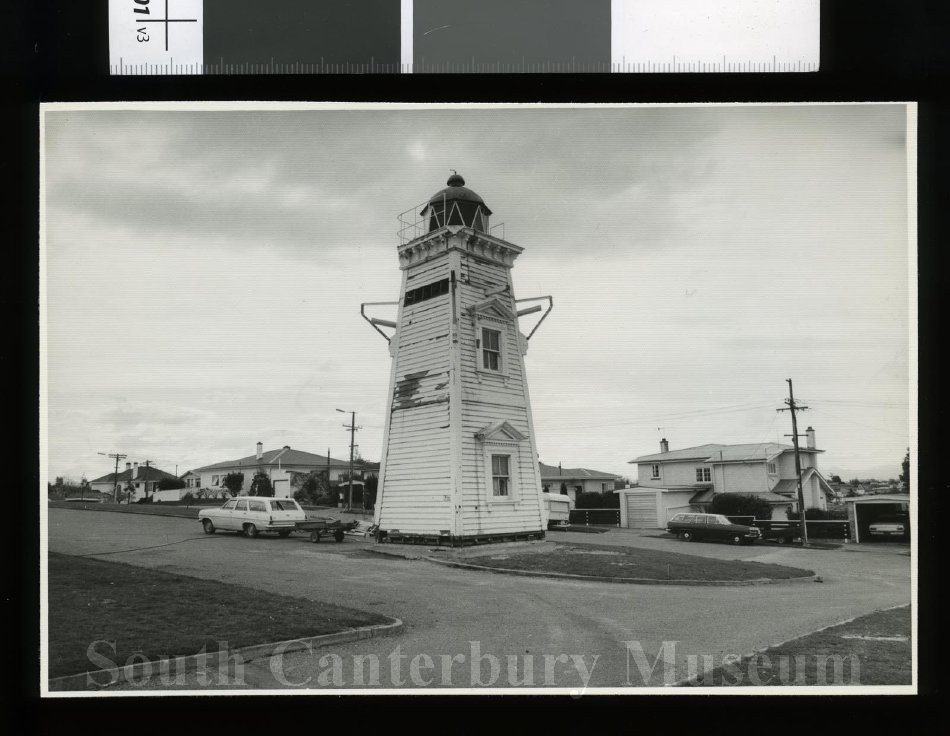
Timaru's Lighthouse, shortly after being relocated to it's 'new' location off Benvenue Avenue in 1980. The lighthouse was kept as a historic building but moved to stand adjacent to the South Canterbury Tennis Centre, after the Harbour Board sold the land it originally stood on. Stamped on the verso "Kinghams Photo Services Ltd" with the reference number "214x-3" - South Canterbury Museum
Moving it revealed how much restoration was needed
Once the lighthouse had been shifted, the true scale of deterioration became apparent.
A newspaper photograph showed extensive rot in the exterior cladding and balcony. Reports mentioned:
rotten base plates and balcony planks;
damaged or decayed exterior timber;
borer in some timber;
a broken lower window;
problems with the lightning conductor;
the need for priming, undercoating and finishing coats.
The old structure was nevertheless judged to contain excellent timber and to be capable of surviving for many more years once repaired.
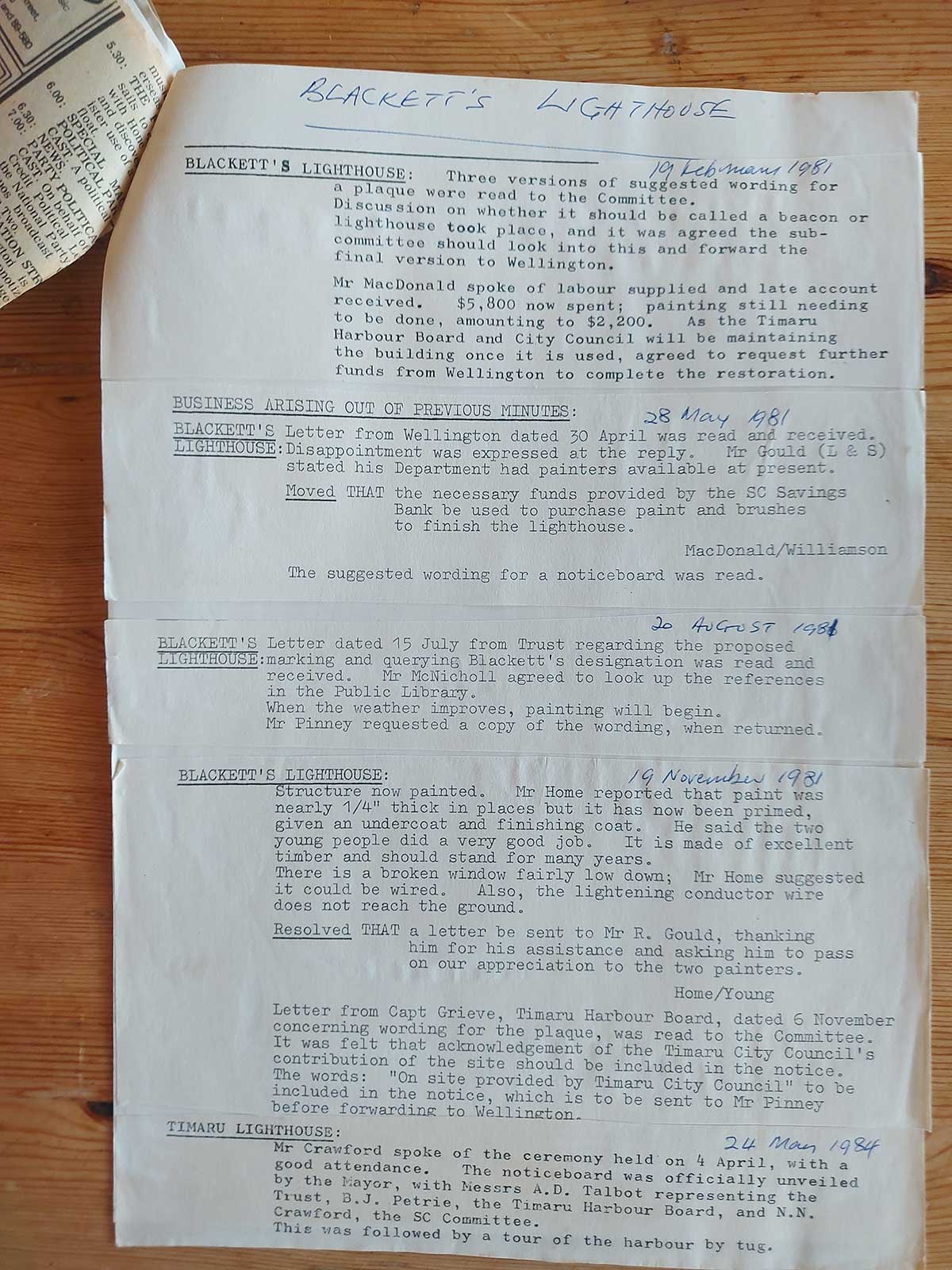
In February 1981, committee minutes recorded that approximately $5,800 had already been spent, with painting still expected to cost another $2,200. The committee decided to ask the Trust’s Wellington office for further funds.
Later that year, money from the South Canterbury Savings Bank was used to purchase paint and brushes. Painters were made available through a government department, and the finished work was praised in the committee minutes.
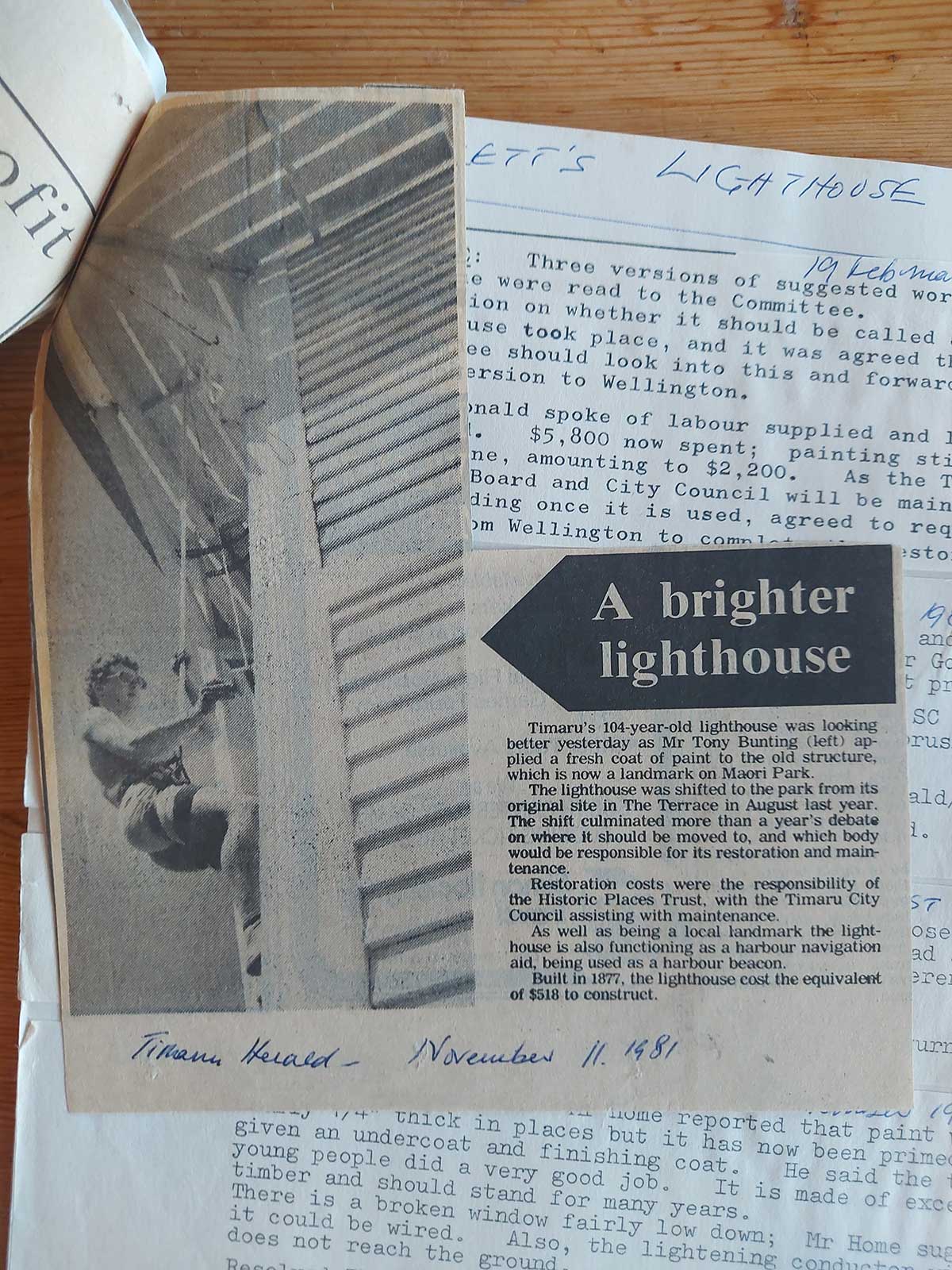
A November 1981 newspaper article described the now 104-year-old lighthouse receiving a fresh coat of paint. It stated that restoration costs were the responsibility of the Historic Places Trust, with Timaru City Council assisting with maintenance.
The surviving cost figures do not align neatly. Some may exclude donated labour, materials, foundations or relocation expenses. By 1984, newspaper accounts said the Trust had spent either $5,000 or more than $5,000 on restoration. The safest conclusion is that the work was funded through several contributions and that different reports counted different portions of the project.

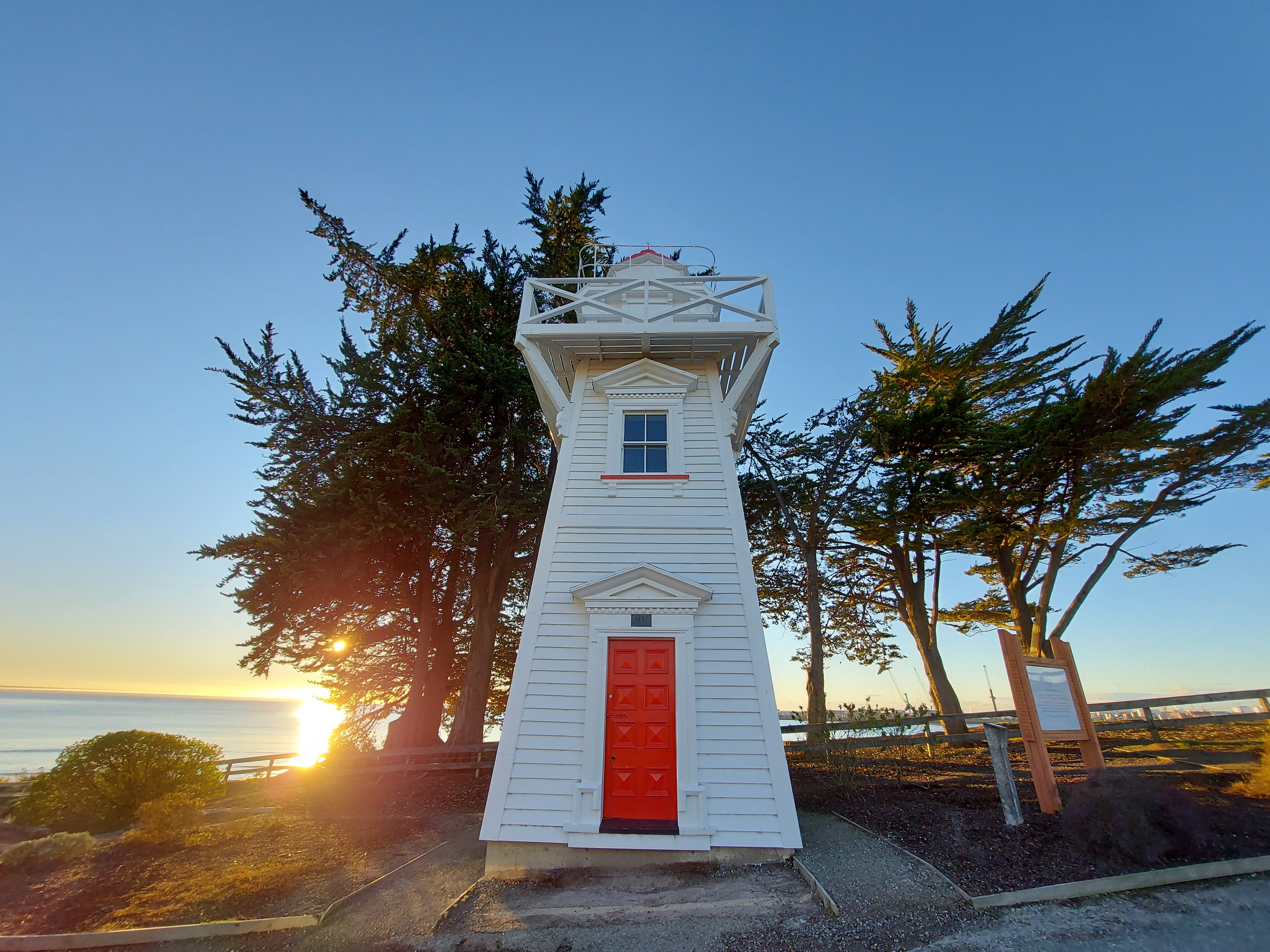
The Blackett Lighthouse was originally on the Terrace, No. 7. It was later relocated to the corner of Te Weka Street and Benvenue Ave, and then again to the Benvenue Cliffs. It is a Category II structure and the Historic Places Trust. LEFT: The Lighthouse at its current site in 2021. Courtesy of Roselyn Fauth. RIGHT: Timaru's lighthouse being relocated 1980. Courtesy of South Canterbury Museum 2014/107.73
The Trust’s work continued after the building was saved
The Historic Places Trust’s involvement included much more than objecting to demolition.
The file shows the Trust:
advocating for preservation;
negotiating with local authorities and government agencies;
considering possible new sites;
seeking professional and architectural advice;
offering and obtaining restoration funding;
assessing the building’s condition;
arranging or supporting repair and painting work;
considering how the lighthouse should be described;
preparing wording for an interpretation plaque;
classifying the building as historically significant;
organising the public unveiling of a noticeboard.
There was even a later proposal to move the lighthouse again, possibly to the South Canterbury Museum grounds. That idea was investigated but did not proceed.
Four years after the move, the work was formally marked
On 4 April 1984, Mayor H. D. L. McIver unveiled a specially designed noticeboard at Māori Park.
Those present or represented included:
the New Zealand Historic Places Trust;
its South Canterbury regional committee;
the Timaru Harbour Board;
Mayor McIver;
Noel Crawford;
A. D. Talbot;
Harbour Board chairman B. J. Petrie.
The ceremony marked both the relocation and restoration of the lighthouse. By then, it had become what the preservation campaigners had hoped for: a historic building retained in public view and still connected with the working harbour.
What Phil Brownie’s box really contains
The box does not hold a tidy success story. It preserves the arguments that came before the success.
It shows how heritage work often happens:
nobody initially accepts complete responsibility;
ownership and legislation have to be investigated;
costs rise as hidden decay is discovered;
organisations disagree over sites and priorities;
practical engineering decisions shape heritage outcomes;
public pressure helps prevent irreversible action;
restoration continues long after a building has been moved out of danger.
Blackett’s Lighthouse survived not because preservation was easy, but because people continued discussing it after the easiest course might have been to remove it.
Phil Brownie’s box labelled “H.P.T.” captures that persistence. It records the difference between admiring an old building and doing the difficult work required to keep it standing.
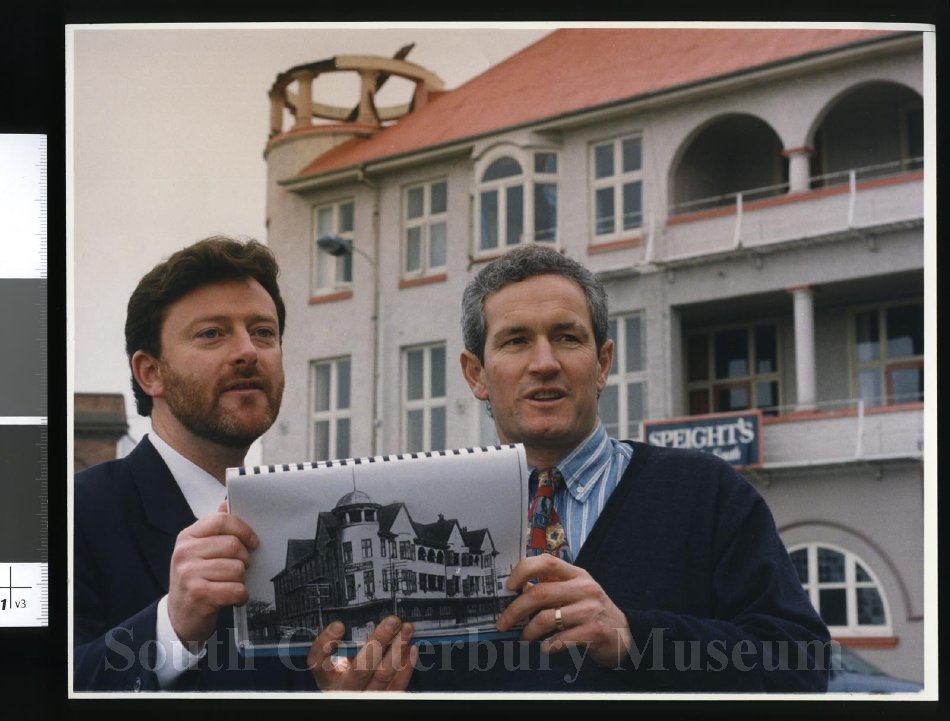
Doctor Stephen Rainbow (left) and Phililp Brownie, dated 15 August 1996. Rainbow and Brownie are standing in fron of the Hydro Grand Hotel holding a historic print of the hotel bound into what appears to be one of the volumes of the 1995 Timaru inner City Heritage Audit. Photo by John Bisset, Photographer, Timaru Herald. South Canterbury Museum 2012/186.1304 https://timdc.pastperfectonline.com/photo/BC603255-D863-4BF9-A651-410354737019
Photography by Roselyn Fauth
A note on the evidence This account is based on the photographed documents in the file box. Some dates, figures and responsibilities remain to be confirmed from clearer copies or original records. In particular, the surviving material does not yet identify the moving contractor, provide a single final project total, or fully explain every organisation’s financial contribution. Where the papers differ, I have retained that uncertainty rather than selecting the most convenient version.
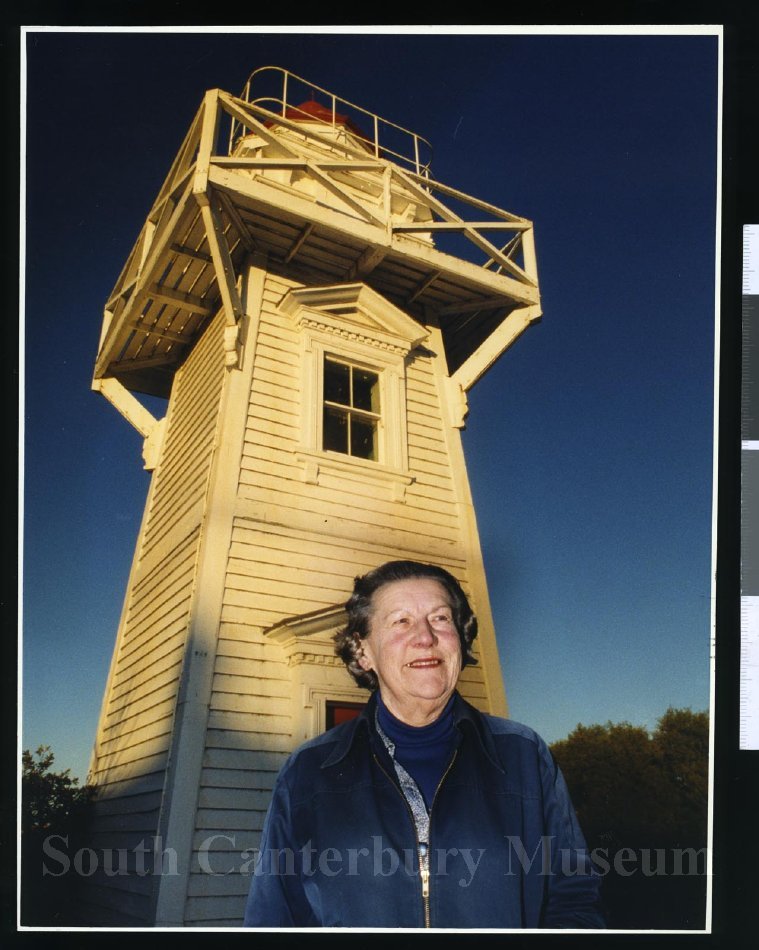
Ginny Talbot posing in front of a Timaru's Blackett lighthouse, dated 29 June 1999. John Bisset, Timaru Herald Photographer. South Canterbury Museum 2012/186.9674
Milestone timeline
1877–1878 — Blackett’s Lighthouse is built on The Terrace and begins service as Timaru’s principal harbour light.
1954–1955 — The National Historic Places Trust is established; it later becomes the New Zealand Historic Places Trust.
1970 — The lighthouse ceases operating as Timaru’s main navigational light.
1976 — The Historic Places Trust begins publicly advocating for its preservation.
1978–1979 — Possible new sites, ownership of the land, restoration costs and responsibility for the move are debated.
November 1979 — The Harbour Board’s title to the original site is reported as confirmed, clearing the way for relocation.
February 1980 — The City Council and Harbour Board agree to share the cost of a new foundation at Māori Park.
August 1980 — The lighthouse is moved from The Terrace to Māori Park. Hidden rot and damage sustained during the move increase the restoration work required.
1980–1981 — The Historic Places Trust funds and coordinates major repairs, while public bodies contribute labour, materials and maintenance assistance.
November 1981 — Painting and restoration are substantially completed, and the lighthouse continues in use as a harbour leading beacon.
1982 — A proposal to move it again, possibly to the South Canterbury Museum grounds, is investigated but does not proceed.
4 April 1984 — Mayor H. D. L. McIver unveils a historical noticeboard marking the lighthouse’s relocation and restoration.
2014 — The New Zealand Historic Places Trust becomes Heritage New Zealand Pouhere Taonga.

Portrait of John Blackett taken circa 1889 by Wrigglesworth and Binns.. PAColl-8810: Blackett, John, 1819-1893 : Photographs. Tiaki IRN: 229554. Tiaki Reference Number: 1/2-080821-F https://ndhadeliver.natlib.govt.nz/delivery/DeliveryManagerServlet?dps_pid=IE140906&dps_custom_att_1=emu
Side Quest: Who—or what—was the Historic Places Trust?
The initials H.P.T. stood for the New Zealand Historic Places Trust. It was not simply a local historical society, nor was it a government department in the ordinary sense. It was a national statutory heritage organisation: established in law by the Historic Places Act 1954, beginning its work in 1955. It was originally called the National Historic Places Trust, becoming the New Zealand Historic Places Trust in 1963.
Its creation reflected a growing recognition that New Zealand’s old buildings, archaeological sites and historic landscapes could easily disappear through demolition, redevelopment or neglect. Its early responsibilities included recording historic places, marking important sites with plaques and noticeboards, helping to preserve buildings, maintaining a register and giving grants towards conservation work. The Trust could also acquire historic properties or accept them as gifts.
From the outset, much of its work was carried out through a network of 17 regional committees. These relied heavily on local volunteers—people who knew their districts, researched buildings and sites, watched for threats and tried to persuade owners and public authorities to preserve them.
That helps explain the mixture of documents in Phil Brownie’s box. Some letters came from the Trust’s national office in Wellington, while others record the work of its South Canterbury Regional Committee. The local committee, chaired during the lighthouse campaign by Noel Crawford, followed the issue closely, attended meetings, discussed sites, sought funding and reported back to Wellington. It was the local face of a national organisation.
The Trust’s work was not limited to buildings. It recorded archaeological sites, supported excavations and documented places that could not be saved. In South Canterbury and the Waitaki basin, for example, it had already been involved in recording Māori rock art threatened by hydroelectric development. It also contributed to the preservation of early South Canterbury buildings, including the Studholme family’s Cuddy at Waimate and the Levels hut near Timaru.
Its approach was not always to insist that a building remain exactly where it stood. Contemporary accounts of the Trust’s work recognised that, when preservation on an original site was impossible, removal and re-erection could be supported. The Trust had helped finance similar projects elsewhere before the Blackett Lighthouse debate.
It also placed considerable importance on interpretation. Plaques and noticeboards were not afterthoughts: they were one of the Trust’s original ways of explaining why a place mattered. Research was undertaken to establish the wording, and more detailed noticeboards were used where a short plaque could not tell the whole story. This makes the 1984 unveiling of the Blackett Lighthouse noticeboard part of a much longer Trust tradition.
What power did the Trust actually have?
The Trust had statutory standing, professional expertise and access to national networks, but that did not mean it could simply order every old building to be saved.
Its influence often depended on:
- formally recognising or classifying a building;
- researching its history and significance;
- negotiating with owners and councils;
- issuing public warnings or objections;
- offering grants or seeking funds;
- arranging professional conservation advice;
- using the legal powers available under heritage legislation.
The Historic Places Act 1980, which came into force while the lighthouse project was under way, continued the Trust and provided for such matters as the classification and protection of buildings, grants, repairs notices, archaeological sites, historic areas and heritage covenants.
In practice, however, heritage projects usually involved negotiation and divided responsibilities. The Trust might pay for restoration while a council provided a site, another authority supplied labour, and the owner paid for relocation or future maintenance. That pattern is visible throughout the lighthouse file.
What the Trust did for Blackett’s Lighthouse
The file box shows the South Canterbury committee and the Wellington office working together, but performing somewhat different roles.
The regional committee:
- kept the lighthouse’s future before the public;
- met or corresponded with the Harbour Board and City Council;
- investigated possible relocation sites;
- discussed who should pay;
- monitored the building’s condition and repair work;
- helped develop the wording for the historical noticeboard;
- organised the eventual unveiling.
The national organisation in Wellington:
provided institutional authority and specialist advice;
considered applications for money;
corresponded with government departments;
evaluated the restoration and relocation proposals;
classified the lighthouse as historically significant;
contributed substantial restoration funds.
The distinction matters. The Trust did not arrive in Timaru with its own construction gang, crane or house-moving equipment. Its role was to make preservation possible through advocacy, negotiation, professional advice, classification and finance. The physical work was shared among the Harbour Board, City Council, government workers, tradespeople and others.
More than a conservation organisation
Phil Brownie’s box captures a period when the Historic Places Trust occupied an unusual position. It was part watchdog, part researcher, part grant-giver and part negotiator. It could challenge public authorities, but it also needed their cooperation. It could identify a building as important, but it often depended on local people to carry the campaign.
That is exactly what happened with Blackett’s Lighthouse. The national organisation supplied status, advice and money, while local committee members kept attending meetings, writing letters, examining proposals and refusing to let the subject disappear.
The organisation still exists, although its name and governing legislation have changed. In 2014 the New Zealand Historic Places Trust became Heritage New Zealand Pouhere Taonga. It remains the national agency responsible for identifying, protecting and promoting New Zealand’s place-based historical and cultural heritage.