
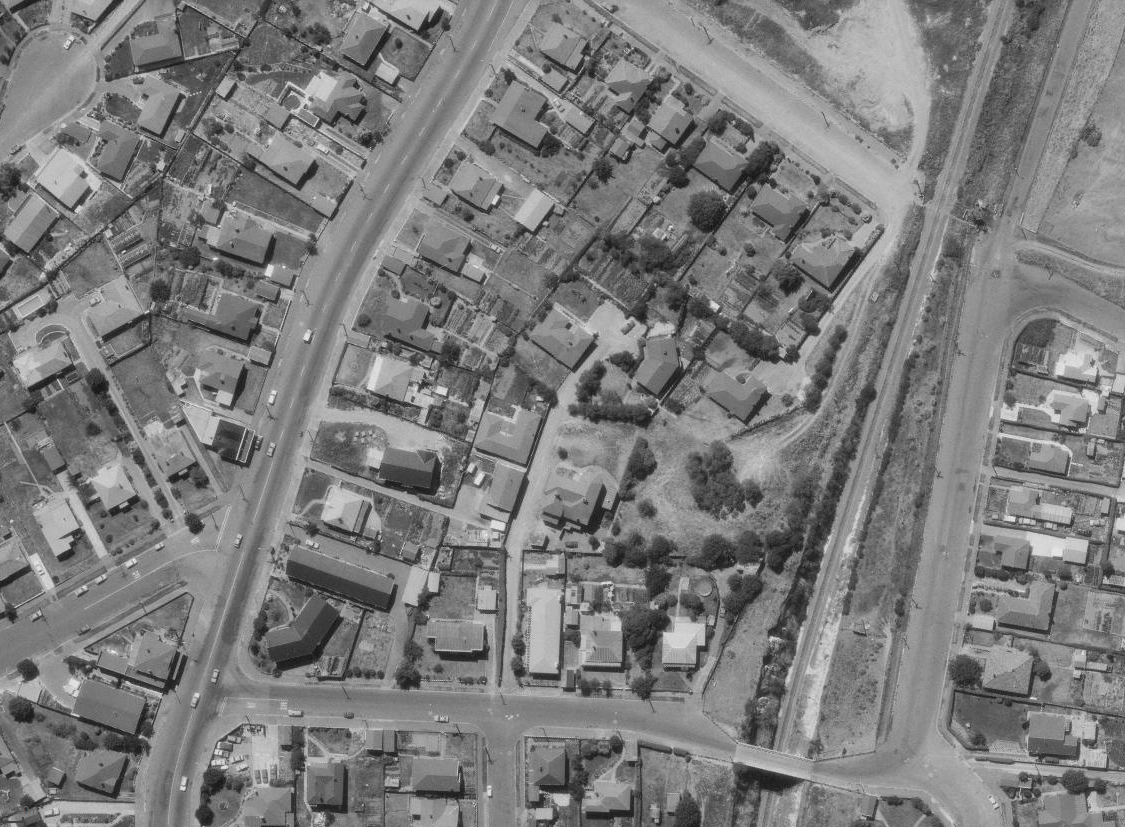
Could this be Emma Leonora Belfield's old Timaru home? The hunt for pollination history that has taken me through The Timaru Herald, the Akbar shipwreck, Timaru High School and two bumblebees
I've been researching three quite different parts of Timaru's history: the beginnings of Timaru High School, our built heritage, and the introduction of bumblebees to New Zealand. I thought I had three separate stories to write. Instead, the same family kept turning up, and now I'm trying to find their house. I've circled a building in yellow on an old aerial photograph of Waimataitai. Could this be the former home of Herbert and Emma Leonora Belfield?
I haven't proved it, but I've found some promising clues. I've also found the Belfields connected with the founding of Timaru High School, the Timaru Herald, the building of the original St Mary's Church, a deadly shipwreck near Washdyke, and an attempt to bring bumblebees from Britain to pollinate red clover.
Some of the discoveries have helped answer questions. Others have sent me off on new research trails. I'm hoping someone might recognise the house, have an old photograph or know something about the family. Here's what I've found so far...
Margaret Louisa Belfield died in Timaru in 1873, aged just 34.
While researching the Belfield family, I searched the Timaru Cemetery records. Only one person with that surname appeared in my search: Margaret Louisa Belfield. The cemetery record gives her age as 34, her date of interment as 21 October 1873, and her burial location as General Section, Row 23, Plot 6.
Who was Margaret?
A transcription of the Lyttelton Times death notices, published on 21 October 1873, provided an answer. Margaret had died in Timaru on 10 October and was the wife of Herbert Belfield. Herbert's name appears regularly in historical newspapers, but I've found very little about Margaret herself. Where was she born? Did they have children? What caused her death at such a young age?
There's another connection between Herbert and her burial place. Herbert was involved in the management of Timaru Cemetery. The New Zealand Gazette of 17 February 1881 published cemetery regulations dated 16 November 1880, signed by Herbert Belfield as chairman. Seven years after Margaret's death, he was helping govern the cemetery where she was buried.
It's an interesting starting point for a house hunt, but I wanted to understand the family before trying to locate their home.
By 24 May 1860, Herbert was living in the Waimataitai area
I started searching backwards to find out when Herbert first arrived in Timaru. His exact arrival date remains a mystery, but an account of a journey through South Canterbury places him here by 24 May 1860. The account was written by Effie Studholme, née Channon, who travelled from Christchurch to Waimate with her husband Michael. They made the journey on horseback, following rough tracks and crossing rivers and creeks. Effie remembered the Washdyke crossing as particularly difficult, with the horses plunging into the soft creek bed. On 24 May, Queen Victoria's birthday, they reached the Waimataitai home of Captain Belfield Woollcombe, where they stayed overnight.
Effie recalled being warmly welcomed by Captain Woollcombe and his cousin, Mr Belfield. There was Herbert. The account also helped me establish their family relationship.
Captain Belfield Woollcombe (1816–1891) and Herbert Belfield (c.1834–1917) were cousins. Belfield was the Captain's first name, but Herbert's surname. They were two different men, with separate homes. Captain Woollcombe had settled in Timaru in 1857 and held an extraordinary range of government positions. He served as resident magistrate, harbourmaster, registrar and in several other official capacities. He established Ashbury, overlooking Waimataitai Lagoon, on land associated with today's Ashbury Park, previously known as North Park. I've already researched Captain Woollcombe while learning about Ashbury Park, so finding Herbert connected with him was particularly useful.
Effie's account also gives us a glimpse of the garden. The following morning, she admired Captain Woollcombe's gum trees. He gave her cuttings from his jessamine to take on the journey south. I rather like that detail. Even after a difficult journey, she remembered the garden and the plants she was given. Effie's recollections were published in the Timaru Herald on 11 June 1914, under the heading What Women Braved. They were also preserved in Te Waimate: Early Station Life in New Zealand, published by her son Edgar Channon Studholme in 1940.
The account was written and published long after the journey, so it needs to be treated as a recollection rather than a newspaper report from 1860. But it gives us an important date and identifies the family relationship. Without Effie's writing, I might never have found Herbert at Waimataitai on that particular day.
By 1864, Herbert was working as Captain Woollcombe's deputy registrar
An Archives New Zealand correspondence register contains an entry dated 17 July 1861 proposing that Herbert Belfield be appointed deputy to Captain Woollcombe, Timaru's Registrar of Marriages. The Southern Provinces Almanac for 1864 then lists Herbert as his deputy. So the two cousins weren't simply living near one another. They also had a documented working relationship.
Did Herbert follow Captain Woollcombe to Timaru? Was his cousin responsible for helping him establish himself here? I haven't found evidence to answer those questions. Captain Woollcombe settled here in 1857. Herbert was present by May 1860 and was serving as his deputy by 1864. At the time, Timaru was still a small European settlement. The Strathallan had brought immigrants in January 1859, and the town was growing around its port and the pastoral economy of South Canterbury.
People were establishing businesses, public services, roads, houses, schools and gardens. Another recollection published in the Timaru Herald in June 1914 remembers Herbert as Timaru's first milkman, carrying milk himself in two large vessels. I haven't independently confirmed that he was the first, but it's an interesting glimpse of the practical work undertaken during the settlement's early years.
The same account places Herbert's house on the hill adjoining Captain Woollcombe's property. That gave me my first geographical clue. Was this early home the same brick residence that was advertised for sale in 1881? I still need to find out.
Herbert and his cousin helped build Timaru's original St Mary's Church
While checking the family relationship, I found another connection with Timaru's built heritage. In Letters from New Zealand, 1857–1911, Archdeacon Henry William Harper recorded a description of Timaru dated 20 February 1876. He described the original St Mary's Church as a small wooden building constructed by Captain Belfield Woollcombe and his cousin Herbert Belfield. He gave particular credit to Captain Woollcombe for the hands-on building work.
That sent me looking into the church's early history. The foundation stone was laid on 7 April 1860, and the original wooden church was dedicated on 28 April 1861. It was South Canterbury's first Anglican church. The building was later enlarged in stone before eventually being replaced by the much larger church we know today. The present St Mary's building belongs to a later period. Its stone construction began in 1880, and the new nave opened in 1886. So Herbert's connection was with the original wooden church, not the later stone building. I've walked past St Mary's so many times, but hadn't previously connected its earliest construction with the Belfield family.
Herbert became sole proprietor of the Timaru Herald on 2 March 1871
Herbert's public responsibilities expanded considerably during the 1860s. The Timaru Herald had been founded in 1864 by Alfred George Horton and Ingram Shrimpton. It was more than a source of news. The paper helped give South Canterbury a public voice at a time when residents were arguing for greater local control over revenue, infrastructure and government decisions. In 1866, Herbert joined Horton in the newspaper and general printing business.
He also represented Timaru on the Canterbury Provincial Council from 1867 to 1874. I've found an original legal notice that gives us the precise date Herbert took over the newspaper business. It was published in The New Zealand Gazette on 11 March 1871, page 132, notice 594. The notice records that Alfred George Horton and Herbert Belfield dissolved their partnership by mutual consent on 2 March 1871.
From that date, Herbert would carry on the newspaper and general printing business independently, collecting money owed to the partnership and paying its outstanding debts. The notice bears the names of both men and identifies Arthur Perry, solicitor of Timaru, as the witness. This is useful primary evidence because it establishes the legal change in the business rather than relying on a later historical account. Herbert continued as proprietor and remained editor until Edward Wakefield assumed the editorial role in 1874. His work with the newspaper placed him close to many of the debates accompanying Timaru's growth, including public works, local government and education. And education is where my research led next.
In 1872, Herbert was chairman of the Timaru Public School Committee
I originally came across Herbert while researching the beginnings of Timaru High School in 1879. But his involvement in education went back further than I expected. In the Timaru Herald of 23 December 1872, I found a detailed account of the Timaru Public School prizegiving, held at the Mechanics' Institute on Wednesday 18 December. Herbert was chairman of the School Committee and presided over the gathering.
Timaru Public School and Timaru High School were two separate schools. Timaru Public School began in 1859 and provided primary education, later becoming known as Timaru Main School. Timaru High School opened on 29 January 1880 as a secondary school for both boys and girls, before separating into Timaru Girls’ High School and Timaru Boys’ High School in 1898. Although the schools were separate, some children who attended Timaru Public School may later have continued their education at Timaru High School.
Headmaster J. F. Hunt told those present that 365 children were on the roll, although average attendance was between 260 and 280. He was concerned about irregular attendance and the difficulties it created for teaching. Mr Hunt also mentioned that some parents were reluctant to pay the weekly school fee of sixpence. I wonder about the circumstances of the families whose children weren't regularly attending. Were the fees difficult to afford? Were children needed at home or for work? How far did some have to travel? The newspaper doesn't answer those questions.
Mr Hunt also spoke against the idea that children from different social backgrounds should be kept apart at school. He believed that bringing children together through education was important for the town's future. Another speaker was the Reverend George Barclay. He explained that he had written an earlier letter to the Timaru Herald, signed simply "Education", which helped prompt public discussion about improving local schooling. It was Barclay who wrote that letter, not Herbert. Both were involved in education, but their contributions need to be distinguished. At the end of the evening, Mr Hunt thanked Herbert for the considerable time and unpaid work he had given to the school.
And Herbert said something during his speech that I found particularly interesting... Herbert recognised that capable pupils might struggle to perform in public.
The annual prizegiving was a new public event for Timaru. Children were being invited to demonstrate what they had learnt in front of parents and the wider community. Herbert supported the idea, but acknowledged a possible disadvantage. Some pupils might be just as capable as those performing publicly, he suggested, but lack the confidence to stand before a large audience. I thought that was interesting, especially when we consider how differently children learn and communicate. Being confident in front of an audience isn't necessarily the same as understanding a subject.
The prizes themselves were interesting too. Alongside academic awards, the school recognised the boy and girl most liked by their fellow pupils. Herbert said he hadn't encountered that particular type of award before, but approved of it because he believed the respect of classmates was valuable.
The recipients were:
Benjamin Hibbard — best boy in school
Hepzebah Jaggar — best girl in school
Alfred Richard Barclay was named Dux.
Other prizes recognised mathematics, classics, general proficiency, mapping, needlework and knitting. And there were women making important contributions to the occasion. Mrs Perry presented the prizes and donated five books. Mrs Hobbs donated two books. Mrs Jaggar was the schoolmistress whose pupils' sewing received praise, while several girls contributed musical performances and recitations. I noticed that prizewinner Hepzebah Jaggar shared a surname with Mrs Jaggar. Were they related? I haven't checked that yet. The report gives us a useful picture of a school community: teachers, committee members, families, donors and children. Herbert's contribution was important, but it was part of a much wider effort.
Emma Leonora Mellish married Herbert in Christchurch on 8 July 1876
Herbert's first wife, Margaret, had died in 1873. Three years later, he married Emma Leonora Mellish. The Timaru Herald of 26 July 1876 recorded their marriage at St Michael's Church in Christchurch on 8 July. Emma was the daughter of the late William Mellish of Guernsey. I haven't established when Emma arrived in New Zealand or what her life had been like before marrying Herbert. But I've found several newspaper reports that offer glimpses of her life in Timaru.
In October 1876, the couple attended a fancy-dress ball at the Mechanics' Institute. Herbert appeared as an Afghan chief, while Mrs Belfield dressed as a Parisian lady of the sixteenth century. Then, in June 1878, I came across a report of a carriage accident. The couple were travelling along the Main North Road near Whale's Creek when the horse pulling their cab fell. The horse got up, but fell again, damaging the cab and throwing luggage from the roof.
Herbert jumped out and held the horse down while Emma got clear. Fortunately, neither was injured. These reports don't tell me much about Emma's personality, but they place her in the community and in the area I'm researching.
Then I found a much more significant event connected with their household.
In January 1879, Herbert helped establish Timaru High School
The Timaru High School Act received assent on 29 October 1878. It created the legal framework for a high school serving South Canterbury and established a Board of Governors to oversee the institution. The Act gave the Board responsibility for managing its land, finances, buildings, staffing, curriculum, admissions and school fees. It also allowed income to be used for scholarships and prizes. The governors first met on 27 January 1879.
Herbert was one of the original members, although he was unable to attend the first meeting because he had suffered an accident that confined him to his home. The Reverend William Gillies became chairman. There was a great deal to organise. The governors needed to secure income, select a building design, recruit teachers and decide which pupils could attend. The Board's discussions give us a glimpse of how the school was established.
Herbert argued that the High School should wait for a proper building
At a meeting held on 5 March 1879, the governors considered whether teaching could begin temporarily in the newly completed rector's residence at Timaru Public School. Herbert opposed the suggestion. He believed the new institution should not open until it had a building designed for the purpose, with suitable accommodation for pupils and teachers. He was concerned that families might hesitate to send children to a school operating from unsuitable premises. The Reverend George Barclay moved that teaching should be deferred until the new school buildings were completed.
Herbert seconded the motion, which was carried. The Board then examined fourteen proposed architectural designs. A design submitted by Timaru architect Henry Evans was selected, although the meeting report suggests the governors were not unanimous about the choice. I've also found an advertisement placed by Evans in the Timaru Herald on 27 March 1879, inviting building tenders for the new high school.
The deadline was noon on 31 March. For my built heritage research, this is particularly interesting... because here are the discussions, the architect's name, the tender advertisement and the proposed school buildings. The next step would be to trace the accepted contract and construction records so that the final building can be connected conclusively with the tender. The governors were also working out how school reserves could provide income.
Herbert questioned how the Board could demonstrate its legal right to lease certain reserves before formal titles were available. These details might seem rather administrative, but without land, income, teachers and buildings, the school couldn't operate.
The governors debated what families should pay for secondary education
At a meeting in August 1879, the governors discussed admission requirements and school fees. The Reverend George Barclay proposed an annual fee of £10 per pupil, with reductions for families sending more than one child. Herbert seconded the proposal. An amendment setting the annual fee at ten guineas (£10 10s), together with different entrance requirements, was carried on the chairman's casting vote. This is an important part of the school's founding story.
The Education Act 1877 had established a national system of free, compulsory and secular primary education, but secondary education still depended on separate arrangements. Timaru was establishing a school for girls and boys, but not every family could afford the fees. Scholarships would later provide opportunities for some pupils, although access remained limited. It's worth remembering that distinction when we look back at the founding of our public institutions.
Six survivors of the Akbar shipwreck reached the Belfield home in June 1879
I've previously researched the wreck of the American brigantine Akbar, which was driven ashore near Washdyke during a violent storm on Sunday 29 June 1879. The vessel had arrived from Newcastle carrying coal. During the storm, its anchor cables parted. The ship drifted northwards and broke apart near Washdyke. Five people died. They were Captain John Watts, his wife Margaret Watts, boatswain Edward Brissen, cook John Thompson and ship's boy James Shea. Six survived. The early newspaper reports describe the survivors being battered by surf and wreckage, with some losing all their clothing. They made their way ashore in bitterly cold conditions and sought help.
That help was at Mr Belfield's house. The New Zealand Mail of 5 July 1879 reported that the survivors reached his residence, where they received food, dry clothing and assistance. The Otago Daily Times of 2 July specifically acknowledged Mr and Mrs Belfield for their kindness towards the survivors.
This is important for Emma's story. The report doesn't specify exactly what she did, so I can't say she personally rescued the men or provided particular items. But both husband and wife were credited with helping them. The tragedy also affected people far beyond Timaru. Captain Watts and his wife Margaret had reportedly been married only seven or eight months. Cook John Thompson left a wife and family in London.
Those details are easily overlooked when a shipwreck becomes a story about a vessel, its cargo and the weather. The names of those who died deserve to be remembered alongside the people who survived.
The Akbar research also helped correct an earlier identification
In a previous WuHoo account, I associated the Mr Belfield who sheltered the survivors with Captain Belfield Woollcombe. But a contemporary report identifies the householder as Herbert Belfield. The two men were cousins, with confusingly similar names, living in neighbouring parts of Timaru. It's a useful reminder of why checking the original reports matters. The shipwreck may also help narrow down the location of Herbert and Emma's home. The survivors came ashore near Washdyke and reached the Belfield residence. That doesn't tell us the exact address, but it may help us understand which part of the Waimataitai ridge the house occupied.
Timaru High School opened on 2 February 1880
The school's own annual report, dated 10 January 1881, records that Timaru High School opened on Monday 2 February 1880. Some later historical accounts give a different date, but the contemporary report is clear. The school educated girls and boys on the site later occupied by Timaru Girls' High School. During its first quarter, 72 pupils were enrolled: 41 girls and 31 boys. These children had previously attended 33 different schools, where they had been taught according to different systems.
Imagine trying to organise classes with such varied educational backgrounds. The school was led by Rector A. L. Halkett-Dawson and initially had a small teaching staff. Boys and girls were taught separately, but the staff served both parts of the school. The curriculum included English, French, German, Latin, mathematics and botany. By the final quarter of 1881, the roll had grown to 135 pupils: 69 boys and 66 girls. The school was also developing scholarships to help some pupils continue their education. These early reports are useful because they take us beyond the familiar opening date. They show teachers trying to organise classes, introduce subjects, meet parents' expectations and provide education to children who arrived with very different experiences. I also found that the girls were studying languages, mathematics and science. The curriculum was broader than some people might expect of a nineteenth-century girls' education.
In February 1881, Mrs Belfield arranged for two surviving queen bumblebees to be released near Timaru
This was the discovery that brought the family into my pollination research. I've been learning more about beekeeping in South Canterbury, partly because of my family's connection with Cloake's Honey. In the New Zealand Times of 9 February 1881, I found an article reproduced from the Timaru Herald about an attempt to introduce bumblebees to New Zealand. The shipment had been arranged for Mrs Belfield of Timaru.
The aim was agricultural. Farmers were growing red clover, an important pasture plant, but had difficulty producing reliable seed crops without suitable pollinators. Bumblebees were considered especially useful because their longer tongues could reach into the deeper flowers of red clover. According to the newspaper, Mrs Belfield had approached an English beekeeper named Mr Neighbor while visiting Britain about three years earlier, around 1878.
He agreed to help, although he warned of the risks. An agent in Scotland was employed to locate bumblebee nests during summer. When winter came and the queens became dormant, the nests were carefully dug out and packed separately in moss. Eighteen queen bumblebees were shipped aboard the John Elder, travelling in its ice-house to keep them cool. At Melbourne, they were transferred to the Arawata for the journey to New Zealand. The newspaper believed that many were still alive when the shipment reached the Bluff, but a delay in transport north was blamed for further losses. Only two of the original eighteen queens survived. On Saturday 5 February 1881, those two queens were released into a clover field near Timaru. The newspaper reported that they flew away briskly and expressed hope that they would survive. But did they establish colonies? I haven't found evidence that they did.
The Timaru Herald believed they might be the first living bumblebees successfully released in New Zealand, but that was a claim made at the time. Successful permanent establishment is generally associated with later introductions in Canterbury in 1885. The newspaper report thanked Mrs Belfield for her efforts. I found that significant. So often, married women in nineteenth-century newspapers were identified only by their husband's name. Here was a woman credited with arranging a complicated experiment intended to help farmers. The report doesn't give her first name.
Herbert's wife in February 1881 was Emma Leonora, so the identification is strong, although I'd still like to find another contemporary record naming her directly.
Even New Zealand's Premier had reportedly failed to import bumblebees
There's another detail in the 1881 report that caught my attention. The newspaper said the person serving as New Zealand's Premier at the time had previously attempted to introduce bumblebees, but that the last of his insects had died about ten days before reaching the country. The Premier in February 1881 was John Hall. I've also found an Otago Witness article from February 1876 describing another unsuccessful shipment of bumblebees aboard the Orari. Every bee in that consignment was dead when the box was opened. These reports show how difficult it was to transport living insects across the world.
It also gives Mrs Belfield's experiment some context. This wasn't simply a matter of posting a box of bees. It involved correspondence overseas, locating nests, understanding winter dormancy, packing insects in moss and managing their journey through several ports. The two surviving queens may not have established colonies, but the experiment represents a substantial effort to address an agricultural problem. And it raises a wider question about the period.
The bumblebee experiment was part of a much larger change to New Zealand's environment
Throughout the nineteenth century, European settlers imported plants and animals they believed would improve farming, provide food, support recreation or make the landscape more familiar. Acclimatisation societies encouraged many of these introductions. Canterbury's society was established in 1864. For farmers growing red clover, bumblebees offered a practical answer to a problem with seed production.
But these introductions were also part of a much wider environmental transformation. Aotearoa already had native pollinators, including native bees, flies, moths and other insects. Settlers weren't introducing pollination to a country where it hadn't existed. They were introducing new pollinators to support the crops and agricultural systems they were establishing. Some introduced species provided economic benefits. Others caused serious and lasting damage to native ecosystems. It's worth understanding what people were trying to achieve, while also considering what we've learned since.
When I read about Mrs Belfield's shipment, I can see the effort and knowledge involved. I can also see how the experiment fits into the wider history of changing New Zealand's plants, animals and farming systems.
An 1881 advertisement describes Herbert Belfield's former two-storey brick house on six acres
This is where my search for the house began to make progress. In the Timaru Herald of 17 August 1881, I found an advertisement for a substantial gentleman's residence on the Main North Road, approximately a mile and a half from Timaru.
It described a two-storey brick house standing on six acres of high ground, close to the sea. There were gardens, shrubbery, stables, a hayloft, a room for the groom, a rat-proof granary and accommodation for the gardener. Then I came across another advertisement, published on 13 October 1881, for the sale of Herbert Belfield's Waimataitai Estate.
A detailed transcription of the advertisement is included in CPlay's local historical research. Auctioneer Moss Jonas was instructed to offer 75 freehold allotments from an estate covering approximately 65 acres. The description included surrounding roads, railway crossings, creeks, neighbouring properties and the coastal cliffs known as the Dashing Rocks.
Among the properties was a two-storey brick residence described as having been "lately occupied by Mr Belfield". The house stood on approximately six acres, with gardens, shrubbery and outbuildings. The August and October descriptions appear to refer to the same substantial residence, although I still need to confirm the connection through land records.
Herbert and Emma had married in 1876. Could this have been their home when the Akbar survivors reached the Belfield residence in 1879? Could it have been where Emma arranged the bumblebee shipment? It seems possible, but I haven't proved it. The advertisements identify Herbert's former residence. They don't establish Emma's occupancy of that particular building or connect it conclusively to the house in the aerial photograph.
There's another complication... The 1881 estate advertisement also describes a separate farmhouse, dairy and orchard. There was more than one dwelling on the estate, so I need to be careful when comparing historic maps and photographs.
The railway cut through Herbert's Waimataitai property in the 1870s
One of the most useful geographical clues comes from the railway. In March 1872, newspapers reported that railway work had begun on a cutting through the hill on Mr Belfield's property. A later Timaru Herald report, published in April 1873, described the cutting as the heaviest on that part of the line. This is important because the railway became a major feature of Waimataitai. The 1881 estate advertisement also describes roads crossing the railway and sections extending towards the coastal cliffs.
I'm now trying to match those descriptions with the old survey plans. The railway alignment, road crossings and former creeks may be more useful than today's street names and property numbers. Some roads have been renamed, and the original estate has been divided into smaller sections.
Parts of the Waimataitai Estate were still being offered for sale in 1886
The 1881 advertisement gave me a description of the house, but it didn't tell me what happened to the estate afterwards. Then I found another advertisement in the Timaru Herald, dated 3 February 1886.
It offered the whole Waimataitai Estate, described as Herbert Belfield's property, for private sale in lots ranging from a quarter-acre to four acres. The advertisement was placed by Timaru solicitor Miles J. Knubley. So parts of the estate were still being marketed several years after the original auction proposal. This doesn't tell us whether any allotments were sold in 1881 or whether the house changed hands.
But it gives me another date to follow through the property records. And I've found one later advertisement that might be relevant. A two-storey brick house called Belfield House was advertised in 1898
The Lyttelton Times of 26 October 1898 contains an advertisement offering a house in Timaru called Belfield House for rent. It was described as a commodious two-storey brick residence, with stabling, a garden and a small paddock.
The description resembles the property advertised in 1881. But I haven't proved that they were the same building. It's possible that the name continued after Herbert left Timaru. It's also possible that the 1898 property was different.
The land titles and subdivision plans should help establish whether there is a connection.
In December 1882, Herbert helped fund prizes for the most popular boy and girl at Timaru High School
One final school connection caught my attention. The Timaru Herald of 28 December 1882 published a detailed report of Timaru High School's end-of-year prizegiving, held earlier that month.
The schoolrooms were decorated with flowers and foliage. Students displayed drawings, paintings, maps, needlework and scientific work. The girls performed a scene from Molière in French, while the boys presented a passage from Shakespeare. The Rector reported on the school's academic achievements and noted that girls were performing at a level comparable with boys in several examinations.
Then came the prize list. Among the special awards were two prizes for the most popular boy and girl, funded by Herbert Belfield and P. W. Hutton.
The recipients were:
George Cole — most popular boy
Emily LeCren — most popular girl
The newspaper names both donors together but doesn't specify which man funded each prize. Do you remember the popularity prizes at Timaru Public School in 1872? Ten years earlier, Herbert had spoken approvingly of recognising children who were respected by their classmates. Now he was helping fund similar awards at the new high school.
The occasions involved different schools, and I haven't found evidence that this was a continuous prize tradition or that an award was later named after Herbert. But it's an interesting connection. It also makes me think about what schools choose to reward. Today we might be cautious about measuring popularity. We might instead recognise kindness, inclusion, service or the way students support one another. George Cole and Emily LeCren are now on my research list. I'd like to know what became of them and whether their families kept the prizes or any photographs from the ceremony.
Herbert resigned from the South Canterbury Education Board in December 1882 and died in Devon in 1917
The South Canterbury Education Board's official report for 1882 records that Herbert resigned as chairman on 7 December 1882 because he was leaving the country. His obituary, published in the Auckland Weekly News on 13 September 1917, says he returned to England in 1882 and never came back to New Zealand. However, the National Library catalogues correspondence from Herbert written at the Christchurch Club in 1883.
I haven't examined the original letter, so I can't yet establish the exact date of his final departure. The obituary records that Herbert died at Dawlish, Devon, England, on 10 July 1917, aged 83. He had been associated with Timaru for more than two decades, from at least 1860 until the early 1880s. During that period he worked as a deputy registrar, became a newspaper proprietor, served in provincial politics, supported the development of public education and helped establish Timaru High School. His name also appears in records connected with the cemetery, the original St Mary's Church and local agricultural affairs. That's a substantial contribution to the town's early European settlement history.
But what happened to Emma?
I still haven't traced her later life. There's another family clue that deserves further research. An Otago Witness engagement notice from September 1928 names Hope Eversley Belfield, described as the only child of the late Herbert and Mrs Belfield, and as a granddaughter of Captain Woollcombe. That suggests a family relationship I haven't yet fully established. I wouldn't identify Hope as Emma's daughter without confirming the relevant birth and marriage records.
Waimātaitai had a much older history than the Belfield Estate
While searching for the house, I've also been learning more about the land itself. Waimātaitai was once a substantial coastal lagoon and an important mahika kai area for Māori. Ngāi Tahu historical information preserved through Kā Huru Manu records Hoani Kāhu of Arowhenua describing Waimātaitai in 1880 as an eel weir where tuna and inaka were gathered.
At the same time that newspaper advertisements described European property boundaries, roads, houses and gardens, Māori were recording knowledge of a landscape that had sustained people for generations. The estate advertisements tell us what was being offered to purchasers. They don't tell the full history of the whenua or the relationships Māori had with the lagoon and surrounding environment. The lagoon was eventually lost in 1933 as harbour development changed the movement of sediment along the coastline. The landscape that had supported food gathering, travel and ecological relationships became one divided by railways, roads, suburban properties and parks.
Understanding that older history is essential if we want to understand how the area changed.
Could the house in the historical aerial photograph be the old Belfield residence?
This brings me back to the building I've circled in yellow. I've been comparing the 1881 property advertisements with a 1911 survey plan prepared by T. N. Brodrick, Chief Surveyor of Canterbury, now held by Archives New Zealand. The plan shows Waimataitai Road, Eversley Road, Creek Street, Belfield Street, the railway and numbered sections. I've also been using Canterbury Maps' historical aerial imagery to look for buildings that might correspond with the former estate.
One house caught my attention because of its position and the land surrounding it. But I haven't established its original construction date, building materials or property boundaries. It might be the old residence. It might be a later house built on part of Herbert's land. Or I might have circled the wrong building altogether. There are several promising clues, but the original subdivision plan and land-title history are what I need next. And if the house survives, I'd love to learn more about it and perhaps photograph it with the owners' permission.
Side quests: Margaret, Effie, Emma, schoolchildren and the people missing from the records
I'm still trying to find out what happened to Emma Leonora after her time in Timaru. I'd also like to know more about Margaret Louisa, whose death notice first helped me understand Herbert's earlier family life.
Effie Studholme's recollections gave me one of the earliest clues about Herbert's whereabouts. Then there are George Cole and Emily LeCren, the school prizewinners, and Benjamin Hibbard and Hepzebah Jaggar from the 1872 public school prizegiving. Mrs Perry, Mrs Hobbs and Mrs Jaggar appear in the school reports, but I haven't yet followed their wider stories.
The Akbar reports name the survivors and those who died, but there's much more to learn about the people and families affected by the tragedy. And the Belfield Estate advertisements mention rooms for a groom and gardener without naming the people who worked there. Herbert held public positions, so he left a substantial paper trail.
Some of the people around him are much harder to trace.
I'm finding that historical records don't give everyone the same space. They reflect what people chose to write down, what newspapers considered important, and what happened to survive. Sometimes someone whose contribution has almost disappeared turns up in a small newspaper notice. Sometimes a family relationship helps explain why a person came to live in a particular place.
And sometimes a new document shows that something I thought I knew needs correcting.
That's part of what I enjoy about researching local history.
Can you help me find Emma Leonora Belfield's Timaru home?
Do you recognise the house I've circled in yellow?
Do you know anything about an old brick residence called Belfield House at Waimataitai?
Perhaps you have an early photograph, a property record, a subdivision plan or family information connected with the Belfields or Woollcombes.
I'd also love to hear from anyone researching Emma Leonora Mellish, Margaret Louisa Belfield or the people connected with the Akbar shipwreck.
And if I've followed the wrong house, please tell me. That's useful information too.
I started out researching three subjects I thought were separate: Timaru High School, built heritage and pollination.
Instead, I've found myself following the people and places that connect them.
It's changed the way I look at Waimataitai, and it's made me more aware of the people whose work and experiences don't always appear in the familiar accounts of our town.
We can't change the decisions people made in the past, but we can learn why they made them, who benefited, who was affected, and what those decisions left behind.
That seems a worthwhile thing to understand when we're making decisions about Timaru's future.
I haven't found Emma's home yet... so if you recognise the house, or know something about the Belfield family, I'd love to hear from you.
Sources and further reading
Research compiled November 2026. The references below distinguish contemporary documents from later recollections, transcriptions and modern historical research. Original newspapers are held digitally by the National Library of New Zealand through Papers Past. URLs were consulted or located during this research on 1 November 2026; where a scan, title record or transcription still needs further checking, this is identified.
1. Margaret Louisa Belfield death notice. Lyttelton Times, 21 October 1873. Transcription of births, marriages and deaths, October 1873. Original newspaper image still to be checked.
https://transcriptions.nz/1870-1908/1873.October.Lyttelton.Times.BMD.html
2. Timaru Cemetery regulations. New Zealand Gazette, 17 February 1881, p. 226. Regulations dated 16 November 1880 and signed by Herbert Belfield as chairman.
https://gazette.howison.co.nz/storage/issue_pdfs/2070/original.pdf#page=16
3. What Women Braved. Timaru Herald, 11 June 1914, p. 7, supplement. Published account of Effie Studholme's journey through South Canterbury in May 1860. A later recollection, not a contemporary 1860 report.
https://paperspast.natlib.govt.nz/newspapers/THD19140611.2.64.13
4. Studholme, Edgar Channon. Te Waimate: Early Station Life in New Zealand. 1940. Includes the recollections of Effie Studholme, née Channon. Digitised by Papers Past.
https://paperspast.natlib.govt.nz/books/ALMA1940-9917502683502836-Te-Waimate---early-station-life-
5. Archives New Zealand correspondence index, 1861. Colonial Secretary's Office correspondence, entry 1861/1397, 17 July 1861. Proposal concerning Herbert Belfield's appointment as deputy registrar. Available through a privately prepared archival index; original government correspondence not independently examined.
https://www.nzpictures.co.nz/ia1861.pdf
6. The Southern Provinces Almanac, Directory, Diary and Year-book, 1864. Registrar of Births, Marriages and Deaths, Timaru; Herbert Belfield listed as deputy to Captain Woollcombe. Christchurch City Libraries digitisation.
https://christchurchcitylibraries.com/DigitalCollection/Publications/Directories/SouthernProvincesAlmanac/1864/PDF/SPA-1864.pdf
7. Harper, Henry W. Letters from New Zealand, 1857–1911. London: Hugh Rees, 1914. Letter XIII, dated Timaru, 20 February 1876. Identifies Herbert Belfield and Captain Woollcombe as associated with the construction of Timaru's original St Mary's Church.
https://en.wikisource.org/wiki/Letters_from_New_Zealand%2C_1857-1911/Letter_13
8. St Mary's Anglican Church, Timaru. Our History. Parish history, including the original church's dedication in April 1861 and the later stone building.
https://www.stmarystimaru.co.nz/our-history
9. National Library of New Zealand. Timaru Herald: Newspaper History. Background on the paper's 1864 founding, Horton, Belfield and subsequent ownership.
https://paperspast.natlib.govt.nz/newspapers/timaru-herald
10. Dissolution of Horton and Belfield partnership. New Zealand Gazette, issue 17, 11 March 1871, p. 132, notice 594. Notice dated 2 March 1871, signed by Alfred George Horton and Herbert Belfield and witnessed by Arthur Perry.
https://library.victoria.ac.nz/databases/nzgazettearchive/pubs/gazettes/1871/1871%20ISSUE%20017.pdf
11. Timaru Public School. Timaru Herald, vol. XVIII, issue 832, 23 December 1872, p. 3. Herbert's speech as school committee chairman; Mr Hunt's report; prize donors and recipients.
https://paperspast.natlib.govt.nz/newspapers/THD18721223.2.8
12. Belfield–Mellish marriage notice. Timaru Herald, vol. XXV, issue 1480, 26 July 1876, p. 3. Marriage dated 8 July 1876.
https://paperspast.natlib.govt.nz/newspapers/THD18760726.2.5
13. Fancy Dress Ball. Timaru Herald, 14 October 1876. Identifies the costumes worn by Mr and Mrs Belfield.
https://paperspast.natlib.govt.nz/newspapers/THD18761014.2.11
14. Carriage accident involving Mr and Mrs Belfield. Timaru Herald, 5 June 1878. Accident near Whale's Creek.
https://paperspast.natlib.govt.nz/newspapers/THD18780605.2.6.4
15. Timaru High School Act 1878. New Zealand Local Act 1878 No. 26, assented to 29 October 1878. Establishes the Board of Governors, its powers and responsibilities, including property, fees, scholarships and prizes.
https://www.legislation.govt.nz/act/local/1878/26/en/1878-10-29.pdf
16. Timaru High School Board of Governors. Timaru Herald, 28 January 1879. First meeting held 27 January; records Herbert Belfield's apology for absence.
https://paperspast.natlib.govt.nz/newspapers/THD18790128.2.16
17. Timaru High School Board of Governors. Timaru Herald, 26 March 1879. Reports the meeting of 5 March 1879, including the debate over temporary teaching accommodation, the selection of an architectural design and discussion of school reserves.
https://paperspast.natlib.govt.nz/newspapers/THD18790326.2.20
18. New High School, Timaru: To Builders. Timaru Herald, vol. XXX, issue 1409, 27 March 1879, p. 1, advertisements, column 7. Tender notice placed by architect Henry Evans.
https://paperspast.natlib.govt.nz/newspapers/THD18790327.2.2.7
19. Timaru High School. Timaru Herald, 20 August 1879. Board discussion of admission conditions, school fees, staffing and curriculum.
https://paperspast.natlib.govt.nz/newspapers/THD18790820.2.14
20. The Gale at Timaru: Five Lives Lost. Star (Christchurch), 30 June 1879. Early account of the Akbar wreck identifying six survivors and five deaths.
https://paperspast.natlib.govt.nz/newspapers/TS18790630.2.24
21. The Great Gale at Timaru. New Zealand Mail, issue 386, 5 July 1879, p. 21. Detailed account of the Akbar wreck, the survivors reaching Mr Belfield's residence and the later identification of the deceased.
https://paperspast.natlib.govt.nz/newspapers/NZMAIL18790705.2.54
22. Shipwrecks at Timaru and Lyttelton. Otago Daily Times, 2 July 1879. Specifically acknowledges the kindness of Mr and Mrs Belfield towards the survivors.
https://paperspast.natlib.govt.nz/newspapers/ODT18790702.2.28
23. Timaru High School annual report for 1880. Report dated 10 January 1881. Appendix to the Journals of the House of Representatives (AJHR), 1881, E.-5, p. 13. Confirms opening on 2 February 1880 and records 72 pupils enrolled during the first quarter.
https://paperspast.natlib.govt.nz/parliamentary/AJHR1881-I.2.1.6.7
24. Timaru High School annual report for 1881. Report dated 11 January 1882. AJHR, 1882, reports of secondary schools. Records 135 pupils during the final quarter and the school's scholarship arrangements.
https://paperspast.natlib.govt.nz/parliamentary/AJHR1882-I.2.1.6.12
25. Humble Bees for New Zealand. Otago Witness, 19 February 1876. Reports an unsuccessful earlier shipment aboard the Orari.
https://paperspast.natlib.govt.nz/newspapers/OW18760219.2.32
26. Untitled report on humble bees. New Zealand Times, vol. XXXVI, issue 6190, 9 February 1881, p. 2. Reprints the Timaru Herald report of 7 February concerning Mrs Belfield's shipment of eighteen queens and the release of two survivors on 5 February.
https://paperspast.natlib.govt.nz/newspapers/NZTIM18810209.2.7
27. Early, John. Introduced Bees. Te Ara — The Encyclopedia of New Zealand, Wasps and Bees, section 5. Overview of introduced bumblebee species and their use in red-clover pollination, with establishment dated from 1885 and later introductions.
https://teara.govt.nz/en/wasps-and-bees/page-5
28. Gibbs, George. Introduced Species. Te Ara — The Encyclopedia of New Zealand, Insects — Overview, section 10. Published 1 March 2009. Explains deliberate insect introductions and their ecological context.
https://teara.govt.nz/en/insects-overview/page-10
29. Gentleman's Residence for Sale. Timaru Herald, 17 August 1881, p. 1, advertisements, column 7. Describes the two-storey brick house on six acres near the Main North Road.
https://paperspast.natlib.govt.nz/newspapers/THD18810817.2.2.7
30. Waimataitai Estate auction advertisement. Timaru Herald, 13 October 1881, p. 3. Auctioneer Moss Jonas, approximately 65 acres, 75 freehold allotments and the residence formerly occupied by Herbert Belfield. Detailed transcription reproduced in CPlay's local history research. The original newspaper scan has not yet been independently compared with the transcription.
https://cplay.co.nz/stories/detailed-stories-to-share/396-coastal-changes-ashbury-park-waimataitai
31. News of the Week. Otago Witness, 23 March 1872. Reproduces a Timaru Herald report concerning railway-cutting work beginning on Mr Belfield's property.
https://paperspast.natlib.govt.nz/newspapers/OW18720323.2.35
32. Railway progress report. Timaru Herald, 9 April 1873. Describes the cutting on Mr Belfield's property as the heaviest on the relevant section of railway. Transcribed in the Waimataitai historical research cited at [30]. Original article identifier still to be confirmed.
https://cplay.co.nz/stories/detailed-stories-to-share/396-coastal-changes-ashbury-park-waimataitai
33. Suburban Land for Sale. Timaru Herald, 3 February 1886, p. 1, advertisements, column 7. Offers the Waimataitai Estate, identified as Herbert Belfield's property, for private sale through solicitor Miles J. Knubley.
https://paperspast.natlib.govt.nz/newspapers/THD18860203.2.2.7
34. Belfield House to Let. Lyttelton Times, 26 October 1898, p. 1, advertisements, column 2. Describes a two-storey brick residence in Timaru with stabling, garden and paddock.
https://paperspast.natlib.govt.nz/newspapers/LT18981026.2.3.2
35. Speech Day at the High School. Timaru Herald, vol. XXXVII, issue 2579, 28 December 1882, p. 5. Records the special popularity prizes funded by Herbert Belfield and P. W. Hutton, awarded to George Cole and Emily LeCren, alongside the school's examination and subject-prize results.
https://paperspast.natlib.govt.nz/newspapers/THD18821228.2.26
36. South Canterbury Education Board annual report for 1882. AJHR, 1883, education reports. Records Herbert Belfield's resignation as chairman on 7 December 1882 because he was leaving the country.
https://paperspast.natlib.govt.nz/parliamentary/AJHR1883-I.2.2.3.1
37. Herbert Belfield obituary. Auckland Weekly News, 13 September 1917. Transcription recording his death at Dawlish, Devon, on 10 July 1917, aged 83. Original microfilm or newspaper image has not been independently checked.
https://www.sooty.nz/awnobitsA-C.html
38. Belfield, Herbert, active 1883. National Library of New Zealand catalogue record. Includes a reference to correspondence written from the Christchurch Club in 1883; original manuscript not examined. Also: Otago Witness, 11 September 1928, Table Talk, notice naming Hope Eversley Belfield.
https://natlib.govt.nz/records/22507187
https://paperspast.natlib.govt.nz/newspapers/OW19280911.2.211.1
39. Ngāi Tahu cultural history of Waimātaitai. Kā Huru Manu, Ngāi Tahu Cultural Mapping Project. Includes traditional place names and mahika kai information associated with the Waimātaitai Lagoon. See also the account of the Ngāi Tahu 1880 map and the evidence recorded from kaumātua.
https://kahurumanu.co.nz/atlas
https://kahurumanu.co.nz/map-stories/ngai-tahu-1880-map/
40. Brodrick, T. N. Borough of Timaru, South Canterbury, 1911. Survey plan. Archives New Zealand, Christchurch Regional Office, series 23545, record R25538727.
https://maps.recollect.co.nz/nodes/view/336
41. Canterbury Maps. Historical Aerial Imagery. Environment Canterbury and partner agencies. Historical aerial photography and georeferenced map layers. The exact date and imagery identifier for the photograph used with this article should be recorded before publication.
https://apps.canterburymaps.govt.nz/hir
https://canterburymaps.govt.nz/news/view-our-historical-imagery-gallery/
Research notes and unresolved questions
Emma's identity: The 1881 bumblebee article identifies the organiser only as Mrs Belfield. The 1876 marriage notice establishes that Herbert married Emma Leonora Mellish, making the identification persuasive, but a report naming Emma directly in connection with the experiment would provide stronger evidence.
The house: The 1881 and 1898 property advertisements have not yet been linked through title records. The aerial photograph is a possible lead, not proof of the building's identity.
Herbert's departure: His 1882 resignation is documented, but the 1883 correspondence catalogue means his precise final departure date needs further checking.
The original school roll: Later accounts differ slightly about the number of girls who first enrolled. The contemporary 1880 annual report reliably records 41 girls and 31 boys enrolled during the school's first quarter, so those figures have been used in the article.
The Akbar: Contemporary accounts identify six survivors and five fatalities, although some later summaries differ. The six-survivor figure is supported by the Star report of 30 June 1879.
Margaret and Hope Belfield: Their relationships to the wider family need further investigation through original birth, marriage, death and probate records.
This article is part of an ongoing local history investigation. Corrections, additional documents and information from descendants are welcome. The aim is to record what the evidence establishes, identify what remains uncertain and make it easier for other people to contribute to Timaru's historical record.