
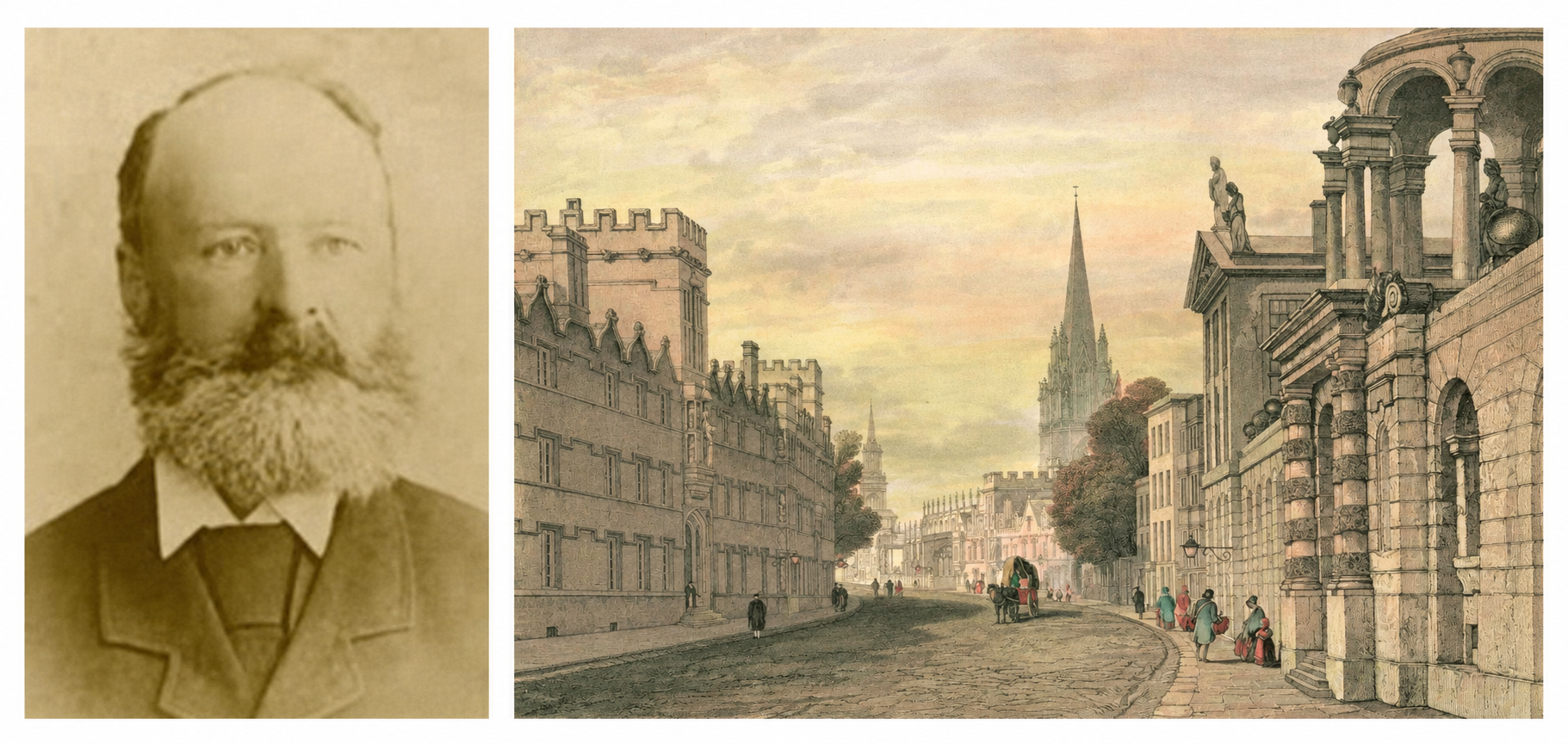
GUEST BLOG: By Robyn McLennan
"Let me introduce you to Henry Jaggar! He was a complicated guy and Richard Turnbull actually stuck up for him when things got rough... although not enough to help him out with money or support when Jane (Turnbull) Jaggar died early. We are sad to know that we never got to taste Jaggar Canterbury Ale..." - Robyn McLennan
Henry Jaggar (1831–1905)
From Oxford to the Canterbury frontier — the life of a pioneer teacher, husband and father.
An historical biography based on the family information assembled in Ancestry, our earlier genealogical research and contemporary New Zealand newspaper reports.
The central events are historical. Descriptions of the voyage, domestic life, hardships and Henry's possible thoughts are imaginative reconstructions based on the conditions of the time. They are not presented as recorded memories.
A young man looking for opportunity — 1831–1851
Henry Jaggar was born on 30 July 1831 in Oxford, Oxfordshire, England, the son of Henry Jaggar and Susanna Maria Rose.
He entered the world at a time when England was changing rapidly. The Industrial Revolution was reshaping towns, businesses and employment. Railways were expanding, manufacturing was growing, and traditional trades were increasingly competing with newer ways of making a living.
Oxford was a city of contrasts. Its university buildings and colleges represented centuries of learning, while beyond their walls lived tradespeople, labourers, servants and families whose lives were quite separate from the privileged academic world.
Henry grew up in a family of coopers. His father made and repaired wooden barrels used to store and transport beer, food and other goods. Several of Henry's siblings also entered the trade, some beginning as apprentices. Cooperage was therefore more than simply an occupation; it was a family tradition, providing practical skills and a means of earning a living.
Henry's childhood was marked by the death of his mother, Susanna Maria Rose, on 8 March 1844, when he was just twelve years old. Her death would have brought considerable change to the family household, particularly for the younger children.
Two and a half years later, on 29 September 1846, Henry's father remarried a woman named Lucy. Henry was fifteen at the time. The arrival of a stepmother introduced another change into his teenage years, although we know little about the relationship between Lucy and her new family.
Like several of his siblings, Henry followed his father into cooperage. Learning the trade would have given him practical skills and the opportunity to earn a living while still a young man. The work demanded precision, strength and an understanding of timber, as barrels had to be carefully constructed to remain watertight and withstand repeated handling.
By the age of nineteen, Henry was a young tradesman with an established family occupation behind him. Yet his future would take a very different direction.
In April 1851, when Henry was nineteen, he married Jane Turnbull, a young woman from a family whose fortunes would become closely connected with the settlement of Canterbury, New Zealand.
Jane was about three years older than Henry. Their marriage, on 24 April 1851, marked the beginning of a partnership that would carry them halfway around the world, through the establishment of schools, the raising of eleven children and the challenges of colonial life.
Within months of their marriage, Henry and Jane made an extraordinary decision. They would leave England.
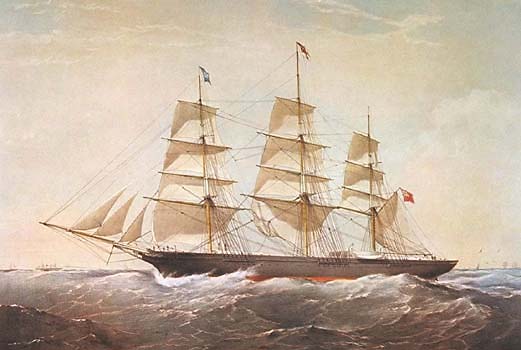
The Clipper Ship Lancashire Witch by Thomas Dutton. The Lancashire Witch was one of the many vessels built at Quebec. She was a full-rigged ship of 1574 tons and was eleven years off the stocks when she came to New Zealand. She was owned by Firnie and Co. of Liverpool and in 1863 was chartered by the Shaw Savill Co. The Lancashire Witch made her first passage to Lyttelton in 1863 and the 420 immigrants who embarked at London experienced a very trying and anxious time. Shortly after her departure scarlet fever broke out, and before reaching Lyttelton three adults and 23 children died and were buried at sea.
The voyage to New Zealand — 1851
In 1851, Henry and Jane boarded the sailing ship Dominion, bound for Canterbury, New Zealand. Travelling with them was Jane's half-sister, Fanny Ellis.
Their departure was part of a much larger family migration. Jane's youngest brother, John James Turnbull, had already made the voyage aboard the Charlotte Jane, one of Canterbury's first four immigrant ships, arriving in December 1850. Henry and Jane followed in 1851, accompanied by Fanny.
Later that year, Jane's mother, her brother Richard Turnbull and her half-sister Emma Ellis arrived aboard the Fatima. Her eldest sister, Elizabeth, also emigrated to New Zealand.
Rather than individual family members leaving England independently, the Turnbull and Ellis families appear to have made a concerted effort to establish themselves in the new Canterbury settlement. Over a relatively short period, much of Jane's family had relocated to the other side of the world.
For Henry, the circumstances were rather different. He was the first member of the Jaggar family to make the journey, leaving behind his parents, siblings and the family trade in Oxford. Although we do not know who first proposed the move, it seems likely that Jane's family connections played an important part in their decision to emigrate.
Henry would not remain the only Jaggar in New Zealand. In subsequent years, his brother Arthur Hughes Jaggar and his sister Susanna also emigrated, joining the growing family community around Kaiapoi.
What began as a journey undertaken by a newly married couple was therefore part of a much wider movement of relatives, gradually bringing two extended English families together in Canterbury.
For a couple barely into adulthood, the journey must have represented an enormous commitment.
There was no guarantee they would ever see England again.
Henry was only nineteen when they departed, celebrating his twentieth birthday aboard the ship on 30 July. Jane was twenty-three.
Their journey took them across the Atlantic and into the Southern Hemisphere. In June, the ship passed the remote islands of Trindade and Martin Vaz in the South Atlantic, east of Brazil. A fellow passenger, Janetta Maria Cookson, recorded these landmarks in sketches made during the voyage.
For the newly married couple, life aboard ship would have been a considerable adjustment. Accommodation was confined, personal belongings were limited, and daily life was governed by the weather, the ship's routines and the food and water carried for the journey. There would have been long periods of monotony, punctuated by rough seas, changes in temperature and the occasional excitement of sighting land.
After nearly sixteen and a half weeks at sea, the sight of the Canterbury coastline must have been a welcome moment. On 30 August 1851, the Dominion arrived at Lyttelton, bringing Henry, Jane and her half-sister Fanny Ellis to the beginning of their lives in New Zealand.
When they arrived at Lyttelton in 1851, Canterbury's organised European settlement was still in its infancy. The first four Canterbury Association ships had arrived only the previous year.
Christchurch was little more than an emerging settlement, surrounded by wetlands, open plains, rough tracks and developing farms.
There was work to be done, institutions to establish and communities to build.
For a young couple prepared to adapt, opportunities existed that might have been difficult to obtain in England.
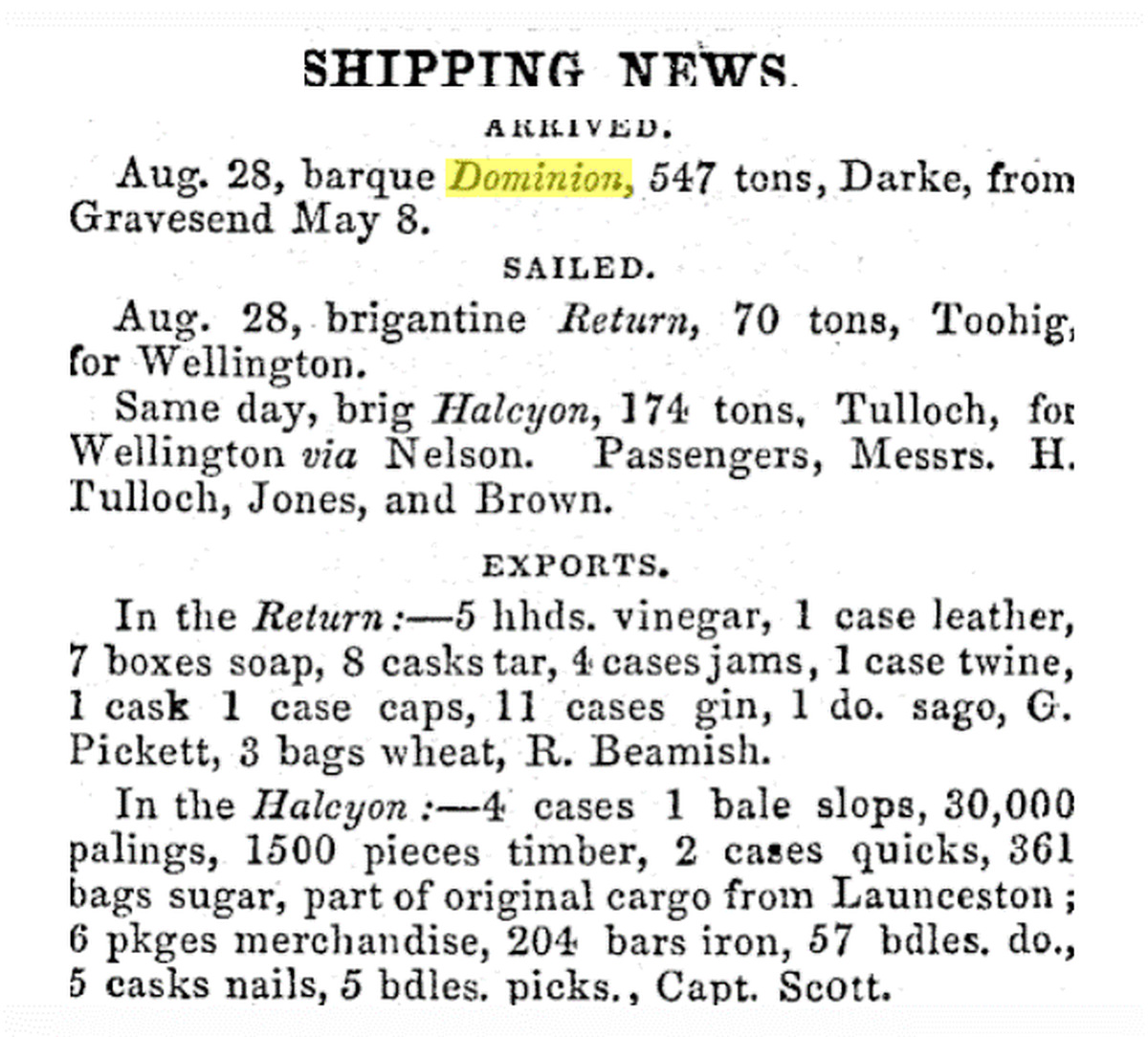
SHIPPING NEWS. Lyttelton Times, Volume I, Issue 34, 30 August 1851, Page 4 https://paperspast.natlib.govt.nz/newspapers/LT18510830.2.7
Building a life in Canterbury — the 1850s
Henry and Jane spent their early years in the Lyttelton, Christchurch and Kaiapoi districts.
Their family began to grow, bringing the challenges of raising children into an environment where houses, transport and community services were rudimentary.
Jane became involved in education and religious instruction. Henry's 1905 obituary specifically remembered her as having conducted the first Sunday school in Christchurch.
Teaching was becoming an important part of their lives, but Henry also explored other ways of earning a living.
Henry initially continued working in trades closely connected with his upbringing. By 1854, he was associated with the Avon Brewery in Christchurch, and in 1859 he was advertising beer for sale from the Kaiapoi Brewery.
The Kaiapoi venture appears to have been an attempt to establish himself in business. Henry advertised different grades of ale, along with malt, hops, grain and yeast, suggesting that the brewery supplied both finished beer and brewing ingredients.
However, his business ambitions were not without difficulties. Henry subsequently experienced insolvency, a significant financial setback for a young man trying to support his growing family. The precise circumstances remain unclear, including whether debts associated with the brewery contributed to his financial problems.
By the time of an insolvency notice placing Henry and Jane at the schoolhouse on Lincoln Road, Henry was described as a cooper rather than a brewer. This suggests he had returned to the family trade, perhaps seeking a more reliable means of earning a living.
The family's connection with the schoolhouse also marks an important development. Jane was becoming involved in teaching, an occupation that would eventually provide both husband and wife with a new direction.

Photograph of Flockton Well near the corner of George St and the Great North Road (Stafford St), between April and December 1868. It is viewed looking along George St to the west. The original wooden Bank of New Zealand building is visible on the corner (centre of image), with Clarkson and Turnbull across the road (left of centre) and the Club Hotel and Flockton Well in the foreground at the left-hand side of the image. There is a man standing on the well and two boys in front of it. The Russell Ritchie and Co. building is on the right corner. The photograph is mounted on a card backing with the photographers' details and "View Up George St., Timaru." handwritten on lower edge. There are also handwritten labels on the top and lower edges of the mount (with small arrows pointing to the appropriate site) that identify the buildings. - nzmuseums.co.nz/3359/flockton-well-corner-of-george-st-and-the-great-north-roadSouth Canterbury Museum
A growing family and a move south — 1860s
By the early 1860s, Henry and Jane were raising an increasingly large family.
The surviving family records identify children including Catherine, Mary Maria, Arthur Henry, Edith Jane, Leonard Rose, Bertha Maud, Frederick Charles, Hephzibah, Henrietta, Keber Richard and Rose May Turnbull.
Their children were born across the places where the family lived and worked.
Arthur Henry was born at Kaiapoi in 1855. Hephzibah was born in Christchurch in June 1864. Later births, including Henrietta in 1865, Keber Richard in 1867 and Rose May in 1869, place the family in Timaru.
The surviving evidence does not yet establish every move with precision, but the family was in Timaru by the middle of the decade.
Henry and Jane were charged with the establishment of the town's early public school.
Timaru was developing as a coastal trading settlement serving the surrounding agricultural districts. Roads were difficult, transport was slow, and the town's institutions were being established as its population increased.
A school was one of the most important services a growing settlement could possess.
For Henry and Jane, this appointment may have represented a considerable achievement.
They were entrusted with the education of the town's children, despite working in a profession that was becoming increasingly demanding.
Their responsibilities would have extended far beyond reading and arithmetic.
Children came from families with different circumstances. Some attended regularly; others were needed at home or on farms. Lessons, classroom discipline, basic supplies and parental expectations all needed managing.
Meanwhile, at home, Henry and Jane had their own large family to support.
In September 1868, an official report recorded approximately 117 pupils attending the Timaru school, under the charge of Mr and Mrs Jaggar.
It was a substantial responsibility.
And it was about to become considerably more complicated.
The Timaru school controversy — 1870–1873
As Timaru grew, so did its expectations of education.
Parents and school committees increasingly wanted more advanced teaching, qualified instructors and better facilities.
The development of a formal education system created difficulties for people who had entered teaching through experience rather than recognised qualifications.
Henry found himself caught in this transition.
By December 1872, the school had approximately 353 children enrolled, with daily attendance varying between 270 and 298. The school committee was pressing the Board of Education for additional staff and higher standards.
Its written report was particularly uncomfortable for Henry.
The committee stated that he, then serving as an assistant master, did not possess the qualifications required to take charge of the school if the headmaster was absent.
It also complained about the standard of teaching available under existing salary arrangements.
For a man who had helped run the original school, this cannot have been an easy position.
Henry had been part of the institution's early development. He and Jane had taught children when Timaru was much smaller, with fewer resources and less formal oversight.
Now, the institution had grown beyond the system in which they had established themselves.
More formally trained teachers were arriving, qualifications were being scrutinised, and the school committee was placing its criticisms in official correspondence.
There was also a dispute about Henry's employment or financial entitlements.
In September 1872, the Board of Education considered a claim he had made against the Timaru School Committee. A committee of inquiry concluded that his claim had no sufficient grounds, and the Board accepted that finding.
The precise nature of that claim needs further examination before we can say what Henry was fighting for.
But the existence of the dispute suggests that all was not harmonious between him and the people responsible for administering the school.
One can imagine the frustration of a man who had worked in difficult pioneering conditions, only to be told that his experience was insufficient for the responsibilities now required.
Yet there is another perspective.
The committee was responsible for hundreds of children. As educational expectations increased, it had legitimate reasons to insist upon suitable qualifications.
Henry's experience and the committee's concerns could both have been genuine.
This is what makes the episode so revealing. It was not simply a disagreement between individuals; it reflected the transformation of colonial education from a largely informal arrangement into a more professional system.
There were also positive reports about the family's contribution.
In 1871, Henry was publicly credited with helping organise a successful children's school entertainment. Several of his children received prizes, including Leonard, Bertha and Frederick.
In 1873, an inspector praised the progress of classes taught by Jane and daughter Edith. Jane's needlework instruction was also commended.
The Jaggar family had become deeply involved in the school's daily life.
But that chapter was coming to an end.
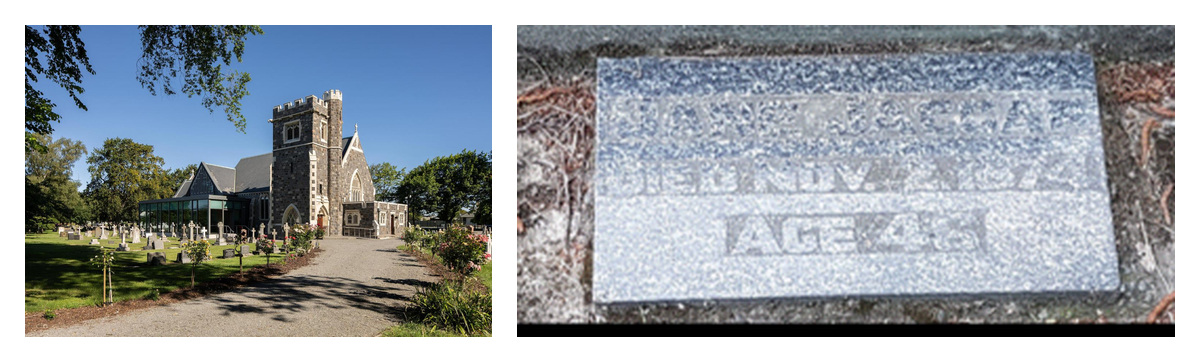
St Peter’s Church, Upper Riccarton, Christchurch, where Jane Jaggar was buried on 2 November 1874, following her death on 30 October, aged just 46. The photograph on the right shows her grave marker.
The loss of Jane — 1874
The years following the Timaru school disputes brought a far more personal upheaval.
In 1873, the Jaggar family's longstanding association with the school was coming to an end. By this time, Jane and their daughter Edith had also been working as teachers.
After approximately a decade connected with the Timaru school, the family returned to the Christchurch district.
Then, on 30 October 1874, Jane died, aged just 46.
Jane was buried at St Peter's Church, Upper Riccarton, on 2 November 1874.
For Henry, the death of his wife meant losing not only his marriage partner of 23 years but also the woman who had shared his work, his migration and the enormous task of raising their children.
Eleven children had been born to the marriage.
The youngest, Rose May Turnbull, was only five years old. Keber Richard was seven, Henrietta eight, and Hephzibah ten.
Other children were older, but several still needed care and financial support.
What followed must have been difficult.
The household that Henry and Jane had built together was now without its mother. The older daughters may have helped care for their younger siblings, as often happened in large Victorian families, but we cannot assume who took on those duties.
Henry also faced the problem of maintaining an income.
A schoolmaster moving from place to place — 1875–1880s
Henry did not abandon teaching.
During the years following Jane's death, he held positions in smaller schools in Canterbury, particularly around Banks Peninsula and the districts surrounding Christchurch.
These communities were very different from the expanding town of Timaru.
In the nineteenth century, Banks Peninsula was a landscape of steep hills, isolated bays, narrow tracks and small coastal settlements.
Travelling between communities could involve walking, riding horses or using boats. The roads were frequently difficult, especially in wet weather.
Schoolmasters in small settlements were expected to be resourceful.
A single teacher might be responsible for children of many ages, teaching everything from basic letters and numbers to geography, history and writing.
There was also considerable attention paid to attendance, behaviour and the moral development of pupils.
Parents and education boards expected results, even when the facilities were rudimentary.
For Henry, moving from one school to another may have offered employment and a degree of independence that was increasingly difficult to find within large, highly organised schools.
One particularly interesting detail is that Henry remained employed in the education system despite the criticism of his qualifications at Timaru.
An official education return for 1883 places him at Port Levy School, earning approximately £128 per year.
His experience apparently retained value, particularly in smaller schools.
And the family connection with education continued.
His daughter Hephzibah also worked in teaching. By 1887, education records list Henry and Hephzibah together at French Farm School on Banks Peninsula.
This offers a glimpse of what may have been an important relationship between father and daughter.
Perhaps Henry assisted Hephzibah in developing her teaching abilities. Perhaps she helped him with the practical work of running a small school.
Whatever the circumstances, their professional association suggests that education had become a family occupation, continuing well beyond Jane's death.
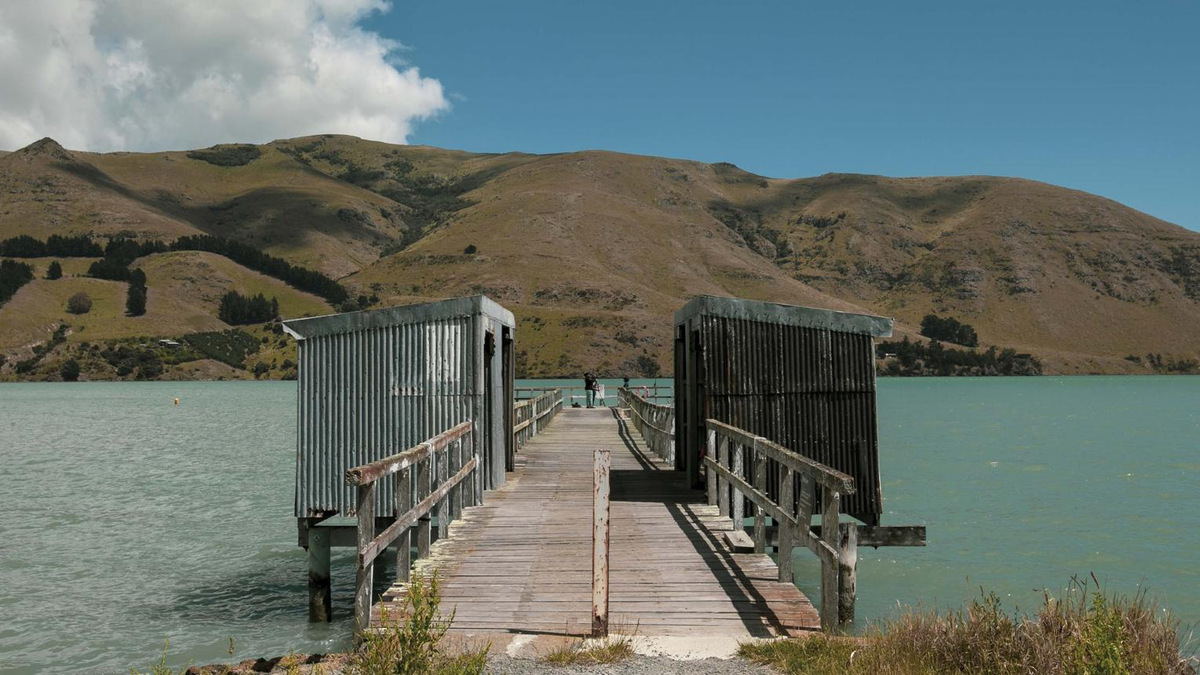
Port Levy, Banks Peninsula
The children grow up — and the family spreads apart
As Henry grew older, his eleven children began establishing adult lives of their own.
Some remained in New Zealand, married and raised families. Others travelled further afield.
Two of their sons, Arthur Henry Jaggar and his younger brother Keber Richard Jaggar, followed particularly unusual paths.
Arthur Henry initially worked in the postal service in New Zealand. However, his early adult life was marked by financial difficulties, including bankruptcy, and a marriage that did not last. He eventually moved to Australia, where he married Mary Loveland McLean and took the McLean surname, adopting the name Reginald Horace McLean.
Remarkably, his younger brother, Keber Richard, also moved to Australia and adopted the name Reginald Horace McLean. He married a different woman and established his own family.
Both brothers therefore left behind the Jaggar surname, and their descendants became part of the McLean family lines in Australia and beyond.
The reasons for these unusual changes of identity remain unknown. Arthur Henry's financial and marital difficulties may have contributed to his desire for a fresh start, but this does not explain why his younger brother adopted the same name.
Later years — 1890s to 1905
By the final years of the nineteenth century, Henry had lived through extraordinary changes.
The young man who had arrived in Canterbury in 1851 had seen Christchurch develop from an emerging settlement into an established city.
Timaru, once a small coastal community, had grown into an important regional centre.
New Zealand's educational system had changed dramatically. Where once communities relied upon anyone with the knowledge and ability to teach, schools increasingly employed formally trained and examined teachers.
Henry had participated in that transition, sometimes successfully and sometimes controversially.
His later years appear to have been quieter.
He had retired from active school teaching and was living among members of his family.
One obituary reported that he had withdrawn from the teaching profession many years earlier, although the dates given in that account are difficult to reconcile with his appearance in official education records during the 1880s.
In the final period of his life, Henry returned to Timaru — the town where he and Jane had once been responsible for the education of its children.
We do not know precisely what his daily routine looked like.
Perhaps he took walks around the town, recognising places that had changed beyond recognition since his arrival in the 1860s.
Perhaps former pupils greeted him in the street.
Some of the children he had taught would now have been parents or grandparents themselves.
He may have enjoyed the company of his family, reading, gardening or attending church.
These are possibilities rather than documented details, but they offer a way of picturing an elderly man whose life had been so closely connected with the development of colonial Canterbury.
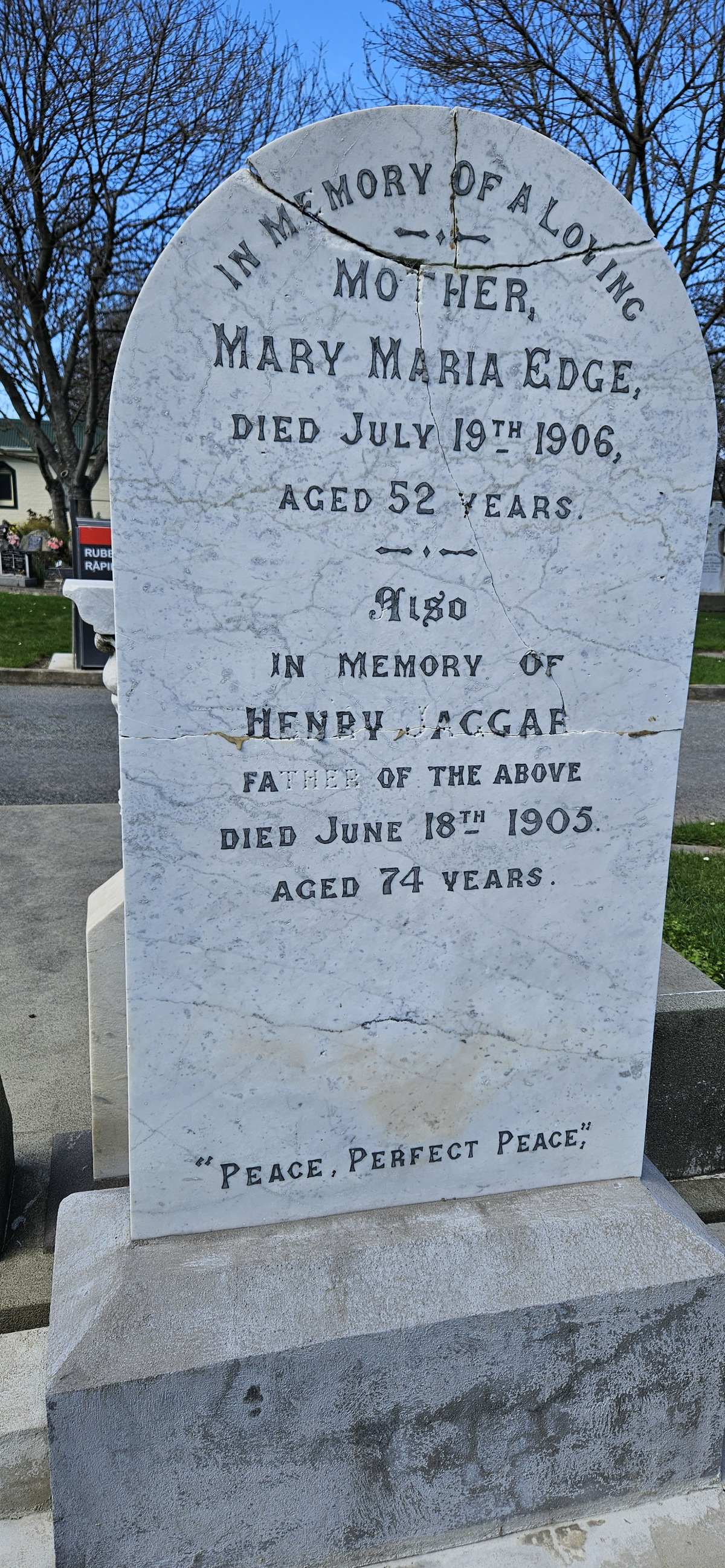
The death of Henry Jaggar — June 1905
Henry died at Timaru on Sunday, 18 June 1905, aged 73, shortly before his seventy-fourth birthday.
His death was reported in both the Timaru Herald and the Christchurch Press.
The Timaru Herald remembered Henry and Jane as the first master and mistress of Timaru's first public school.
The report also recalled their arrival aboard the Dominion in 1851 and Henry's later employment in Canterbury schools.
The Press similarly noted his contribution to early education and described his long residence in New Zealand.
He had spent more than half a century in New Zealand.
He left behind a large family, and through his children and grandchildren, a legacy extending across New Zealand and Australia.
His life had begun in Oxford, surrounded by institutions of learning that were already centuries old.
It ended in Timaru, where he had helped build one of the institutions that a new community needed.
It was a life of migration, adaptation, work, family, loss and persistence.
Henry Jaggar's story was not necessarily one of remarkable wealth or public recognition. It was the story of a man who repeatedly found ways to make a living and contribute to the communities around him, even as the world changed and the expectations placed upon him changed with it.
Family chart
Henry Jagger 1805 - 1806
Henry Jaggar 1807 - 1856
William Jagger 1808 - 1856
Mary Ann Jagger 1812 - 1834
William Jaggers
M
Mary Ann Walker
Charles Rose
M
Susannah Thatcher
Mary Rose 1796 - 1849
Elizabeth Rose 1798 -
Frances Rose 1800 -
James Rose 1802 -
Charles Rose 1804 -
Susanna Maria Rose 1808 - 1844
Charles Thomas Rose 1811 - 1819
Martha Ann Jaggar 1829 - 1834
Henry Jaggar 1831 - 1905
Arthur Hughes Jaggar 1833 - 1881 (NZ)
Charles Jagger 1835 - 1884
Susannah Elizabeth Jaggar 1837 - 1890 (NZ)
Mary Hughes Jaggars 1838 - 1841
Aaron Nicholls Jaggar 1841 - 1842
Mary Ann Jaggar 1843 - 1844
Jane Turnbull 1828 - 1874
Catherine Jaggar (Worthington)
Mary Maria Jaggar (Edge)
Arthur Henry Jaggar / Reginald Horace McLean
Edith Jane Jaggar (Jamieson)
Leonard Rose Jaggar
Bertha Maud Jaggar (Bell)
Frederick Charles Jaggar
Hephzibah Jaggar
Henrietta (Etta) Jaggar (Gully)
Keber Richard / Reginald Horace McLean
Rose May Turnbull Jaggar (Hunt)