
By Roselyn Fauth

Wai-iti Rd Gate - Photo Roselyn Fauth
I was dropping a friend home the other day, Dr Andrew Paul Wood, and he pointed out an interesting gate. I know that sounds random, but he was right, the gate was interesting. After dropping him off I noticed an identical one on Grey Road leading to what was probably the entrance to the headmasters house of Main School. I thought to myself... there must be a story here... but I needed a lead, somewhere to start the history hunt, so I reached out to another friend Christopher Templeton who sent me a link to a Museum photo of the gate. The photo depicted a house, the gate and a couple in a car in the drive way. The photo caption gave me some clues of what was going on, and with a few google searches I was able to biuld some more leads and start a history hunt. Today's blog is quite random, a bit like the conversation about a gate. As random as it is, it has been an interesting history hunt... so here is my blog on a domestic gate and its links to stories of the past.
This gate is not grand, or famous... its just interesting. Most people probably idle next to it as they wait for the traffic lights on Wai-iti Rd and the Evans Street Highway to flick to green. That's when I noticed them.

Wai-iti Rd Gate - Photo Roselyn Fauth

Wai-iti Rd Gate - Photo Roselyn Fauth
Thank you to Christopher Templeton who shared a link to the South Canterbury Museum's online catalouge of the wall and gate many moons ago. A couple sit in an early motor car at a gate on Wai-iti Road, Timaru. They are posed and still for the photo. The car is small, open to the elements. The more I studied the photo, the more I realised that the gate might matter. It was not just part of the background. It was part of the story, and one of the remaining elements of this time in our local history. It is a threshold between home and road. Between the familiar world of a suburban house and the promise of new technology. of the looming motor age.
In the car is Frank and Maud Brown at their Wai-iti Road home.
A report in the South Canterbury Times on 14 April 1900 recorded that the Canterbury Farmers’ Co-operative Association, acting through auctioneer J. Mundell, had sold John Meikle’s Wai-iti Road property to Mr Francis Brown. It also noted that there was “a keen demand for property in the suburbs of Timaru”. This notice places Francis Brown at Wai-iti Road years before the photograph was taken, and it shows that this was already a desirable suburban address at the turn of the century. The house in the photograph was not an incidental backdrop, it is a snap shot of a wider story of suburban growth, ambition, and settlement in Timaru.
I think this is Francis Sherman Brown, and his wife as Maud Augusta Brown, née Boddy. There are reports of a Frank Brown living here, and I think Francis and Frank are the same person.
Interestingly I found a marrage notice for the couple in Greymouth. My sister in law's mother was a Boddy. another side quest to follow for another day.
The surname Meikle rung a bell, then I remembered I had written a blog about him and his wife. Sadly Janet was recorded in the newspaper as the first person to die due to a motor car. They were living at Table Downs in Washdyke Valley at the time when the tragedy struck. Janet Meikle was killed when their 8 hp De Dion Bouton overturned on the farm, making her the first person in New Zealand to die in an accident caused directly by a car. John Meikle survived with a fractured thigh. The accident is often remembered nationally as an early motoring milestone, but it is also part of Timaru’s local story. It connects Meikle’s life with two transport eras at once: the age of coaches and hotels, and the beginning of motoring. The first hotel on the Grosvenor site was erected by Meikle in 1875–76. It was a two storey brick hotel designed by Francis Wilson, opened in June 1876, was extended along Beswick Street in 1877, and remained the largest hotel in Timaru for many years. The present Grosvenor, the building still standing on the corner today, is the 1915 replacement, not Meikle’s original hotel. c. 1869: A Cobb stable associated with John Crammond stood on the future Grosvenor site before Meikle’s hotel was built there. A 1906 newspaper report, written after the death of his wife Janet, likewise remembered him as “well-known as a driver of Cobb and Co.’s coaches in the early days” before he became proprietor of the Grosvenor for many years. His business life in Timaru was active rather than settled. In June 1883 Meikle advertised that he had let the Grosvenor Hotel to J. D. Kett, thanking the public for their support over the previous seven years. By late 1884 he had taken over the Commercial Hotel on Main South Road. Then, in 1888, he announced that he had returned to Timaru and resumed the proprietorship of the Grosvenor.
1915, after Meikle’s original era on the site: The first Grosvenor Hotel was demolished and replaced by the present building. And interesting co-incidence is that the brick house in this photo is attributed to architect James Turnbull. James also design the Grosvenor.
The next clue I found when hunting for the couples history, was that on 5 September 1911, the Timaru Herald reported that Mr Frank Brown, after eight and half years in the land department of the Canterbury Farmers’ Co-operative Association, had left Timaru for Sydney. Before he departed, fellow employees gathered in the board room and presented him with a travelling outfit. It is only a short personal item, but it reveals a man who was known, respected, and established in Timaru’s professional world. He was not just someone who happened to own an early car. He was part of the social and commercial fabric of the town. Frank Brown’s purchase of property in 1900 and his later role within the CFCA place him squarely within a growing suburban and business Timaru.

Mr and Mrs Francis Brown, posed in their 1905 Darracq, alongside their home on Wai-iti Road, Timaru, circa 1907. A handwritten note on the verso reads: "Mr & Mrs Francis Brown then living at Wai-iti Rd. Car -1905 Darracq (later used by CFCA as a garage truck up till 1940 at least)." South Canterbury Museum - Catalogue Number 1382
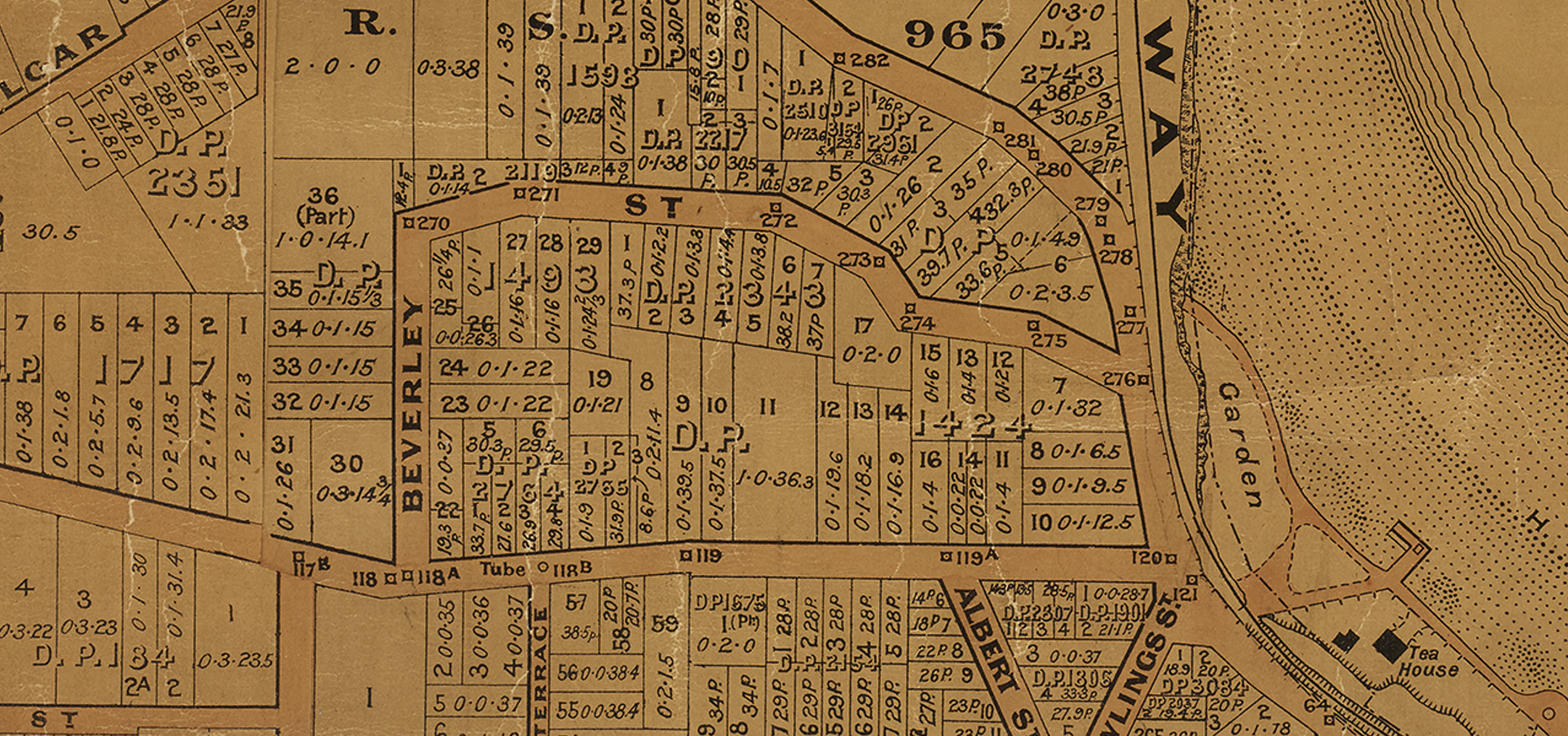
1911 Borough of Timaru, South Canterbury
Held by: Archives New Zealand/Te Rua Mahara o te Kāwanatanga, Christchurch Regional Office
https://maps.recollect.co.nz/nodes/view/336
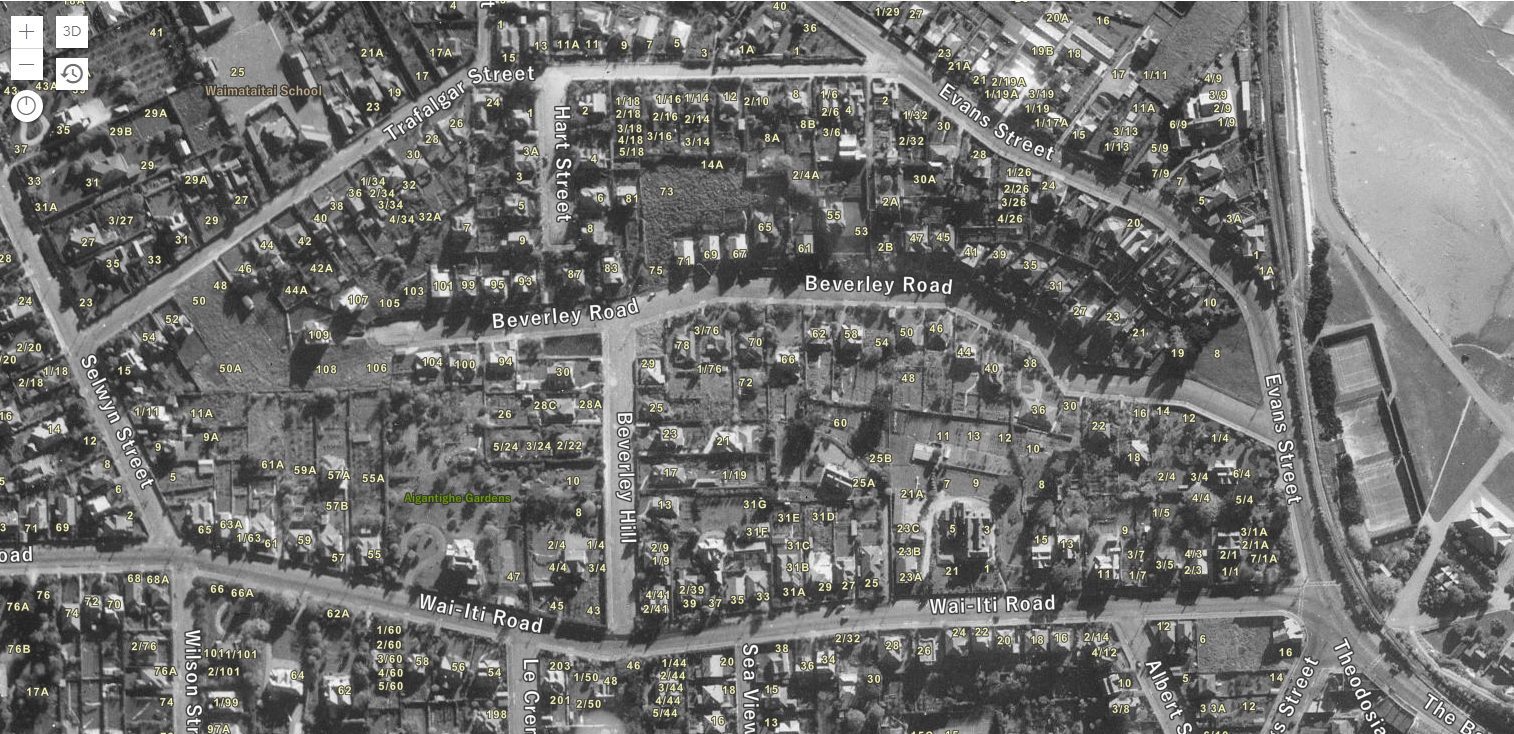
https://propertysearch.canterburymaps.govt.nz/property?navigateExtent=1456029.162219735,5080064.523050233;1462163.2337396124,5086227.258455716
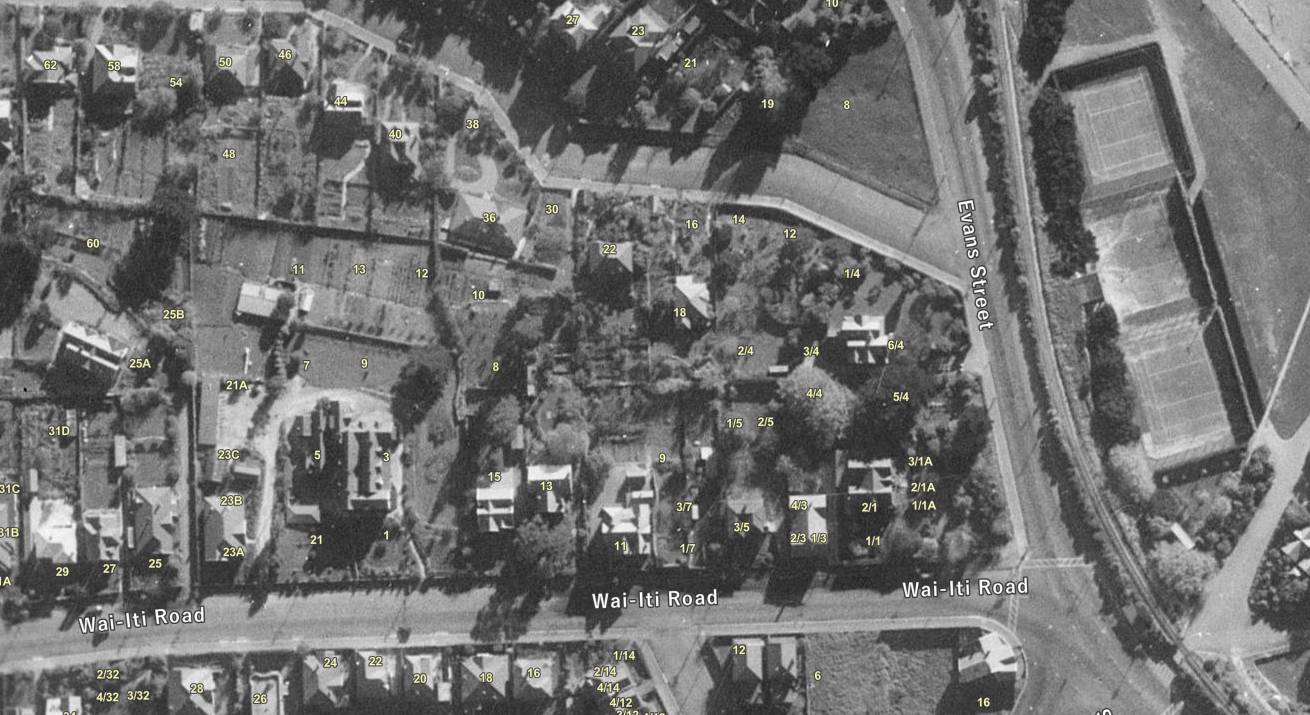
1935 1939 Wai iti Rd Timaru close up
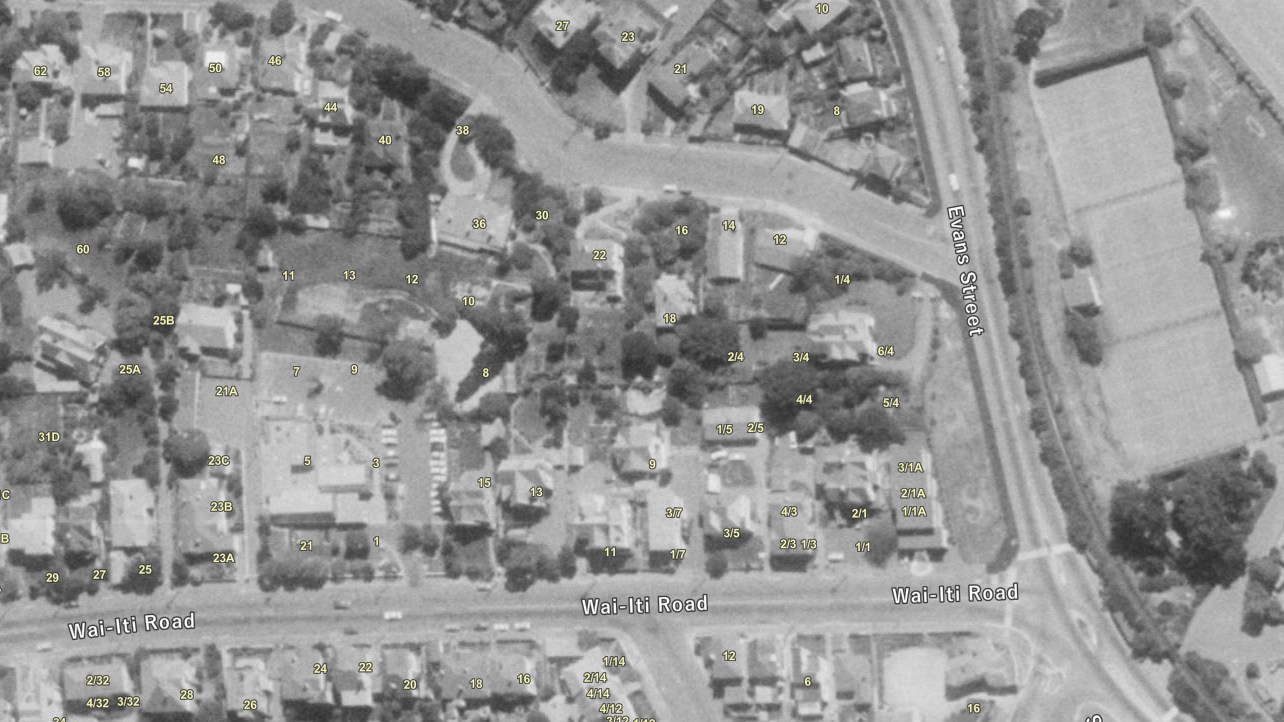

2000s Wai iti Rd Timaru close up

A pictorial celebratory card featuring an image of Mr and Mrs Francis Brown sitting in a 1901 Oldsmobile motor car in front of a stone building, circa 1903. Printed along lower edge of dark green card mount in gold lettering reads: "With Best Wishes" indicating the card has possibly been used as a Christmas card or similar. The verso bears a hand-written notation that reads: "Mr & Mrs Francis Brown, then living at Wai-it Rd. Car is a 1901 Oldsmobile with tiller steering and was one of 5 or 6 of these cars - the first cars in South Canterbury apart from Cecil Woods locally made car." Photographer Ferrier, William, photographer, Timaru. South Canterbury Museum - Catalogue Number: 1358
A Timaru Herald advertisement of 30 July 1920 looked back to the earliest days of motoring in Timaru and described the first car on the town’s “motor horizon” as the 5 h.p. single-cylinder Oldsmobile bought by Frank Brown in 1902. It added that Mr Duncan Scott brought from the Old Country a 7 h.p. single-cylinder Oldsmobile in the same year. The advertisement was placed by R. C. Robinson of Garage Royal, Sophia Street, and its purpose was to sell a new shipment of Oldsmobiles. That is precisely what makes it so interesting. It was not neutral history. It was memory used as persuasion. To market a modern Oldsmobile in 1920, Robinson reached back into local memory and invoked Frank Brown’s early car as part of Timaru’s own motoring beginnings.
This tells us that Frank Brown’s car was remembered nearly twenty years after it first appeared. The Browns’ car was notable not because it was grand or luxurious, but because it was early. It belonged to that first local moment when the motor car still seemed novel, slightly improbable, and worth talking about.
The wider history of Oldsmobile helps explain why that mattered. The company had been formed by Ransom E. Olds in the late nineteenth century, and its early single-cylinder cars helped make motoring more practical and more widely imaginable. These were small, simple, pioneering vehicles from the opening chapter of the motor age. So when one appeared on Wai-iti Road, it connected Timaru not just to a local fad, but to a much larger global shift in transport and technology.
And that is why the photograph becomes so rich - more than a snap shot, its a post in our timeline.
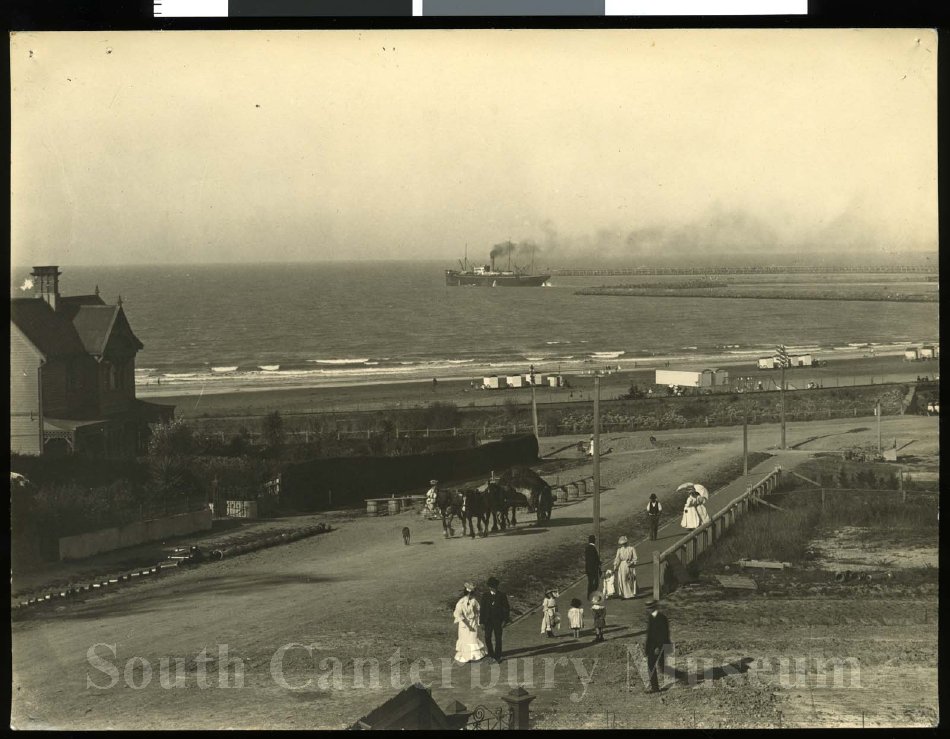
The lower end of Wai-iti Road, Timaru, with Caroline Bay and the harbour in the background, circa 1908. Depicts several people and a horse drawn wagon, on Wai-iti Road. On Caroline Bay the bathing sheds and swings are visible, while a ship exits the harbour in the background. Excavations and drainage pipes along the side of the road suggest that this was taken during James Craigie's mayoralty when the previous 'open drains' were piped underground. Handwritten on reverse "Wai-iti Road & Evans St early 1900s". Catalogue Number 2312 https://timdc.pastperfectonline.com/photo/02CF8A05-F0DF-4617-9164-339245655591
Frank and Maud Brown were not standing in a factory or at an exhibition. They were at home. The car is not shown as abstract progress. It is shown beside a gate, beside a house, beside the ordinary things that make up a life.
There is still a small puzzle in the record. In 1929, the Timaru Herald referred to a model of the first Oldsmobile sold in Timaru as dating from 1904, not 1902. That discrepancy reminds us that memory can shift, that promotional writing can simplify, and that local history often survives in overlapping versions rather than a perfectly neat line. I do not think that weakens the story though. I think it strengthens it. It reminds us to keep asking questions, to notice when details do not quite align, and to resist the temptation to tidy the past into something smoother than it really was.
A gate on Wai-iti Road leads to a property sale in 1900...
A property sale leads to Francis Brown...
Francis Brown leads to Frank Brown of the CFCA...
Frank Brown leads to an early Oldsmobile...
That car leads to the memory of Timaru’s first motor age...
And all of it leads back to a couple sitting quietly at their gate, as if none of this could possibly matter so much.
But it does.
Timaru had already been shaped by movement for generations. Māori pathways and coastal knowledge came first. Then surfboats, ships, horses, drays, and rail all helped define how people and goods moved through the district. The motor car did not erase those older worlds, but it began to alter the way people imagined distance, convenience, independence, and status. A suburban gate on Wai-iti Road no longer opened only onto the familiar patterns of horse-drawn life. It now opened onto something faster, noisier, and more modern.
So what did Frank and Maud think as they sat there?
Did they see the car as practical, thrilling, fashionable, or simply useful? Did neighbours gather at the fence to watch? Did children stare? Did horses shy when it passed? Did they sense that this small vehicle, parked so neatly beside their gate, was part of a change much larger than themselves?
We cannot know all of that. But we can know enough. We can know that Frank Brown bought the Wai-iti Road property in 1900. We can know that he later worked for years in the CFCA land department before leaving for Sydney in 1911. We can know that his early Oldsmobile was remembered in 1920 as one of the first cars on Timaru’s “motor horizon”. And we can know that the gate in the photograph is more than timber and hardware. It is a marker of transition.
That is the word I keep coming back to: transition. The gate marks the crossing between one world and another. Frank and Maud Brown are seated right there at that crossing point. Behind them is home, property, and a carefully made place in Timaru. Before them is the road and the future. The photograph holds both at once.
Sometimes change arrives quietly, beside a gate on Wai-iti Road, in the shape of a small early motor car and a couple composed enough to sit still while the future waits beside them.
That is what makes this photograph so valuable now. It is not simply a record of Frank and Maud Brown. It is a way into Timaru’s past. It shows us suburban growth, professional identity, domestic life, local pride, early technology, and the way a community begins to absorb a new age. It reminds us that history is not only found in big events. Sometimes it is hidden in details. In a gate post. In a handwritten note. In the way one ordinary image can open into a much bigger story.
That is why I keep coming back to the gate.
Because once you notice it, you cannot quite unsee it.
It becomes the hinge of the whole image. The place where home met road. The place where local life met global invention. The place where Frank and Maud Brown sat, knowingly or not, at the edge of Timaru’s motor age.
South Canterbury Times 14 April 1900 page 2 COMMERCIAL The Canterbury Farmers’ Co-operative Association, limited (per J. Mundell, auctioneer), report having sold on account Mr John Meikle, his property situated on Wai-iti road, to Mr Francis Brown, at a satisfactory price. At present there is a keen demand for property in the suburbs of Timaru.
TH 5 September 1911 page 5 PERSONAL ITEMS Mr Frank Brown, who for the last 8 1/2 years has been connected with the land department of the Canterbury Farmers’ Co-operative Association, left yesterday for Sydney. On Saturday the employees of the Association met Mr Brown in the board room, and presented him with a travelling outfit. The general manager (Mr. J. P. Newman) made the presentation.
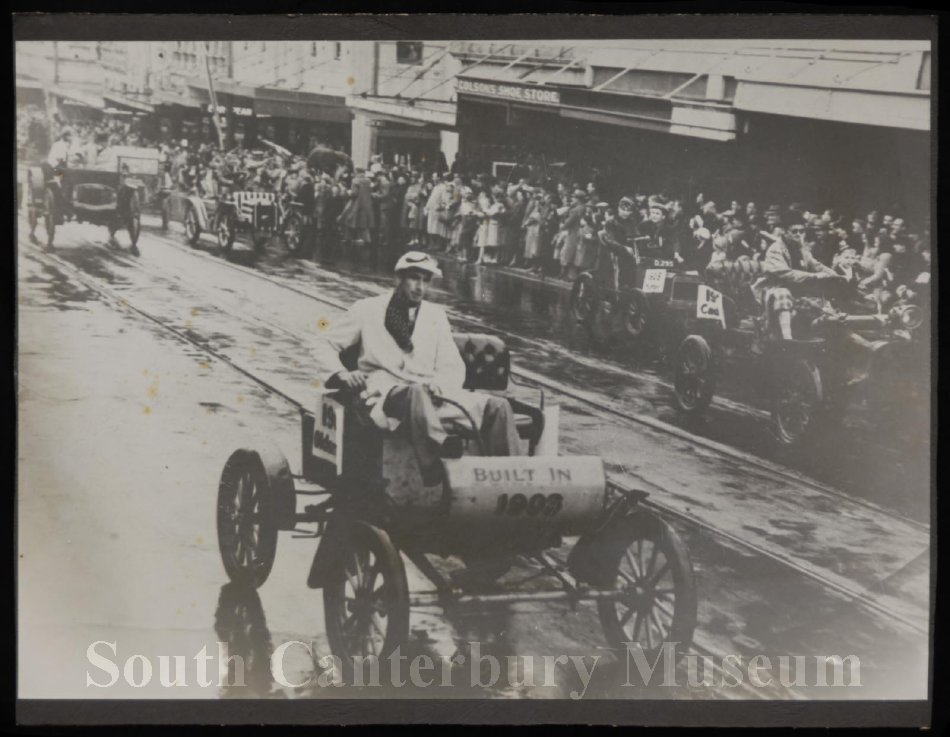
201316611 Jack Little driving a 1903 Oldsmobile Dunedin The Dominion Motors Jack Little in Dunedin with 1903 Oldsmobile now at Southwards On loan for day. South Canterbury Museum 2013/166.11
https://timdc.pastperfectonline.com/photo/09357C91-5737-4958-AF57-041422771978

https://paperspast.natlib.govt.nz/newspapers/THD18710816.2.15.5?items_per_page=100&query=Wai-iti&snippet=true&sort_by=byDA&title=SCANT%2CTEML%2CTHD%2CWDA
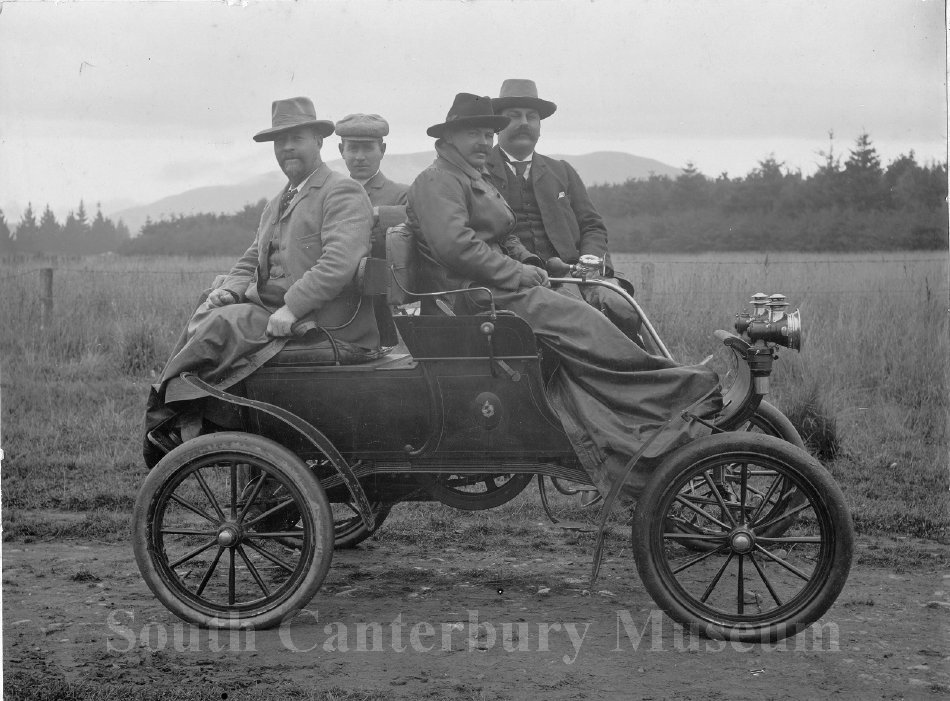
Four Waimate County Councillors pictured in an Oldsmobile motor vehicle, pictured while on a tour over Burkes Pass into the Mackenzie and through the Hakataramea Pass to Waimate in March 1904.
Handwritten on the verso is: "Tour of Waimate County Councillors. Waimate, Fairlie, Dalgety, Hakataramea, Redcliff, March 5th, 6th, 7th, 8th, 9th, 10th, 1904. 4-1/2 hp Oldsmobile motorcar. County Chairman R H Rhodes, Cr Geo Lyall, County clerk[?] C.P Bremmer, S. Clark, Driver. From [----?] from Wm P. Black, County Organizer E A G Word[----], 8th Nov 1957." Lyall, George, 1849-1925 Clarke, Sam Rhodes, Robert Heaton, 1857-1918 Bremner, Charles Edward, 1855-1940 -South Canterbury Museum Catalogue Number 1385
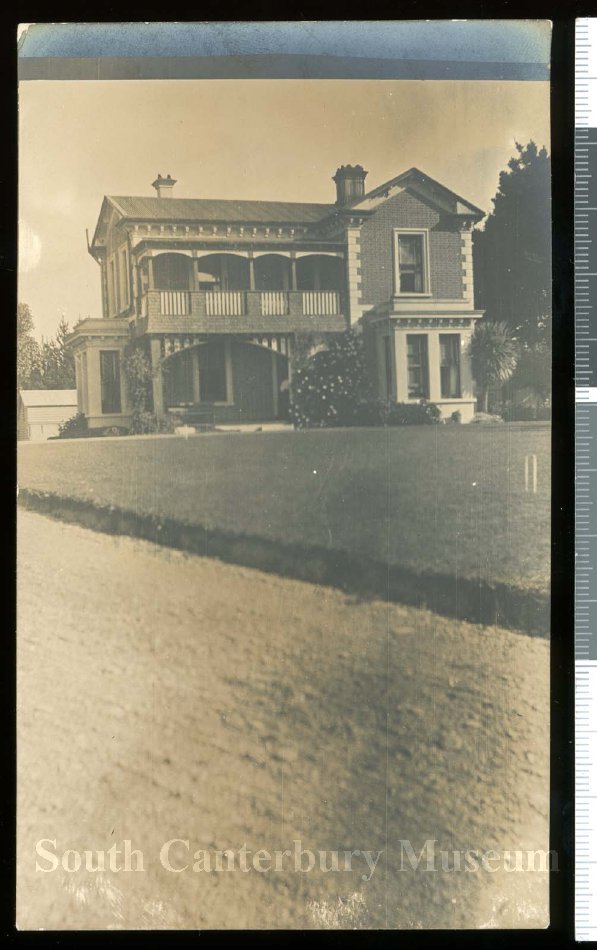
Catalogue Number 2017/020.06 https://timdc.pastperfectonline.com/photo/6B3980BA-8A9E-4D35-A2D9-120307722200
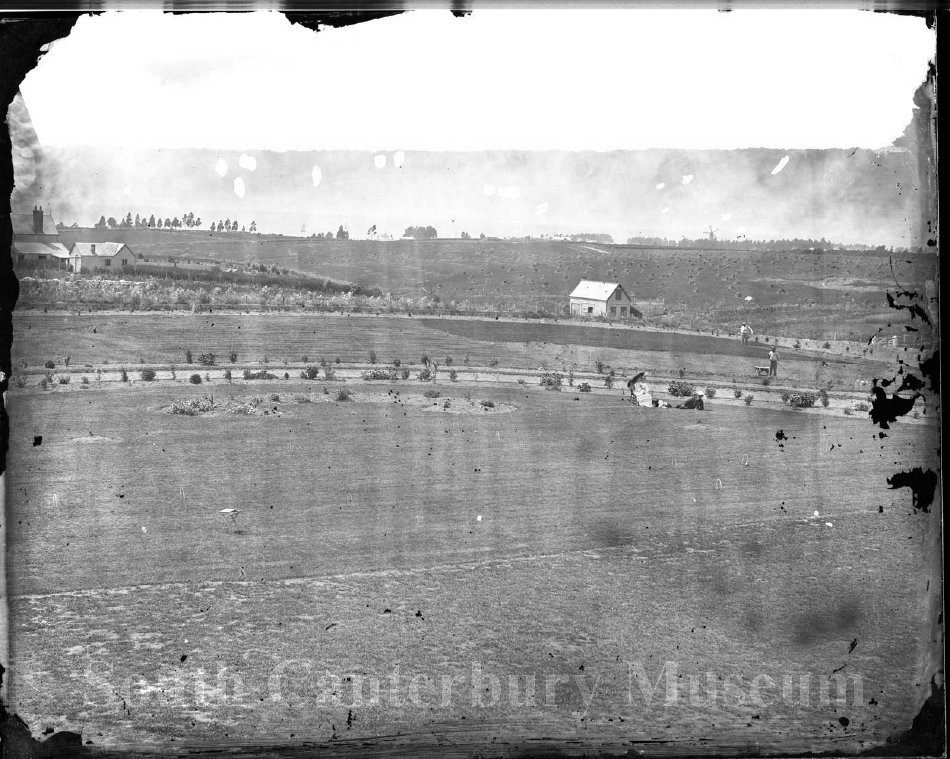
Timaru as viewed from Edward Sealy's home Southerndown South Canterbury Museum 6105.
Depicts a view of a couple and their dog posed on a manicured lawn and relatively young garden. Behind them, and beyond a driveway, are a pair of gardeners, one with a rake and wheelbarrow, the other with a scythe. Beyond them is an outbuilding and adjacent fenced animal enclosure (chickens maybe). On the left is a wooden homestead complex.
In the mid-ground the view passes over a large field with stooked crops towards Timaru in the background. The five-bladed Parr's windmill appears toward the left along with the rooves of houses in the town, and closer to the centre the Timaru flagstaff can just be discerned. On the left a homestead appears somewhat closer, probably connected to the partially visible road in the right mid-ground (Wai-iti Road?). In the very distance at least three tall sailing vessels can also just be made out moored off the coast within the roadstead.
https://timdc.pastperfectonline.com/photo/F6B601BA-B537-42C1-8BC0-070643221854
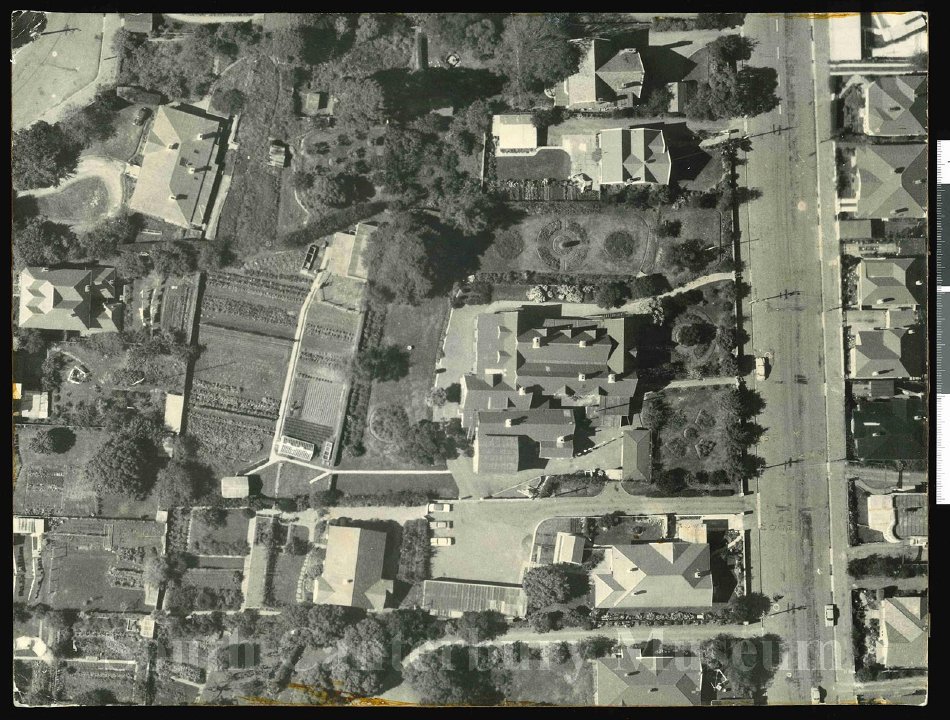
An aerial view of the Beverly War Veterans Home, Timaru, dated 3 April 1967. Identified on the verso, which also bears the photographer's stamp and reference number "802136". Scaled approximately 40 foot to an inch. Aerosurveys, photographers, Tauranga. 03/04/1967 South Canterbury Museum Catalogue Number 2022/060.38 2022060038 Beverly War Veterans Home Timaru https://timdc.pastperfectonline.com/photo/DBED46FA-F68B-4B39-A2B1-047025337531
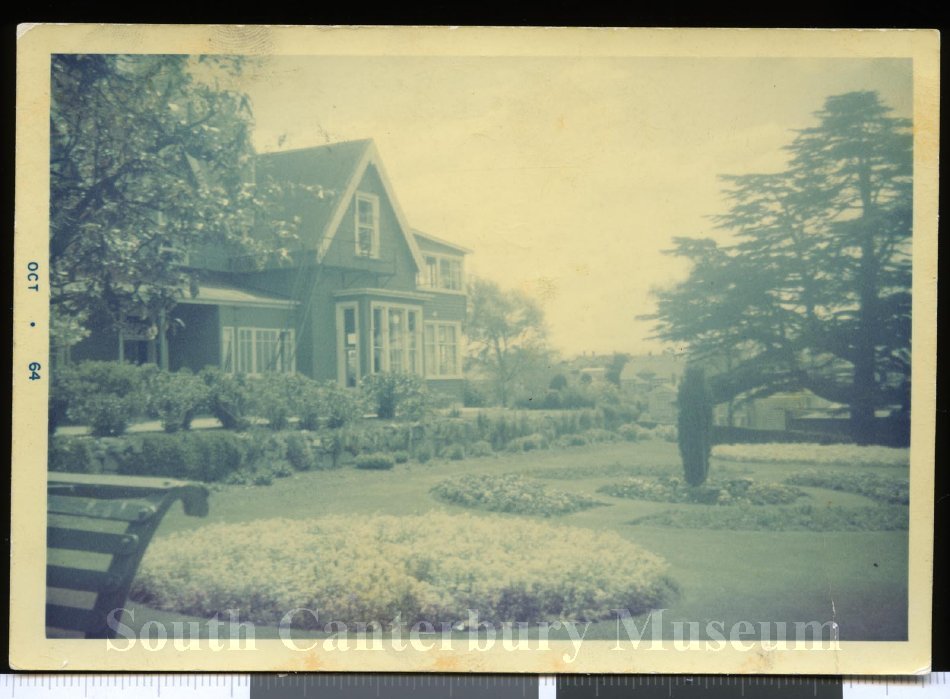
202206023 Garden Beverly War Veterans Home looking at the eastern side 1964. South Cantebury Museum - Catalogue Number 2022/060.23
2022060022 Gardens Beverly War Veterans Home Timaru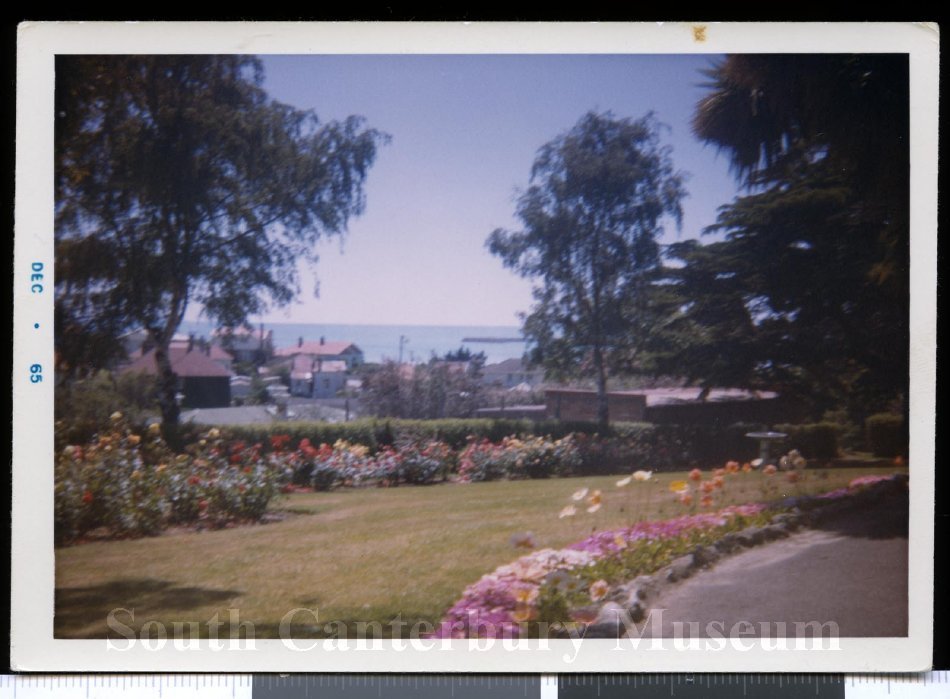
2022060022 Gardens Beverly War Veterans Home Timaru. South Canterbury Museum. Catalogue Number: 2022/060.22
https://timdc.pastperfectonline.com/photo/30344888-5CE5-4EF3-88EE-473524436480
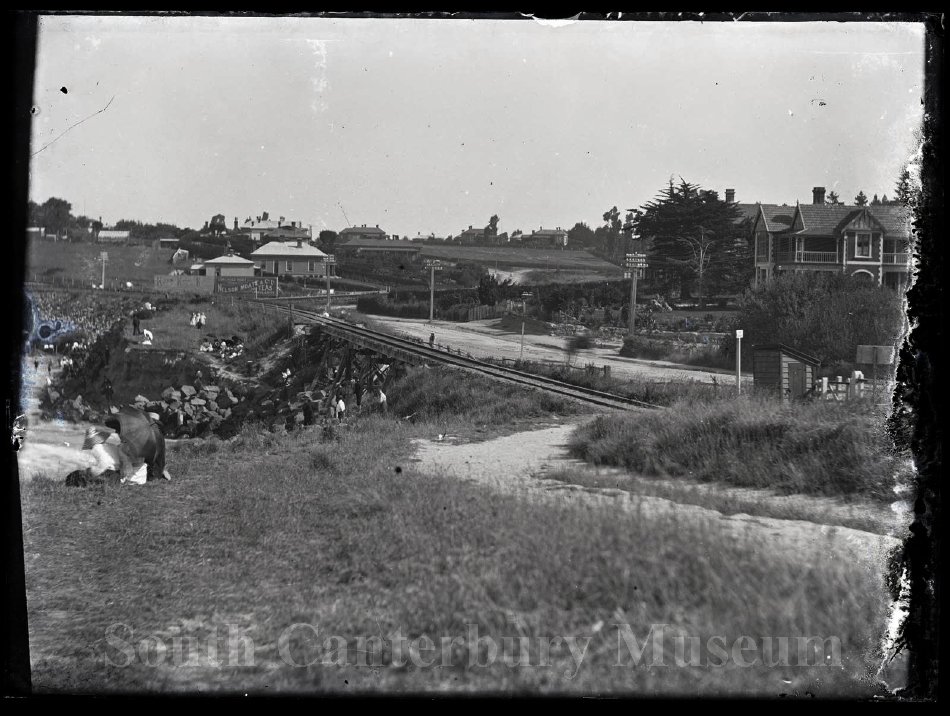
Evans Street looking toward the corner of Wai-iti Road South Canterbury Musuem 2310 https://timdc.pastperfectonline.com/photo/EAD4964C-365D-469C-A508-869378282730
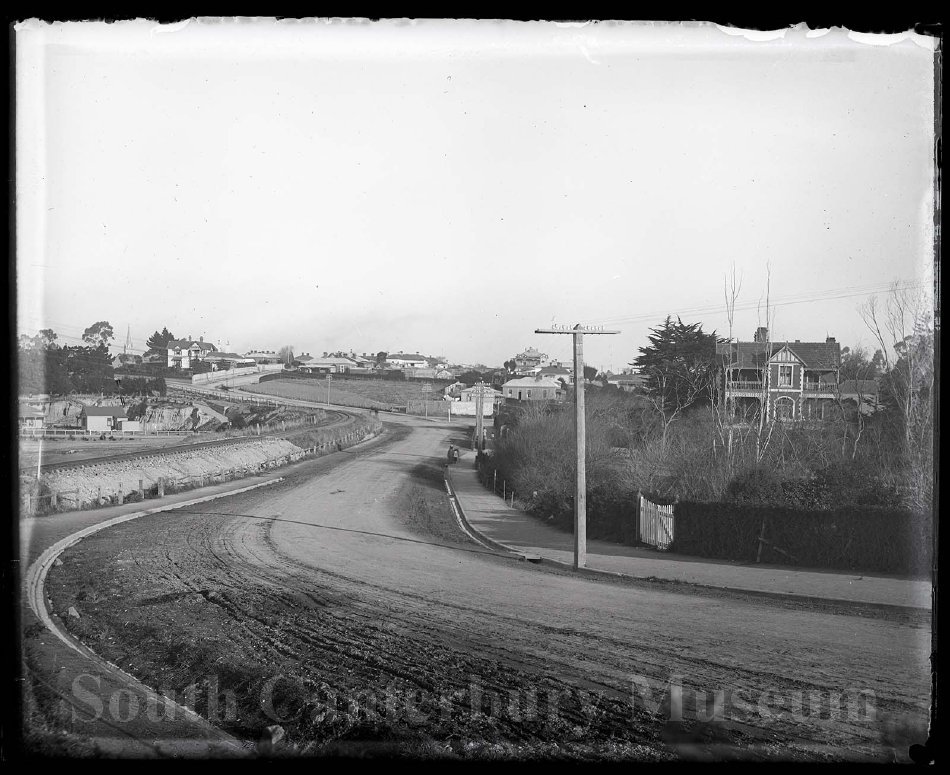
Evans Street Timaru and the Gabels 1910
2021062003 Evans Street Timaru and the Gabels 1910. An undated view looking south along Evans Street, Timaru, from the north end of Caroline Bay, circa 1910. In the foreground the rutted roadway is visible, with the residence known as "The Gables" on the right. In the left background the rear edge of the Caroline Bay tearooms and the caretaker's cottage are visible, and behind them Sarah Street.
South Canterbury Museum - https://timdc.pastperfectonline.com/photo/22D76C20-BC31-4923-AE05-323246506928
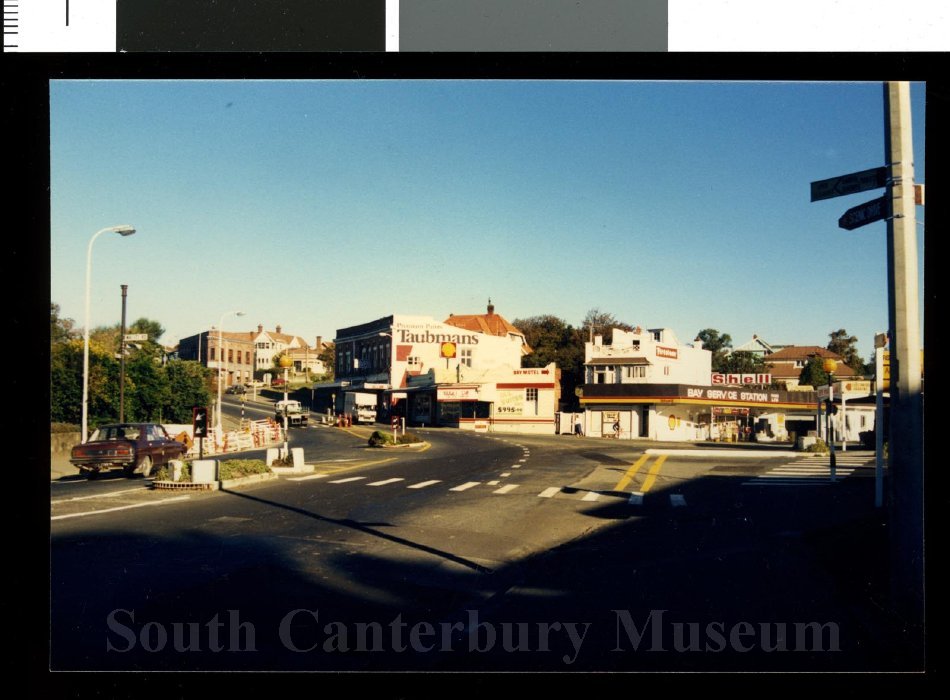
The Bay Hill, Hewlings Street, and Wai-iti Road intersection, prior to the Timaru bypass realignment, circa 1990. Depicts the view looking south along Evans Street towards the block that was largely demolished to make way for the main road bypass. - South Canterbury Museum Catalogue Number L2012/007.001 https://timdc.pastperfectonline.com/photo/3E7E2EB3-622C-4D12-8888-685128474632
Sources
Marriage notice for Francis Sherman Brown and Maud Augusta Boddy, used to identify Frank Brown as Francis Sherman Brown and Mrs Brown as Maud Augusta Brown, née Boddy.
South Canterbury Times, 14 April 1900, page 2, “Commercial.” Notice recording the sale of John Meikle’s Wai-iti Road property to Mr Francis Brown through the Canterbury Farmers’ Co-operative Association.
Timaru Herald, 5 September 1911, page 5, “Personal Items.” Notice stating that Mr Frank Brown, after 8½ years with the CFCA land department, left Timaru for Sydney.
Timaru Herald, 30 July 1920, page 4, advertisement, column 1. Advertisement recalling the first cars on Timaru’s “motor horizon”, including the 5 h.p. single-cylinder Oldsmobile bought by Frank Brown and the 7 h.p. single-cylinder Oldsmobile brought by Duncan Scott.
Timaru Herald, 6 August 1929, “Ploughing Match.” Used for the later reference to a model of the first Oldsmobile sold in Timaru as dating from 1904.
Earlier research into Ransom E. Olds, the early Oldsmobile company, and the Curved Dash Oldsmobile, used here for wider context on why such an early car would have been notable.
Timeline
1897
Ransom E. Olds forms the company that becomes Olds Motor Works.
1900 – 14 April
John Meikle’s Wai-iti Road property is sold to Mr Francis Brown through the Canterbury Farmers’ Co-operative Association.
1902
According to the later 1920 advertisement, Frank Brown buys a 5 h.p. single-cylinder Oldsmobile, remembered as one of the first cars on Timaru’s “motor horizon”. The same notice says Duncan Scott brings from the Old Country a 7 h.p. single-cylinder Oldsmobile.
1903
Francis Sherman Brown marries Maud Augusta Boddy.
circa 1907
Frank and Maud Brown are photographed in their early motor car outside their Wai-iti Road home at the gate.
1911 – 5 September
The Timaru Herald reports that Mr Frank Brown, after 8½ years in the CFCA land department, leaves Timaru for Sydney.
1920 – 30 July
A Timaru Herald advertisement uses local motoring memory to promote new Oldsmobiles, recalling Frank Brown’s early car and Duncan Scott’s imported car.
1929 – 6 August
The Timaru Herald refers to a model of the first Oldsmobile sold in Timaru as dating from 1904, creating a small date discrepancy in the local record.
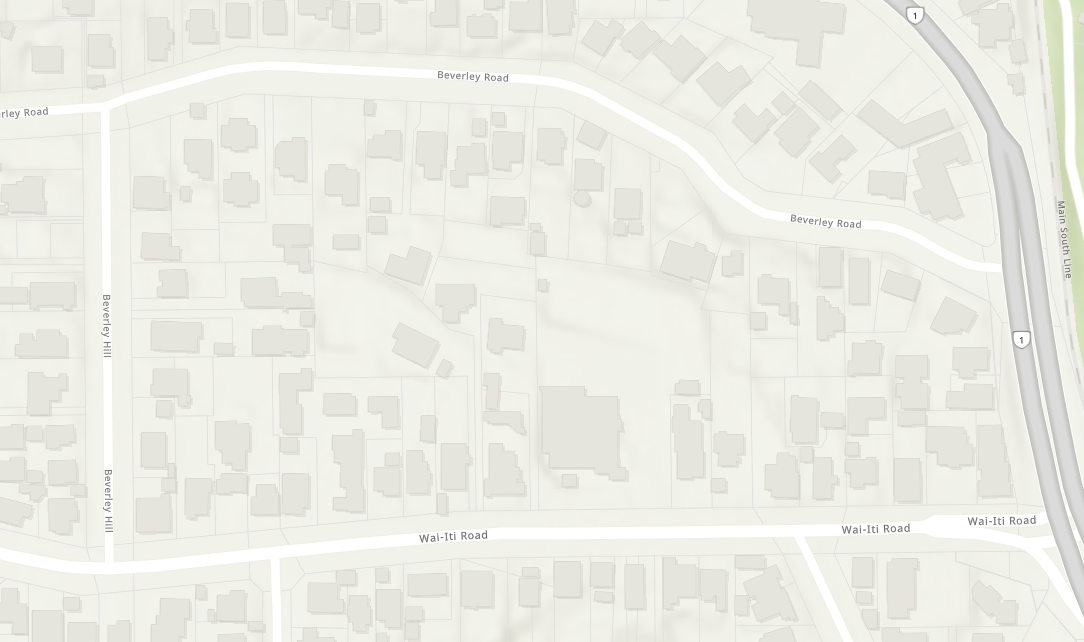
https://retrolens.co.nz/#/main
Side Quest: Maud Augusta Boddy Brown and the Boddys of Greymouth
The woman in the Wai-iti Road motor car photograph is easy to miss at first. The eye goes to the gate, then the car, then the house. Frank Brown tends to take over the story because the car was his, or at least remembered through him. But beside him was Maud.
And Maud has her own side quest.
Her full name was Maud Augusta Boddy. Before she was Mrs Francis Brown of Wai-iti Road, she was a Boddy from Greymouth. More specifically, she came from the Boddy family associated with Marsden Road and Boddytown, a West Coast family whose story reaches from Britain into the mining, road, church, suffrage, and settlement history of the Grey district.
This side quest became even more special because of a family connection close to home. My sister-in-law, Mel Fauth, née Boddy, is a relative of the Boddy family. It was neat to connect the dots with Mel, from the Wai-iti Road photograph back to Maud Augusta Boddy, and then further back to the Boddys of Greymouth and Boddytown. There is something lovely about taking a local history rabbit hole and suddenly realising it is not just an old photograph or a surname in a newspaper. It is someone’s family.
Maud’s parents were Richard Boddy and Mary Boddy, née Norton. Mary was born at Nettleham, Lincolnshire, in 1847. She married Richard Boddy in 1865. Before leaving Britain, Richard and Mary had four children. In 1876, they emigrated to Westland on the Howrah.
After arriving in New Zealand, Richard and Mary settled near Greymouth. They had six more children in Westland, although one died in infancy. Maud Augusta Boddy, born in Greymouth in 1883, belonged to this New Zealand-born generation of the family.
The family later lived at Boddytown, inland from Greymouth. The name itself is a useful clue. Boddytown was not a large town in the formal sense, but a locality associated strongly enough with the family that their surname became attached to place. They were not simply passing through. They became part of the local map.
Mary Boddy’s story adds another layer. In 1893, she signed the women’s suffrage petition at Greymouth. Maud would have been about ten years old. She was too young to sign the petition herself, but she grew up in a household where her mother’s name entered one of the major public documents of New Zealand democracy.
By 1903, Maud was still living in Greymouth. The Intention to Marry record gives a useful snapshot of her life at that moment. She was 20 years old, described as a domestic, and had lived in Greymouth for 20 years. Because she was under 21, her father Richard Boddy gave consent for the marriage.
On 21 December 1903, at the Wesleyan Church in Greymouth, Maud Augusta Boddy married Francis Sherman Brown. The newspaper marriage notice described her as the fourth daughter of Richard Boddy of Marsden Road, Greymouth. Francis was described as the second son of the late George Brown of Stawell, Victoria.
Frank, as he seems to have been known, was older than Maud. The marriage record describes him as 28, a boilermaker, and resident in Greymouth for two years. Later records and family-tree material give variations of his name, including Francis Sherman, Francis Shermann and Frank Sheringham Brown. For now, the safest wording is Francis Sherman Brown, also known as Frank Brown, while noting that the records vary.
Then the trail moves to Timaru.
Frank had bought John Meikle’s Wai-iti Road property in 1900, through the Canterbury Farmers’ Co-operative Association. The South Canterbury Times reported on 14 April 1900 that there was “a keen demand for property in the suburbs of Timaru”. This places the Wai-iti Road property in a wider story of suburban growth, aspiration and professional life at the turn of the century.
Maud’s Timaru years appear to have been roughly from her marriage period into the early 1910s. By about 1907, she and Frank were photographed outside their Wai-iti Road home in a motor car. The South Canterbury Museum catalogue identifies the couple as Mr and Mrs Francis Brown and records the car as a 1905 Darracq. Another related museum image shows them in a 1901 Oldsmobile.
This is where Maud becomes visible in a very particular way. Not through a speech. Not through a committee. Not through a public office. But through a photograph at the threshold of a home.
She is seated beside her husband, outside their gate, in one of the early cars associated with Timaru’s motor age. The photograph catches her at a crossing point between old and new: home and road, horse era and motor age, West Coast girlhood and suburban Timaru respectability.
The records do not give us everything we would like. I have not yet found Maud named as a member of a society, church guild, committee, or women’s organisation. I have not yet found reports that name her friends. That silence is not unusual. Married women were often recorded only as “Mrs Brown”, “Mrs F. Brown”, or not recorded at all. Their husbands, houses, occupations and public roles were easier for newspapers to notice.
But we can still build a careful picture.
Maud was a young married woman in a respectable suburban household. Frank worked in the land department of the Canterbury Farmers’ Co-operative Association for eight and a half years. That placed the Browns within Timaru’s commercial and farming-connected professional world. Their circle may have included CFCA staff and families, land agents, auctioneers, clerks, business people and farming clients.
There may also have been Methodist or Wesleyan connections. Maud and Frank married in the Wesleyan Church at Greymouth, so it would be worth looking further at Methodist church socials, ladies’ guilds, bazaars, Sunday school events and farewell gatherings in Timaru. At this stage, that is a promising research direction rather than a confirmed fact.
Family-tree leads suggest Maud and Frank had several children: Clara Augusta Brown, James Francis Brown, Muriel Glory Brown, Richard Sherman Brown and Stawell Marsden Brown. These names still need certificate-level checking against official birth records, but they give a strong clue that Maud’s Timaru years were likely shaped by motherhood as well as by the household and social expectations of a young wife.
In September 1911, the Timaru Herald reported that Mr Frank Brown, after eight and a half years connected with the land department of the Canterbury Farmers’ Co-operative Association, had left Timaru for Sydney. His fellow employees gathered in the board room and presented him with a travelling outfit. The notice suggests Frank was respected within the Association. It also marks the likely end of Maud’s main Timaru chapter.
Did Maud go to Sydney with him? That seems likely, but it still needs a firmer record. Later family traces suggest the Browns eventually returned to New Zealand, with strong links to Tauranga. Frank died in 1944, and family-tree leads give Maud’s death as 1967. Her exact burial place still needs confirmation.
So who was Maud?
She was Maud Augusta Boddy, born in Greymouth in 1883. She was the daughter of Richard and Mary Boddy, part of a British-to-Westland migration story. She was the daughter of a suffrage petition signer. She was a young domestic before marriage. She became the wife of Francis Sherman Brown, known as Frank. She moved into a Timaru household on Wai-iti Road, where she was photographed at the gate with one of the district’s early motor cars. She was likely a mother, a suburban householder, and part of the CFCA-adjacent social world of early twentieth-century Timaru.
She was not famous. That is the point.
Maud’s life shows how easily women disappear from local history when records are built around men’s work, property, machines and public roles. The car made Frank memorable. The gate made the photograph interesting. But Maud was there too, sitting quietly at the edge of change.
And once you notice her, the image changes.
The story is no longer only about a gate or an Oldsmobile. It is also about a young woman from Greymouth, carrying a West Coast family story into Timaru’s suburban motor age.
Chronological Timeline
1847
Mary Norton, later Mary Boddy, was born at Nettleham, Lincolnshire.
1865
Mary Norton married Richard Boddy.
1876
Richard and Mary Boddy emigrated to Westland on the Howrah.
After 1876
The family settled near Greymouth. Richard and Mary had further children in Westland.
1883
Maud Augusta Boddy was born in Greymouth.
1893
Maud’s mother, Mary Boddy, signed the women’s suffrage petition at Greymouth.
By the late nineteenth century
The Boddy family became associated with Marsden Road and Boddytown, inland from Greymouth.
1900, 14 April
The South Canterbury Times reported that John Meikle’s Wai-iti Road property had been sold to Mr Francis Brown through the Canterbury Farmers’ Co-operative Association.
1903, 21 December
Maud Augusta Boddy married Francis Sherman Brown at the Wesleyan Church, Greymouth. She was 20 and he was 28.
1904, 6 January
The Greymouth Evening Star published the marriage notice, identifying Maud as the fourth daughter of Richard Boddy of Marsden Road, Greymouth.
c. 1907
Maud and Frank Brown were photographed outside their Wai-iti Road home in Timaru, seated in an early motor car. South Canterbury Museum records one image as showing them in a 1905 Darracq.
1907
Family-tree material records Richard Sherman Brown, son of Frank and Maud, as born in New Zealand. This needs official verification.
1911, 5 September
The Timaru Herald reported that Frank Brown had left Timaru for Sydney after eight and a half years in the land department of the Canterbury Farmers’ Co-operative Association.
1917
Richard Boddy died at Greymouth Hospital.
1937
Mary Boddy died after moving to Christchurch.
1944
Family-tree and grave-record leads suggest Frank Brown died in New Zealand, with a Tauranga connection. This should be checked against official records.
1967
Family-tree material gives Maud Augusta Boddy Brown’s death year as 1967. Her burial place still needs confirmation.
Research Notes and Cautions
The surname Boddy is misread in some newspaper OCR as Roddy or Bonny. The Intention to Marry record confirms Boddy.
Frank’s middle name varies across records and family-tree material. Forms include Sherman, Shermann, Sheringham and possibly Sherringham. The Greymouth marriage notice uses Francis Sherman Brown.
I have not yet found firm evidence of Maud’s membership in women’s societies, church groups, or committees.
I have not yet confirmed her burial place.
The listed children come from family-tree leads and should be checked against official BDM records before being treated as fully confirmed.
The statement that Boddytown was named after the Boddy family is supported by local-history material, but could be strengthened with land records or Grey district histories.
Sources and Links
NZ History, “Mrs Boddy”, suffrage petition biography for Mary Boddy:
https://nzhistory.govt.nz/suffragist/mrs-boddy
Intention to Marry record, 1903, Francis Sherman Brown and Maud Augusta Boddy, Greymouth:
https://itm.howison.co.nz/year/1903si/page/34168
Greymouth Evening Star, 6 January 1904, marriage notice for Francis Sherman Brown and Maud Augusta Boddy:
https://paperspast.natlib.govt.nz/newspapers/GEST19040106.2.14
South Canterbury Times, 14 April 1900, commercial notice recording sale of John Meikle’s Wai-iti Road property to Mr Francis Brown:
https://paperspast.natlib.govt.nz/
Timaru Herald, 5 September 1911, personal item recording Frank Brown’s departure from Timaru for Sydney:
https://paperspast.natlib.govt.nz/
South Canterbury Museum, catalogue record 1382, Mr and Mrs Francis Brown in 1905 Darracq outside Wai-iti Road home:
https://timdc.pastperfectonline.com/Photo/C9E8A302-76D9-4E63-AE38-204913538712
South Canterbury Museum, catalogue record 1358, Mr and Mrs Francis Brown in 1901 Oldsmobile:
https://timdc.pastperfectonline.com/
South Canterbury Museum, catalogue record 2312, lower end of Wai-iti Road, circa 1908:
https://timdc.pastperfectonline.com/photo/02CF8A05-F0DF-4617-9164-339245655591
West Coast New Zealand History, “The Boddys of Boddytown”:
https://westcoast.recollect.co.nz/
WikiTree, Francis Sheringham Brown profile, family-tree lead only:
https://www.wikitree.com/wiki/Brown-93548
WikiTree, Richard Sherman Brown profile, family-tree lead only:
https://www.wikitree.com/wiki/Brown-91812
Find a Grave, Frank Sheringham Brown memorial, death and burial lead only:
https://www.findagrave.com/memorial/242357286/frank-sheringham-brown
NZ BDM Historical Records, recommended for certificate-level checking of Maud’s birth, marriage, death and children:
https://www.bdmhistoricalrecords.dia.govt.nz/
Papers Past, for further searching of “Mrs Frank Brown”, “Mrs F. Brown”, “Maud Boddy”, “Richard Boddy”, “Marsden Road” and “Boddytown”:
https://paperspast.natlib.govt.nz/
South Canterbury Museum catalogue search:
https://timdc.pastperfectonline.com/
Retrolens, for aerial imagery and landscape context:
https://retrolens.co.nz/