
By Roselyn Fauth
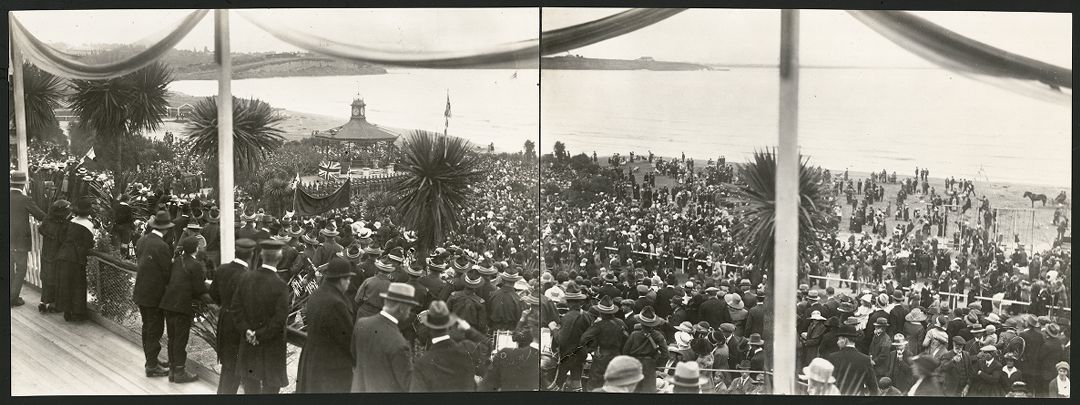
Crowds greet Edward, Prince of Wales, at Caroline Bay, 17 May 192, nine years after Timaru celebrated a king who was not there. This time royalty finally came to town.
On Monday 17 May 1920, Edward, Prince of Wales, stepped off the royal train at Caroline Bay. He was the eldest son of George V and the future king. Timaru had been allocated just 30 minutes to welcome him before his train continued south. Yet the surviving official photograph is not a close portrait of the Prince... It is a panorama of the crowd.
The Alexander Turnbull Library holds two silver-gelatin prints joined to form a wide view of people gathered at Caroline Bay. The photograph was taken by the New Zealand Government Tourist Department and inscribed on the back: “Reception Caroline Bay, Timaru.” The catalogue names Edward, Prince of Wales, but gives most of the picture to the people waiting to see him.
That makes it a perfect companion to Timaru’s 1911 coronation photographs.
In the first story, the King was absent because he was being crowned on the other side of the world. In this photograph, the future king was physically present, but he is still not the most important thing in the frame.
Thirty minutes for Timaru
Edward arrived in New Zealand on 24 April 1920. His visit was intended partly to thank the country for its contribution to the British Empire’s First World War effort. He spent four weeks travelling by royal train and motor vehicle, stopping in cities and small towns from Auckland to Invercargill.
This was not simply a sightseeing trip.
Te Ara describes the wider tour as a carefully arranged exercise intended to strengthen support for the Empire after the war. The itinerary took the Prince into communities that would normally have had little direct contact with royalty.
Timaru’s visit was brief even by royal-tour standards.
The timetable presented to the local organising committee had the Prince arriving at 12.35 pm and leaving at 1.05 pm. Within that half-hour, he was expected to receive the town’s formal welcome and pass before thousands of children and spectators.
The short visit concerned at least one local correspondent. Writing to the Timaru Herald, they suggested organising a march-past so that everyone might obtain a glimpse of the Prince. Otherwise, they feared, only a few would see him and hundreds would leave disappointed.
The panorama helps explain that concern. This was not a small reception clustered around a railway platform. Caroline Bay appears packed with people.
Nearly 4,000 children were expected
The preparations began well before May.
By the end of March, 80 schools had been contacted. Twenty-eight country schools had replied, saying they expected to send 1,203 children. Timaru’s town schools accounted for another 2,749. That was already close to 4,000 children, before replies had arrived from Geraldine, Temuka or St Andrews.
Special trains were to bring country children into Timaru. Organisers planned to give them afternoon tea before their journeys home. A site plan showed where the pupils would stand and where the Prince would walk, while one committee member proposed that they sing God Bless the Prince of Wales.
Those figures describe expected attendance rather than a confirmed final total. Even so, they reveal the scale of the organisation behind a visit lasting only half an hour.
For many children, the journey may have taken longer than the royal reception itself.
Surviving railway tickets show that special travel arrangements extended well beyond Timaru. Return fares from Waimate for the visit on 17 May cost one shilling and two pence for a child, and one shilling and six pence for an adult or teacher.
The crowd therefore represented more than the town. Families and school groups had travelled from across South Canterbury to be there.
Why Caroline Bay?
Caroline Bay was a practical place for a railway reception. The Prince’s train could stop beside the reserve, allowing him to step directly into an open area large enough for thousands of spectators. A newspaper report on the 1927 royal visit later confirmed that the Prince of Wales had detrained at Caroline Bay seven years earlier.
The setting carried another message.
By 1920, the bay had been deliberately transformed into Timaru’s public playground. Harbour construction had caused sand to accumulate north of the port, creating the beach. The Borough Council then planted lawns, laid paths and added public facilities. A band rotunda opened in 1904, followed by tearooms, a drinking fountain, a piazza, bathing sheds, tennis courts, a playground and heated saltwater baths.
The Caroline Bay Association, formed in 1911, had also begun developing the area through voluntary effort and public entertainment. By the time the Prince arrived, the bay had become one of the clearest examples of what Timaru could achieve through civic investment and community work.
Stafford Street had been the stage for the coronation parade in 1911. In 1920, the royal welcome moved to the town’s growing seaside reserve.
The choice placed the Prince beside the railway, but it also placed him inside a public landscape Timaru had made for itself.
The photograph belongs to the people who waited
Royal photographs usually direct our attention towards one person.
This one works differently.
The Government Tourist Department photographer stood far enough back to record the scale of the gathering. The result required two prints to make one panorama. Individual faces become difficult to distinguish, and the royal visitor is absorbed into the event around him.
We see rows of people rather than a royal portrait.
That does not make Edward unimportant. His presence explains why the crowd was there. But the photograph preserves the effort made by everyone else: the children brought in by train, the teachers supervising them, the organisers calculating positions and timetables, and the families who waited for a fleeting view.
Most of their names were not recorded.
One small story did survive. Several days after the visit, the Timaru Herald reported that seven-year-old Whenua Smith of Waimataitai had wanted to give the Prince a photograph of herself because they shared a birthday. His private secretary later wrote to say that Edward had accepted it.
It is a tiny detail, but it brings the panorama back to human scale. Inside that mass of people were thousands of separate reasons for attending and thousands of individual memories of the day.
The future king who was never crowned
The photograph gained an unexpected meaning 16 years later.
Edward succeeded his father as King Edward VIII in January 1936. In December, he signed an instrument of abdication, which took legal effect the following day. His brother became George VI.
Edward VIII left the throne before his planned coronation. He is one of only two English or British monarchs since 1066 who were never crowned at Westminster Abbey.
Timaru had therefore gathered to welcome a future king who would reign for less than a year and never have a coronation.
No one in the Caroline Bay crowd could have known that.
They saw the young heir to the throne, travelling through the country after a war that had taken thousands of New Zealand lives. His visit connected a South Canterbury seaside reserve with a monarchy and empire centred on the other side of the world.
We look at the same photograph with knowledge they did not possess.
What does the crowd tell us?
The 1911 photographs showed Timaru choosing who would represent the town in a parade. The 1920 panorama shows the town gathered as an audience.
The Prince was the reason for the photograph, but the crowd is its lasting subject.
It records the importance placed on monarchy, Empire and public ceremony. It also shows the reach of the railway, the organisation of local schools and the ability of Caroline Bay to hold a major civic occasion.
More than a century later, the royal visitor is almost secondary to those details.
That is the curious thing about photographs made to record famous people. Time can shift our attention away from the person everyone came to see.
We begin looking at the hats, the children, the buildings and the shape of the landscape. We wonder who travelled the furthest, who managed to glimpse the Prince and who kept the ticket afterwards.
Edward came and went in half an hour.
The crowd remained in the photograph.
1920 Crowds to greet Edward Prince of Wales, Caroline Bay, Timaru, New Zealand. Grant, F J (Mr), fl 1981 :Photographs of the tour of the Prince of Wales in 1920 and New Zealand scenic photographs. Ref: PAColl-0362-18. Alexander Turnbull Library, Wellington, New Zealand. /records/23227274