
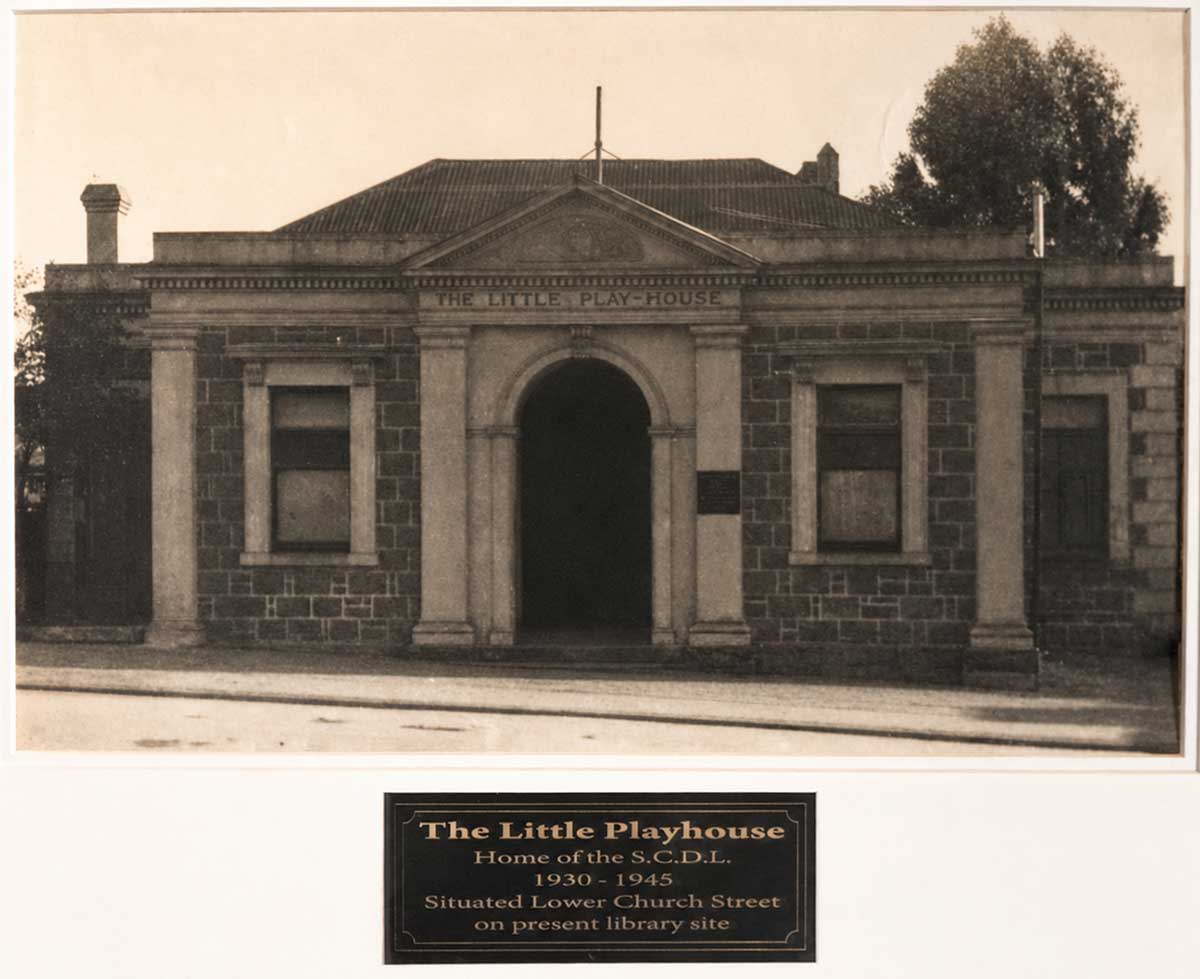
Little Playhouse Theatre, Timaru. This is from a framed photograph that hangs in the South Canterbury Drama League's foyer. A lovely bluestone building designed by Francis Wilson for the theatrics of the town to mingle, play and perform. It was demolished 1969. Consecration of the new masonic hall was in december 1873. The South Canterbury Drama League is formed in 1926, with its first one-act play competition in 1927. The drama league acquired the used of the Masonic Lodge room in Church Street. This became the first drama group in New Zealand to have its own home. For 16 years the Little Playhouse was used for the staging of plays, and readings, rehearsals, meetings and social events. "The South Canterbury Drama League holds the honour of being the pioneer of community drama in New Zealand. It is the senior branch of the British Drama League outside the United Kingdom... the people of Timaru, who gained themselves the reputation of being one of the most drama-minded communities in New Zealand " - Averille Lawrence 1967 - Timaru Herald
I was at a show at the Little Playhouse recently, doing what I often do in an interval: wandering, looking at the walls, reading the bits other people walk past. In the foyer I spied a photograph of a sweet wee building. Small, timber, humble, with that look old community buildings have, as if they have held a thousand cups of tea, meetings, rehearsals and last-minute panics.
That little building sent me off on today’s side quest...
I decided to learn more about the history of the South Canterbury Drama League, and found a cracker of an article written by Timaru Girls’ High Old Girl and alumna Averille Lawrence. She wrote about the group’s fortieth birthday for the Timaru Herald in 1967, and it gave me some fabulous intel that helped shape this blog. A big thank you to the Aoraki Heritage Collection, prepared by Timaru District Libraries. Their online database of past news is a gold mine.
The Playhouse story is not one building simply changing use... I learned on this history hunt that it was a chain of places, each one carrying a bit of Timaru’s community life forward tothe theatricial fun we get to share today.
It was bluestone, with a galvanised iron roof, cement facings made to imitate white stone, and a Grecian-style front. Above the entrance was a Masonic emblem, and above that the date of the building, A.L. 5873. Inside was a vestibule, lobby and a main hall 50 feet by 25 feet, with a height of 17 feet 6 inches. The room was plastered throughout, with a star in the centre of the ceiling, an ornamental brass chandelier, three fireplaces, polished cedar furniture, and a dais reached by three steps. The Herald called it “without exception by far the best room in Timaru”. The total cost was reported as £1250. F. J. Wilson’s design had been selected, and Thomas Parsons’ tender accepted for the work.
Before this was a theatre story, it was a story about a young town building rooms for gathering, ceremony and belonging. Timaru was still shaping itself after the 1868 fire, and stone buildings carried a message: we are here, we are organised, and we intend to last.
The South Canterbury Drama League was founded in 1926 by a local doctor and a local newspaper editor, inspired by the British Drama League. In 1927, eight groups took part in its first one-act play competition.
Decades later, that Masonic Lodge room became part of Timaru’s theatre story.
In 1930, the South Canterbury Drama League opened it as the Little Playhouse. But the League had already been busy. Averille Lawrence looked back to its first dramatic competition, held in the Bay Hall on 23 and 24 September 1927. Professor J. Shelley of Christchurch judged the festival, and eight teams took part. At the time, it was described as “a new departure in the way of entertainment” and “something novel for the district”.
I love that phrase, because it reminds us that amateur theatre was not just a pleasant pastime. It was a way for ordinary people to stand up, use their voices, work together, and make something for their own community. It was education, entertainment, confidence-building, public culture and social glue all at once.
The Timaru Girls’ High School connection is a lovely little thread too. Lawrence’s 1967 article records that in 1928 the League tried a panel of three judges, and that the junior competition was won by Timaru Girls’ High School with Peter Pan. That detail stopped me for obvious reasons. Here were schoolgirls, already part of this growing drama culture, stepping onto a local stage and helping build the reputation of a very drama-minded town.
By 1930, having a home mattered and The Little Playhouse was not just somewhere to put on a show and lock up afterwards. It held plays, readings, rehearsals, meetings, social occasions, stage equipment, costumes and the League’s library. I love that list because it tells the truth about community culture. The performance is only the visible part. Behind it are the cupboards, borrowed chairs, working bees, cups of tea, and people who know where the extension cord lives.
Early Little Playhouse productions included locally written work by Mrs V. Targuse, Miss Miriam Harris and Miss Betty Kerr. That caught my eye too. Here were women’s names in print, local voices on stage, and South Canterbury stories being treated as worthy of an audience. The stage was not only importing plays from elsewhere. It was making room for people here to write, perform and be heard.
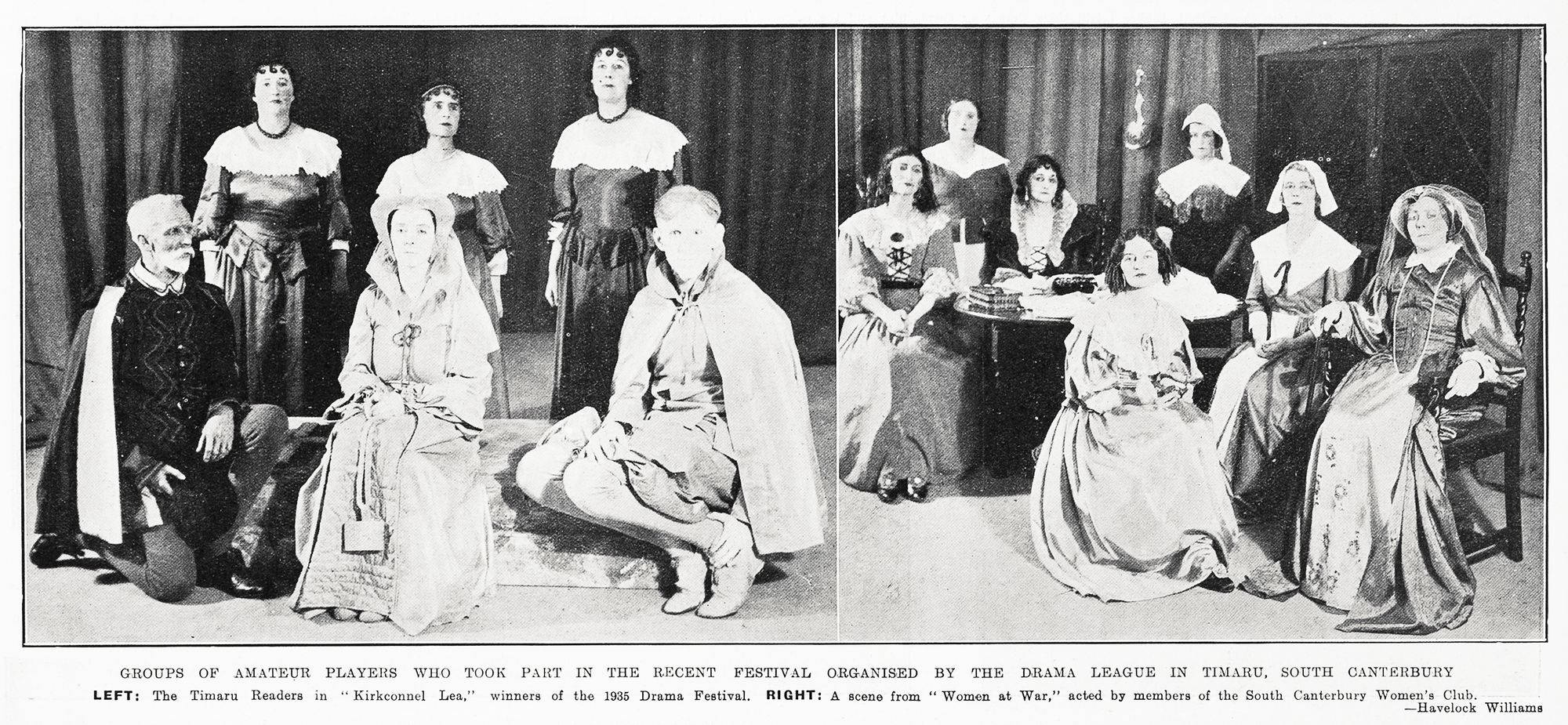
Groups of amateur players who took part in the Drama League festival in Timaru, South Canterbury, published in the Auckland Weekly News on 11 September 1935. Left: the Timaru Readers performing Kirkconnel Lea. Right: members of the South Canterbury Drama Club performing Women at War. Photograph by Auckland Weekly News and Havelock Williams. Auckland Libraries Heritage Collections AWNS-19350911-51-02.
Lawrence gave the League’s achievement a proud frame in 1967: “The South Canterbury Drama League holds the honour of being the pioneer of community drama in New Zealand. It is the senior branch of the British Drama League outside the United Kingdom.” She also credited “the people of Timaru, who gained themselves the reputation of being one of the most drama-minded communities in New Zealand.”
That is a bold claim, but the record does show how energetic the League was. By 1933 it had extended into three-act plays, with The Women Have Their Way produced by Miss E. H. Lee. In 1936 the first junior festival was held, with Miss Ngaio Marsh as commentator. Imagine that. Ngaio Marsh, now remembered as one of New Zealand’s great literary names, connected into this local drama world as a commentator for young performers.
During New Zealand’s centennial year in 1940, the League’s work moved beyond a theatre room. It staged a provincial one-act play final, and its Repertory Section performed The Way of the Cross in the Timaru Botanic Gardens. I like that image: drama stepping out into one of Timaru’s public green spaces, turning the gardens into a civic stage.
There were setbacks, as The first Little Playhouse was sold in 1946. Lawrence called it a great loss, although the new owner allowed the League to use the basement for storage for a time. That detail says a lot. When community groups lose a home, they do not just lose walls. They lose a place to keep costumes, books, props, habits, routines and momentum.
In 1952, the League bought a house in Dee Street, hoping to build a little theatre, storerooms and a library. Those plans did not come off. Then, in the mid-1950s, the League bought the former Cullmantown Hall in Church Street West. This was the sweet wee building I had noticed in the foyer photograph.
Cullmantown Hall had its own earlier life. The Timaru Herald later recorded that in 1884 the Trinity Session decided to use land at Sandietown gifted by Fritz Cullmann, and a church to seat 120 people opened that October. The hall became known as Cullmantown Hall in honour of the land donor. By the time the Drama League bought it, the Cullmantown Sunday School, later known as Trinity West Sunday School, had closed. Once again, a useful community building was given another life.
That is one of the loveliest parts of this story. The present Playhouse site was not born grand. It grew through use. The old hall had held worship, children’s lessons and meetings before actors, stage crews and audiences made it their own. The building was useful before it was theatrical, and perhaps that is why it suited the Drama League so well.
By 1969, that 85-year-old wooden building had reached the end of its practical life. The Timaru Herald described the planned demolition and rebuild as the League’s most ambitious project yet. The new building was to use concrete blocks and steel trusses, with a 14 ft 9 in stud, initial floor space of 2400 square feet, and room to extend to about 3000 square feet. It was planned as a practical home, with a small auditorium, storage, workshop and off-street parking. Not glamorous, perhaps, but exactly the sort of useful building community groups dream about.
Mrs H. O. Button, the League president, was one of the people who helped steer that rebuild. In 1969 she said two-thirds of the money was already in hand, with the rest to be raised through loans and an “all-out fund-raising campaign”. When the new theatre opened in August 1970, the Timaru Herald reported that the split-level building was 130 feet long, cost $28,000, and had taken only ten months to complete.
That achievement came from more than plans on paper. Mrs Button said the public had been “marvellous”, with money raised through a mortgage, a loan, donations, raffles and “quite a lot of hard work”. Round Table No. 8 and League members helped with labour alongside the builder, Mr J. Young. The new building included wardrobe space, a workshop area and room for the different sections of the League to keep making theatre.
Those wardrobe and workshop spaces matter. They remind us that a theatre is not only seats and a stage. It is also fabric, timber, paint, catalogues, tools, props, racks, labels, volunteers, memory and practical know-how. The built heritage is not only in the public face of the building. It is in the back rooms where people make the magic possible.
The current Playhouse at 198 Church Street still carries that practical community spirit. The South Canterbury Drama League continues to run productions, costume hire, membership, sections, archives, maintenance and all the invisible work that keeps a local arts organisation alive. The names change, the plays change, the building has changed, but the pattern is familiar: people turn up and make things happen.
So The Playhouse is not just a theatre... It is a place where Timaru people have practised the same community habits for generations. That is why the wee building on the foyer wall stopped me. It reminded me that heritage is not always the grandest building in town, sometimes they are even lost... The library is now the site of the drama leagues first home. I wonder if it can hear the theatric ghost voices from time to time.
Side quest: When the Playhouse story passes through the Masons
Before the South Canterbury Drama League had the Playhouse we know today, one of its early homes had a very different past. It was connected with Timaru’s Freemasons.
Timaru’s Freemasons were part of the town’s organised social life from the 1860s. Their Masonic Hall in Church Street was consecrated in 1873, only a few years after the great fire of 1868 had pushed Timaru towards stronger stone and brick buildings.
The hall was built to express identity and purpose. It had bluestone, a Grecian-style front, cement facings, a Masonic emblem and the date A.L. 5873 above the entrance. A.L. stands for Anno Lucis, or “Year of Light”, the Masonic dating system. Even from the street, the building showed that it belonged to a group with its own customs, symbols and language.
Inside, the hall was arranged for ceremony. Newspaper descriptions mention a vestibule, lobby, library and committee room, ante-room, Tyler’s room and a main hall with a dais. Details such as a ceiling star, brass chandelier, fireplaces, cedar furniture and scarlet-covered seating suggest a formal room designed for ritual, order and fellowship.
That makes its later use by the Drama League especially interesting. When the South Canterbury Drama League began in 1926, it became part of a growing local interest in community drama. People were forming groups, reading plays, rehearsing one-act works and creating opportunities for local performers.
By the early 1930s, the Little Playhouse was being reported as a lively venue for short plays and local performance. A room once associated with private Masonic ritual had become part of Timaru’s public creative life.
The connection matters because theatre needs more than enthusiasm. It needs rooms. Somewhere to rehearse, store props, hold meetings, try things out, make mistakes, fix problems and return the next night.
The Masonic side quest shows that the Playhouse story is also a story of reused community spaces. A room built for fellowship and ceremony later helped support local theatre, storytelling and performance.
A wee point I learned on this history hunt is that this early Masonic Hall is not the same building as the present Playhouse. The later purpose-built Playhouse opened on Church Street.
Side quest: The Drama League, the Playhouse and the Theatre Royal
The Playhouse has its own story, but it also sits inside the much larger story of live performance in Timaru.
For more than a century, the South Canterbury Drama League has helped keep local theatre alive, not just by staging productions, but by creating a place for people to learn the craft of performance. Behind every polished show were rehearsals, set building, costumes, lighting cues, ticket sales, nervous first entrances and the quiet confidence that grows when a community makes art together.
The Theatre Royal was Timaru’s grand civic stage, the place for major productions, touring shows and large audiences. The Playhouse offered something more intimate: a working home for local theatre, where performers could gather, experiment, rehearse and grow. One space gave the town scale and spectacle. The other gave it roots.
This matters because theatres are not just buildings. They are ecosystems. A grand theatre needs local performers, technicians, audiences, volunteers and advocates. Smaller venues like the Playhouse help grow those people. They keep the habit of theatre alive between the big nights under the bright lights.
When the Theatre Royal closed and its future was debated, the Drama League’s voice mattered because it came from lived experience. It represented people who understand what a theatre needs from the inside: backstage access, dressing rooms, sightlines, sound, lighting, storage, rehearsal space and a stage that works for both local and touring productions.
So the Playhouse is not a footnote to the Theatre Royal. It is part of the same performance whakapapa. Together, these places show how Timaru has made room for drama, laughter, music, storytelling and community effort across generations.
The Theatre Royal may be the grand old civic stage, but groups like the South Canterbury Drama League are part of what kept the curtain rising.
What this story really tells us is that theatre needs more than a stage.
Buildings matter. The Theatre Royal matters deeply. It carries Timaru’s civic memory, from Richard Turnbull’s bluestone store to the grand auditorium, the Bughouse years, council ownership, restoration, closure and redevelopment. But a theatre only becomes meaningful when people bring it to life.
That is where the Drama League and the Playhouse are so important. They remind us that theatre is not created by architecture alone. It is created by people giving their time, courage, skill and imagination. It is the actor learning lines after work, the volunteer painting flats, the person sewing costumes, the technician solving a lighting problem, the committee member writing grants, the audience member buying a ticket, and the young person discovering confidence on stage for the first time.
The Theatre Royal gives Timaru a civic stage. The Playhouse helps grow the people who can use it.
So supporting theatre means supporting both places and people. It means caring for heritage buildings, but also investing in rehearsal spaces, technical equipment, affordable access, training, volunteers, local productions and the community groups who keep performance alive between the big events.
If we want the Theatre Royal to be more than a restored landmark, we need the living theatre culture around it to thrive too. Otherwise we risk saving a beautiful shell and forgetting the heartbeat.
The lesson from this whole story is simple: theatres survive when communities value them, use them and make room for the people who keep the curtain rising.
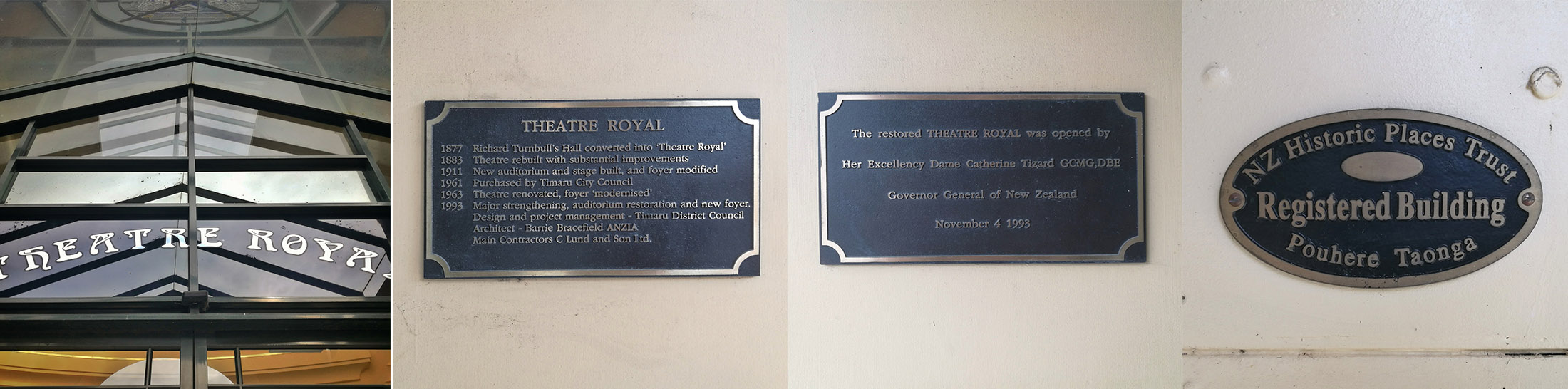
Theatre Royal plaque Detail - photos Roselyn Fauth
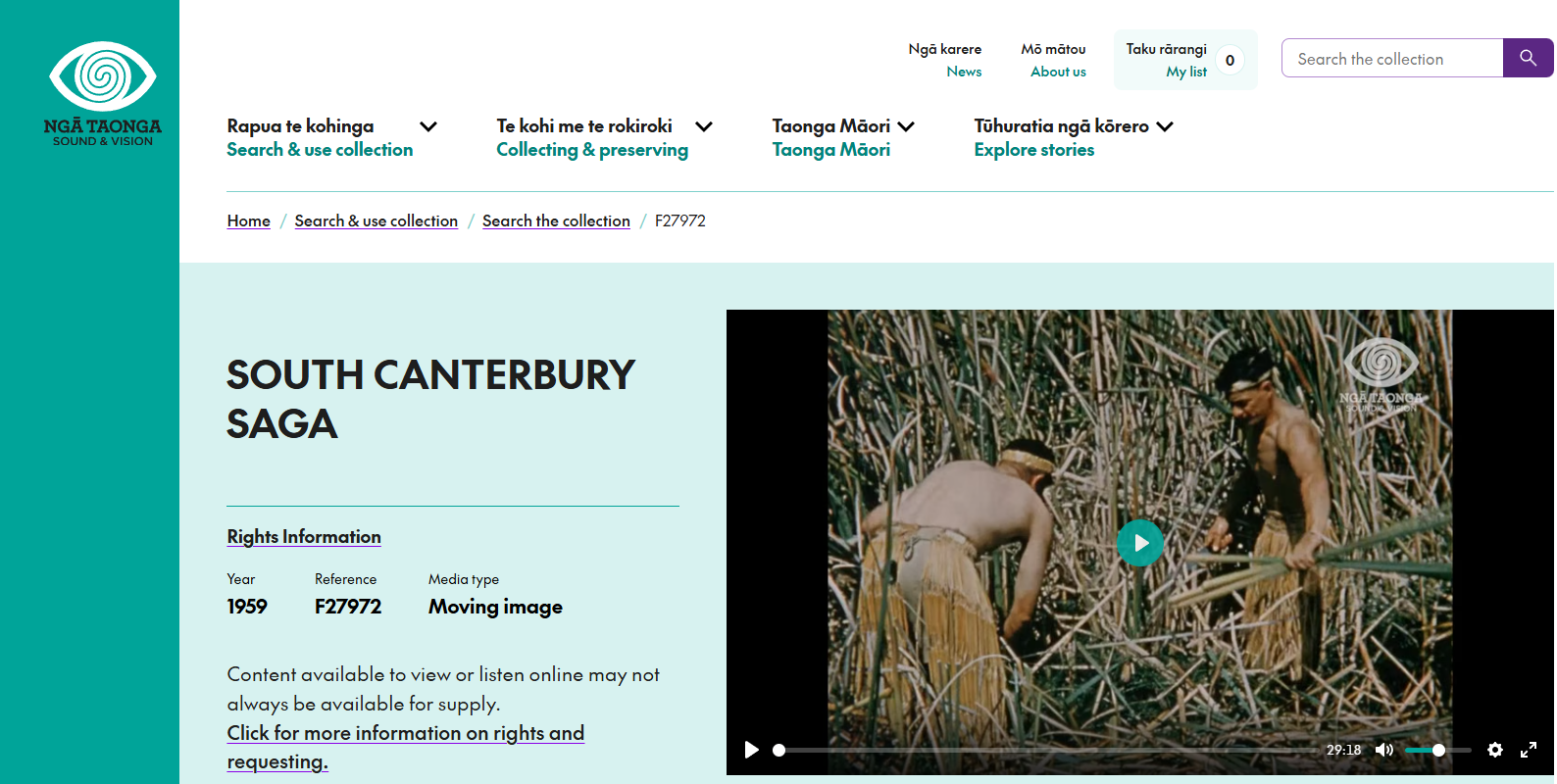
https://www.ngataonga.org.nz/search-use-collection/search/F27972/
A glimpse into an old Canterbury Centennial film tracing the early story of Timaru. The scene opens with a newspaper headline, “Canterbury Centennial”, before a man settles into an armchair and opens a history book. The pages take us back to the dawn of recorded Māori history, when Ngāi Tahu lived near Arowhenua on the Ōpihi River. The film recreates early life along the river, with Māori women weaving, men carving a canoe, and tools being taken from a kete. It then moves to 1836, when a whaling station was established at Timaru, showing men rowing out to sea and working on the beach. The story continues with Edward Shortland’s 1844 journey, flax cutting, weaving, travel by canoe, and a pōwhiri. It then shifts to the voyage of the Strathallan, advertised as sailing directly to Timaru in October 1858. A young man reads the poster, boards the ship, and meets a young woman who farewells her mother. They marry on board and arrive together on the Timaru shore. By 1859, the film marks “the birth of Timaru” with the arrival of the Strathallan, ending with the couple sharing tea as the story of settlement begins.
Timeline
1873 The new Masonic Hall in Church Street, opposite St Mary’s, was consecrated. The Timaru Herald described a bluestone building with a Grecian-style front, cement facings, a Masonic emblem, chandelier, dais and polished cedar furniture. F. J. Wilson’s design was selected and Thomas Parsons’ tender was accepted.
1884 Trinity Session opened a wooden church and Sunday School building at Sandietown on land gifted by Fritz Cullmann. It later became known as Cullmantown Hall.
1926 The South Canterbury Drama League was founded. Aoraki Heritage records that it was founded by a local doctor and a local newspaper editor.
23 to 24 September 1927 The League held its first dramatic competition in the Bay Hall, judged by Professor J. Shelley of Christchurch. Eight teams took part.
1928 The League experimented with a panel of three judges. Averille Lawrence’s 1967 article records that Timaru Girls’ High School won that year with a junior team performing Peter Pan.
1930 The League opened the old Masonic Lodge room in Church Street as the Little Playhouse, with a programme of one-act plays.
November 1930 Locally written plays were staged at the Little Playhouse, including Rabbits by Mrs V. Targuse, The Telegram by Miss Miriam Harris and The Return by Miss Betty Kerr.
1930 to 1946 The first Little Playhouse was used for plays, readings, rehearsals, meetings, social occasions, and storage of stage equipment, costumes and the League’s library.
1933 The League extended into three-act plays. The Women Have Their Way was produced by Miss E. H. Lee.
1936 The first junior festival was held, with Miss Ngaio Marsh recorded as commentator.
1940 During New Zealand’s centennial year, the Drama League staged a provincial one-act play final, and the Repertory Section staged an open-air performance of The Way of the Cross in the Timaru Botanic Gardens.
1946 The first Little Playhouse was sold, a major loss for the League, although the new owner allowed basement storage for a time.
1952 The League bought a house in Dee Street, hoping to build a little theatre, storerooms and a library. The plan did not proceed.
1956 to 1957 The Cullmantown Sunday School, later known as Trinity West Sunday School, closed and the building and land were offered for sale. The 1969 article places the purchase in 1956, while Averille Lawrence’s 1967 article gives 1957.
1956/1957 to 1969 The former Cullmantown Hall served as the League’s Little Playhouse in Church Street West.
8 July 1967 Averille Lawrence’s Timaru Herald article marked the League’s fortieth anniversary. She described the South Canterbury Drama League as the pioneer of community drama in New Zealand and the senior branch of the British Drama League outside the United Kingdom.
1967 The League’s management committee included H. A. Craig as president, Mrs M. E. Middleton as secretary, and vice-presidents Mrs H. O. Button, Mr J. M. Young, Mr A. F. Ellis and Mr G. S. Stirling, alongside other committee members.
29 November 1969 The Timaru Herald reported that demolition of the 85-year-old Little Playhouse was about to begin, and that a new permanent home was planned at an estimated cost of $18,000 to $20,000.
1969 The proposed new building was described as concrete block with steel trusses, a 14 ft 9 in stud, initial floor space of 2400 square feet, and possible extension to about 3000 square feet.
1969 Mrs H. O. Button, League president, said two-thirds of the money was already in hand, with the balance to be raised through loans and an all-out fundraising campaign.
1 August 1970 The new South Canterbury Drama League theatre opened in Church Street West. The Timaru Herald reported the cost as $28,000 and said the project took only ten months to complete.
1970 The new building was described as split-level and 130 feet long, with a mezzanine floor, wardrobe space, workshop area and facilities for the League’s theatre sections.
1970 Mrs Button credited public support, raffles, donations, loans, a mortgage, Round Table No. 8, League members, and builder Mr J. Young for helping bring the project to completion.
Today The Playhouse continues at 198 Church Street as the home of South Canterbury Drama League activity.
Side quest timeline: the Drama League and the Theatre Royal
1868
A great fire swept through Timaru’s wooden business district. The disaster pushed the town towards stronger stone and brick buildings, including the bluestone store that would later become part of the Theatre Royal story.
1869
Merchant Richard Turnbull built a two-storey bluestone warehouse on Stafford Street. At first it was a practical commercial building, but like many early Timaru buildings, it soon became a place for public life as well as business.
1877
Turnbull’s Hall was converted into the Theatre Royal. This gave Timaru a proper performance venue and marked an important step in the town’s cultural confidence. The Theatre Royal became the grand civic stage.
1911
Theatre architect Henry Eli White remodelled the auditorium, giving the Theatre Royal a more modern theatrical interior. It was still adapting, still changing, and still trying to meet the needs of audiences and performers.
1926
The South Canterbury Drama League was founded. Its beginnings came from the same civic energy that had made the Theatre Royal important: the belief that drama, performance and storytelling mattered in a regional town.
1927
Eight groups took part in the League’s early one-act play competition. This is where the Theatre Royal story and the Playhouse story begin to overlap in spirit. The Theatre Royal offered Timaru a grand stage, but the Drama League helped grow the people who could fill stages: actors, directors, stage crews, volunteers and audiences.
1930s to mid twentieth century
The Theatre Royal continued as a major entertainment venue, including its picture theatre years, when locals affectionately remembered it as the “Bughouse”. Meanwhile, community theatre kept developing in South Canterbury, building a local culture of performance beyond one building.
1961
Timaru City Council bought the Theatre Royal, securing it as a public civic theatre. This mattered because the building was no longer just a commercial venue. It belonged, in a wider sense, to the town.
1970
The South Canterbury Drama League opened its new theatre building in Church Street, on the site associated with the Little Playhouse and the former Cullmantown Hall. This gave local theatre a more intimate home of its own. If the Theatre Royal was the town’s grand stage, the Playhouse became the workshop, gathering place and heartbeat of community drama.
1992 to 1993
The Theatre Royal underwent major restoration and strengthening work. This was another reminder that performance spaces need constant care. They survive because communities keep choosing to use them, repair them and argue for them.
2019
The Theatre Royal closed because of earthquake concerns. For Timaru’s theatre community, this was not simply the loss of a building. It affected the whole performance ecosystem, from touring shows to local productions and civic events.
2024
As the future of the Theatre Royal was debated, theatre advocates, community voices and groups connected to local performance helped keep the issue visible. The Drama League’s interest mattered because it came from people who understand theatres from the inside: stages, backstage spaces, dressing rooms, lighting, storage, rehearsal needs and the feeling of performing to a live audience.
2026 and beyond
The Theatre Royal redevelopment is now part of Timaru’s next cultural chapter, while the Playhouse continues to do what community theatres do best: nurture local talent, welcome volunteers, teach skills and keep people connected through performance.
Together, the Theatre Royal and the Playhouse show two sides of the same story. One is the civic stage, built for scale, ceremony and spectacle. The other is the community stage, built through practice, participation and belonging. The South Canterbury Drama League sits beautifully between them, helping keep Timaru’s theatre tradition alive from generation to generation.
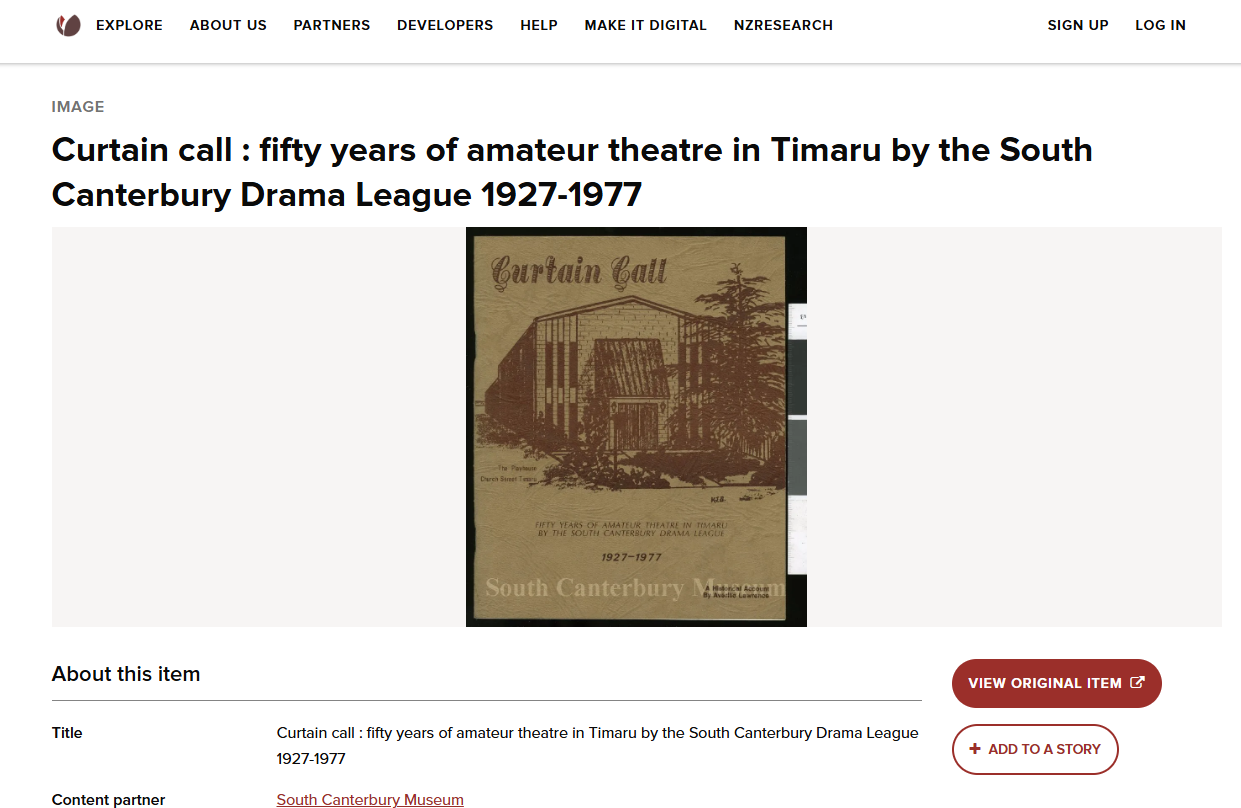
Curtain call: fifty years of amateur theatre in Timaru
This 1977 publication, Curtain call: fifty years of amateur theatre in Timaru, records the story of the South Canterbury Drama League from 1927 to 1977.
Created by Averille Lawrence, it brings together the history of amateur theatre in Timaru, including lists of past office bearers and productions from the various sections of the league. It is a valuable record of the people, performances, volunteers, and creative energy that helped shape Timaru’s theatre scene over half a century.
The publication is held by the South Canterbury Museum and connected with the South Canterbury Drama League and Little Playhouse Theatre, Timaru.
Source: https://timdc.pastperfectonline.com/Library/B5534C20-E2F5-4B73-88C4-366135458520
Sources
Timaru Herald, “Consecration of the New Masonic Hall”, Volume XX, Issue 985, 19 December 1873, page 4, Papers Past.
https://paperspast.natlib.govt.nz/newspapers/THD18731219.2.9
Timaru Herald, “The Drama League”, 2 May 1930, Papers Past.
https://paperspast.natlib.govt.nz/newspapers/THD19300502.2.32
Timaru Herald, “Original Plays”, 10 November 1930, Papers Past.
https://paperspast.natlib.govt.nz/newspapers/THD19301110.2.89
Timaru Herald, “Original Drama: Local Plays Presented”, 11 November 1930, Papers Past.
https://paperspast.natlib.govt.nz/newspapers/THD19301111.2.16
Averille Lawrence, “Unique in NZ: South Canterbury Drama League Celebrates Fortieth Anniversary”, Timaru Herald, 8 July 1967, Aoraki Heritage Collection.
https://aorakiheritage.recollect.co.nz/nodes/view/3941?showbacklinknav=217
Timaru Herald, “Drama League to Build New Permanent Home: Demolition of Little Playhouse”, 29 November 1969, Aoraki Heritage Collection.
https://aorakiheritage.recollect.co.nz/nodes/view/674
Timaru Herald, “S.C. Drama League Opens New Little Theatre Today”, 1 August 1970, Aoraki Heritage Collection.
https://aorakiheritage.recollect.co.nz/nodes/view/3943
Aoraki Heritage Collection, “South Canterbury Drama League”.
https://aorakiheritage.recollect.co.nz/nodes/view/217
South Canterbury Drama League, current website.
https://dramaleague.org.nz/
South Canterbury Drama League, contact page, confirming present address at 198 Church Street, Timaru.
https://dramaleague.org.nz/contact/
South Canterbury Regional Website, “South Canterbury Drama League”, current summary of The Playhouse and its facilities.
https://southcanterbury.org.nz/business-listing/south-canterbury-drama-league/
DigitalNZ, “Curtain call: fifty years of amateur theatre in Timaru by the South Canterbury Drama League 1927 to 1977”, creator Averille Lawrence, South Canterbury Museum record.
https://digitalnz.org/records/42255238