
Roselyn Fauth
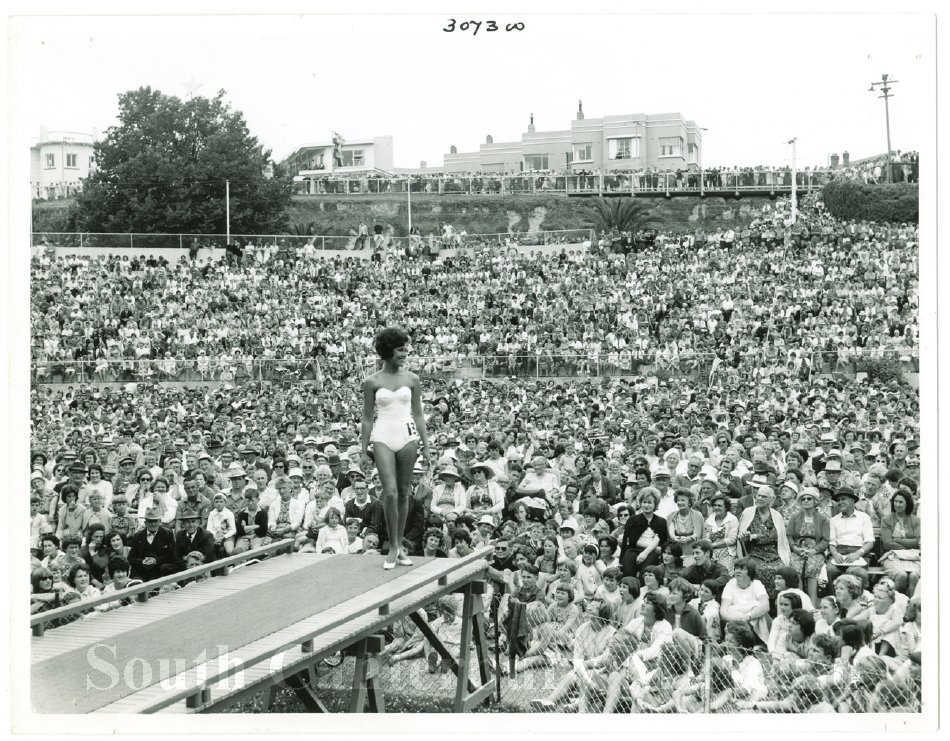
Number 13 at the End of the Catwalk: Ruby Foley, Caroline Bay, and the Summer Crowd at the Soundshell
If you have sipped or eaten at the Oxford Restaurant, you may have noticed the mural. Most people see a summer carnival contestant first. Then they spot the crowd. Then someone usually asks the same question: Who was she? That question sent me back to the original photograph...
A young woman stands at the end of a catwalk in front of the Caroline Bay Soundshell. She has turned back towards the stage, I wonder how she felt looking out as a huge crowd at Timaru watched on.
Behind her, the concrete seating is packed. Those who missed a seat, stand up on the cliff by the road to catch a view. This is a stunning capture of that moment in time, a wall of faces fixed on a sole lady on a stage.
She stood as contestant number 13 in the Miss Caroline Bay competition, around 1965. She is Ruby Foley, the eventual winner of Miss Caroline Bay, photographed in January 1965.
Ruby is the obvious subject of the photograph, but look again. The crowd is a subject too.
The image captures a moment when Caroline Bay was one of Timaru’s great public stages. People did not just go there to play, swim or wander. They gathered there for concerts, contests, sideshows, children’s events, talent quests, sand modelling, music and as you can see in the photo, spectacle.
The Caroline Bay Association was formed in 1911 to promote the Bay and provide family entertainment over the Christmas and New Year holiday period. By the 1950s and 1960s, the Carnival had become part of Timaru’s summer rhythm.
Miss Caroline Bay belonged to that world. It was a beauty pageant title connected with the Caroline Bay Carnival. The records also point to related names and events over the years, including beauty contests, bathing beauties, holiday queens, carnival queens and junior competitions.
So when we look at this photo of Ruby, we are not only looking at one young woman in a swimsuit. We are looking at Timaru at play. We are looking at what people came to see, what they thought was glamorous, and how the Bay turned summer leisure into a public performance.
The Bay itself had changed
Some may not know that Caroline Bay did not always look like the beach and lawns people know today.
Before the harbour works changed the coastline, this was not the broad sandy recreational bay we recognise now. The completion of the north mole in 1890 altered the way sediment moved along the coast. Sand began to build up below the cliffs. Over time, that transformation of a stoney shoreline to sandy bay, made room for recreation.
Even earlier than the ports construction this was a simple harbour where ships had smaller vessels ferry cargo and people between the ships and the shore, and even earlier the coastline has older Maori histories.
So in many ways, Ruby’s photograph is also a landscape story.
The catwalk, the Soundshell, the summer crowd, all of it is part of the wider story of the Bay becoming a public playground, our "Port Restort".
As well as the natural tidal forces, Caroline Bay was also shaped by harbour engineering, council decisions, voluntary effort. there were years of fundraising, planting, and building with a local belief that Timaru should have a seaside gathering place.
This photo of a woman on a public stage captures one moment when Timaru gathered to watch.
The Soundshell made the moment possible
The Soundshell was built in 1936, designed by Timaru architect Victor Panton and built by W. Hayes. It replaced an earlier band rotunda.
Its Art Deco Architecture, stage arch and curved form were made for public entertainment. The concrete auditorium seating was added in 1957. That seating is what gives Ruby’s photograph so much force. Without it, the crowd would not rise behind her in the same way.
The Soundshell made spectatorship part of the Bay. It turned concerts, civic events and competitions into shared memories. For decades, people did not just go to Caroline Bay.
Ruby’s story travelled beyond the Bay
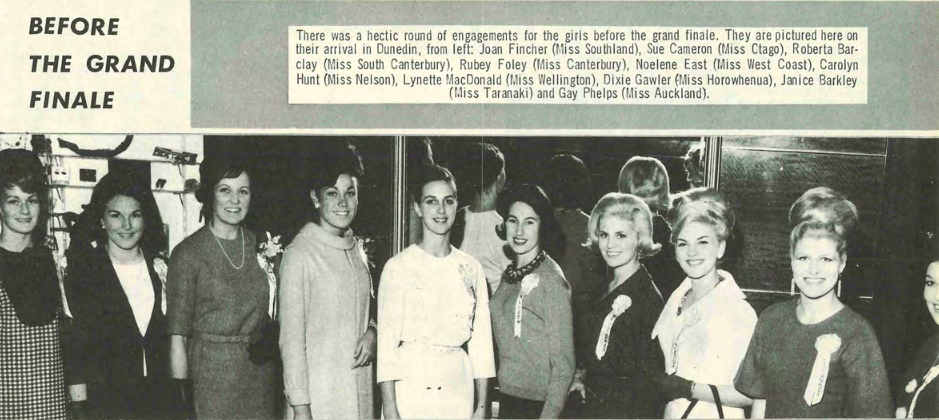
Ruby Foley’s story did not stop at the end of the Caroline Bay catwalk. By May 1965, she was appearing as Miss Canterbury on the Miss New Zealand Show tour. Gisborne Photo News photographed her being interviewed by compere Ian Saxon and listed her among the provincial finalists in the 1965 Miss New Zealand contest. Miss South Canterbury that year was Roberta Barclay. Ruby's public pageant story reached well beyond Timaru.
I read a womans recollection on the Timaru History and Memories Facebook page, that if Ruby was entered in the pagant you knew it was all over for your chances. I also read that after a few years Ruby was asked not to compete, perhaps to give others a go.
The 1965 Miss New Zealand contest was not only local affair. It was part of a travelling show directed by Dunedin promoter Joe Brown. Entertainers included Howard Morrison, Peter Posa, John Hore, Lou and Simon, and the Quin Tikis. The final was held in Dunedin on 7 June 1965. Gay Phelps won the 1965 Miss New Zealand title and later became a Miss World semi finalist.
This places Ruby’s Caroline Bay photograph in a bigger world of national entertainment, touring shows, glamour culture and international pageant systems.
It is joyful and uncomfortable to look on with today's lens.
I look at this bathing beauty contests and feel uncomfortable. These competitions placed young women on public display and judged them by appearance, confidence and presentation. With my lens looking back I think this era reflected a narrow idea of beauty and a narrow idea of what kinds of women were publicly admired. But that was how it was in those days.
I can imagine that many supporters at the time believed pageants gave young women confidence, prizes, travel, visibility and a chance to step outside ordinary life. Thousands of women entered regional contests around New Zealand. Some may have enjoyed the experience. Some may have felt proud. Some may have found doors opened.
Later critics, especially from the women’s liberation movement of the 1970s, challenged that view. They argued that beauty contests reduced women to looks and body shape. By the late 1980s and early 1990s, beauty contests no longer had the same public standing they once had.
Both things can be true.
Pageants could offer opportunity. They could also enforce a very narrow idea of what kind of woman was allowed to be admired.
That is why Ruby’s photograph is so interesting. She is standing in the middle of those tensions, before many of the later arguments had fully arrived in public conversation.
What do we do with a photo like this now?
We could laugh at the old fashioned bathing beauty contest and move on.... we could condemn it and move on... or we could do something more useful. We could ask what the photograph reveals... what did people come to see?
A competition? A holiday ritual? A public performance of poise, glamour and youth? Or simply something free and festive at the Bay, where everyone else was going anyway?
Who had the confidence, money, family support or social permission to enter contests like this?
Who is missing from the photograph?
What did pageants offer young women in 1965, and what did they ask of them in return?
Would we fill the Soundshell today for the same reason?
The photograph shows us a community that loved a spectacle. It shows us young women being celebrated, but within strict limits. It shows us how summer holidays, public space, local pride, fashion, gender and entertainment all met at Caroline Bay.
I love seeing images of our community getting together in volumes, it looks like a lot of fun, and to be honest I wish it could happen more often. The Caroline Bay Association do a fantastic job each year pulling off the summer carnivals. There must be so much work behind the scenes to plan over the year and then roll out the entertainment.
The last time I experienced a packed crowd like in this photo was in 2024 when New Zealand singer-songwriter from Waimate Kaylee Bell took the Caroline Bay Soundshell stage with a free concert. It was exciting to see her so well supported, and to see the crowd having a fantastic time.
Ruby Foley at the end of the catwalk is not just a beauty queen, not just contestant number 13, and not just a name in a museum record.
She is a clue... Follow her, and we find the Carnival. Follow the crowd, and we find the Soundshell.
Here we find a town having a great time together at public summer gatherings, and somewhere in that crowd, perhaps, are people who still remember the day.
That is the invitation of this photograph, and probably the real reason it stirs conversation at the Oxford Restaurant.
Next time you are at Caroline Bay, stand near the Soundshell and look back at the seating and imagine it full, designed to gather people.
Then think about Ruby Foley at the end of the catwalk in January 1965.
As a real person in a public moment, held by a crowd, a stage, a town, and a changing idea of what women were allowed to be.
That is what this history hunt helps us learn... our local identity and story is connected to these summer rituals, crowds, performers and organisers.
Ruby’s photograph helps us talk about Timaru’s pride in Caroline Bay, but also about the social rules that shaped women’s public lives.
The past can be joyful and uncomfortable at the same time.
What a photo!
Timeline
1890: Completion of the north mole helps alter sand movement along the Timaru coast, contributing to the later formation of the sandy Caroline Bay recreation area.
Late 1890s: Work to improve Caroline Bay begins, including planting, paths and public beautification.
1904: An earlier band rotunda opens at Caroline Bay.
1911: The Caroline Bay Association is formed to run carnivals and continue improvement work at the Bay.
1912: A piazza is constructed at Caroline Bay.
1936: The earlier band rotunda is replaced by the Caroline Bay Soundshell. It is designed by Victor Panton and built by W. Hayes.
1957: Concrete auditorium seating is added in front of the Soundshell.
January 1965: Ruby Foley is photographed at the end of the catwalk during the Miss Caroline Bay competition. South Canterbury Museum identifies her as the eventual winner.
May 1965: Ruby Foley appears as Miss Canterbury on the Miss New Zealand Show tour.
7 June 1965: The Miss New Zealand final is held in Dunedin. Gay Phelps wins the 1965 title.
1979 A group gathered outside the cabaret hosting the Miss Wellington contest. In the 1970s, beauty contests were targeted by the women's liberation movement. Beauty contests remain popular but become more publicly challenged by feminist critics.
1983 19 Year old Lorraine Downes was crowned Miss Universe in Missouri in front of 16,000 people and a global television audience of 700 million. Downes went on to establish a successful modelling agency and image consultancy. She was New Zealand's most successful beauty contestant.
Late 1980s to early 1990s: Beauty contests decline in public standing and television profile.
Today: The photograph and the Oxford mural continue to prompt local questions about Ruby Foley, Caroline Bay, public memory and how Timaru gathered in summer.
Sources
South Canterbury Museum, “Ruby Foley, Miss Caroline Bay 1965”
https://timdc.pastperfectonline.com/photo/58DF05D4-1EBC-4F8C-811B-101544326310
DigitalNZ, “Ruby Foley, Miss Caroline Bay 1965”
https://digitalnz.org/records/42281788
Te Ara, “Miss Caroline Bay contest, Timaru, around 1965”
https://teara.govt.nz/en/zoomify/38682/miss-caroline-bay-contest-timaru-around-1965
Timaru District Council, “Historic Heritage Assessment Report HHI30 Caroline Bay Soundshell”
https://www.timaru.govt.nz/__data/assets/pdf_file/0005/673853/Historic-Heritage-Assessment-Report-HHI30-Caroline-Bay-Soundshell-Category-B.pdf
Timaru District Council, “Historic Heritage Area Assessment Report HHA2 Caroline Bay Historic Heritage Area”
https://www.timaru.govt.nz/__data/assets/pdf_file/0007/674035/Historic-Heritage-Historic-Heritage-Area-Assessment-Report-HHA2-Caroline-Bay-Historic-Heritage-Area.pdf
South Canterbury Museum, “Caroline Bay Beauty Pageants, Timaru”
https://timdc.pastperfectonline.com/bysearchterm?keyword=Caroline+Bay+Beauty+Pageants%2C+Timaru
Aoraki Heritage Collection, “Photo Review: Volume 1, Number 11, February 1965”
https://aorakiheritage.recollect.co.nz/nodes/view/4490
Aoraki Heritage Collection, “Photo Review: Volume 2, Number 4, July 1965”
https://aorakiheritage.recollect.co.nz/nodes/view/4498
Gisborne Photo News, “Beauties On Parade”, No. 131, 19 May 1965
https://photonews.org.nz/gisborne/issue/GPN131_19650519/t1-body-d34.html
Gisborne Photo News, Miss New Zealand contestants, No. 131, 19 May 1965
https://photonews.org.nz/gisborne/issue/GPN131_19650519/t1-body-d35.html
National Library of New Zealand, “Miss New Zealand contest 1965. Direction Joe Brown Enterprises, Dunedin. Programme”
https://natlib.govt.nz/records/22785238
Te Ara, “Beauty contests, 1960s to the 2000s”
https://teara.govt.nz/en/beauty-contests/page-2
Te Ara, “Winners of beauty contests, 1960 to 2015”
https://teara.govt.nz/en/table/38685/winners-of-beauty-contests-1960-2015
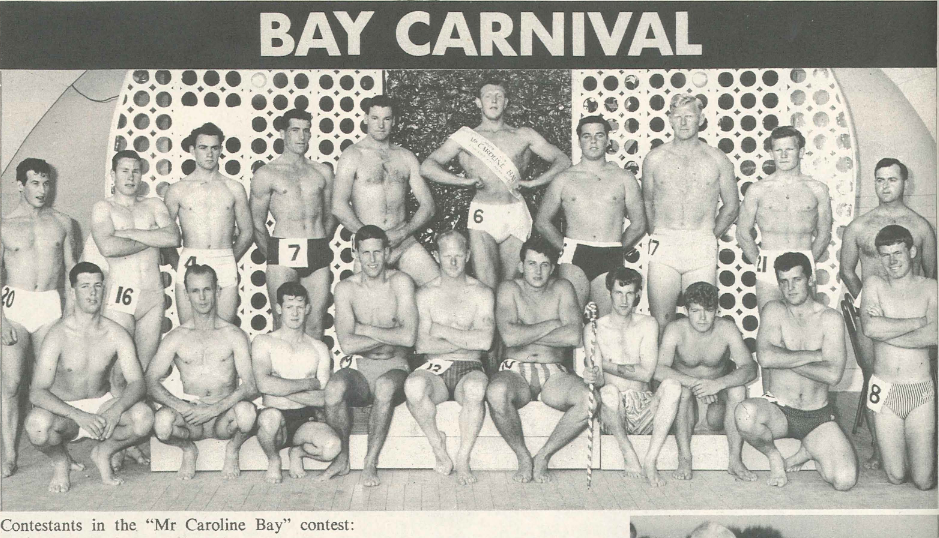
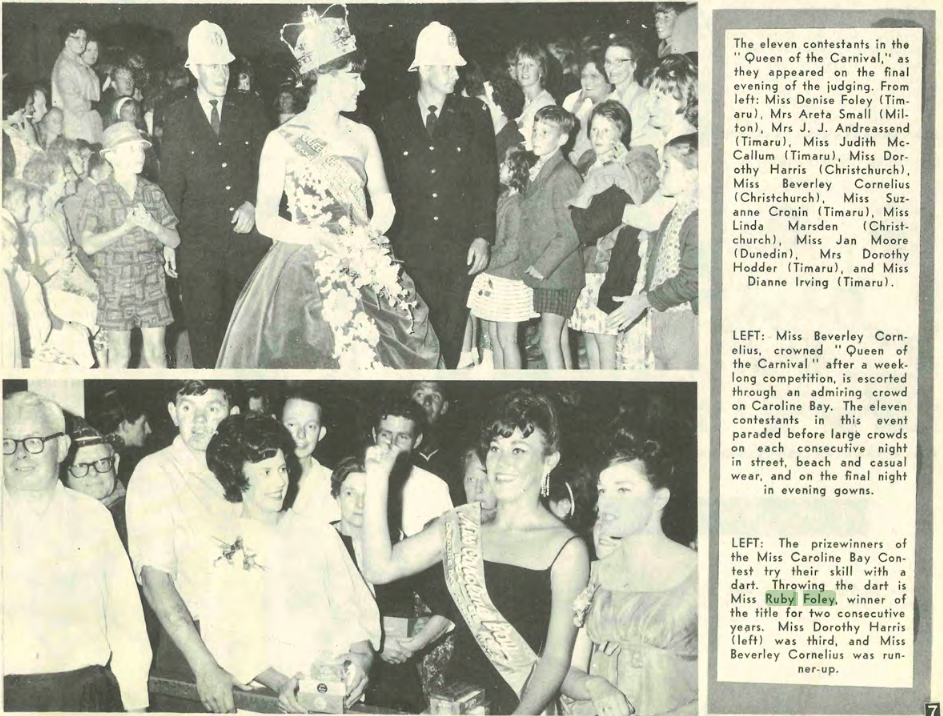
Photo Review: Volume 1, Number 11, February 1965. Aoraki Heritage Collection, https://aorakiheritage.recollect.co.nz/nodes/view/4490
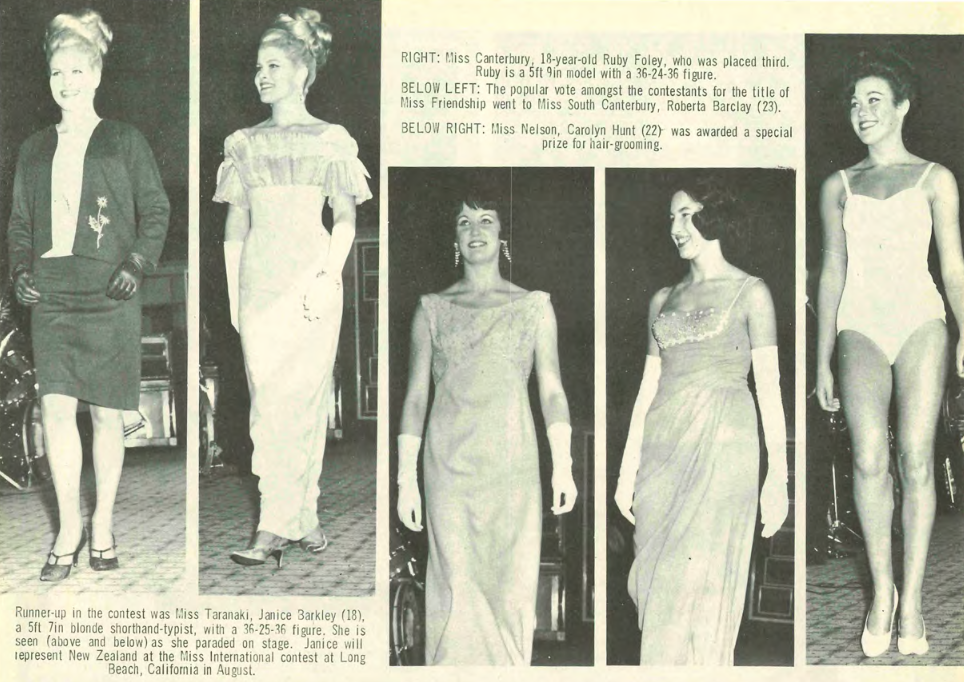
Photo Review: Volume 2, Number 4, July 1965. Aoraki Heritage Collection, https://aorakiheritage.recollect.co.nz/nodes/view/4498
Timeline
1890: Completion of the north mole helps sand accumulate at Caroline Bay, making later recreational development possible.
1902: Timaru Borough Council leases the new foreshore from the harbour board and begins shaping Caroline Bay as a seaside resort.
1911: The Caroline Bay Association is formed to promote Caroline Bay and provide family entertainment over the Christmas and New Year holidays.
1936: The Caroline Bay Soundshell is built. It is designed by Victor Panton and built by W. Hayes.
1957: Concrete auditorium seating is added to the Soundshell, creating the tiered spectator setting seen in the 1965 photograph.
January 1965: Ruby Foley is photographed on the catwalk at the Caroline Bay Soundshell during the Miss Caroline Bay competition. The South Canterbury Museum record identifies her as the eventual winner.
May 1965: Ruby Foley appears as Miss Canterbury on the Miss New Zealand Show tour and is photographed by Gisborne Photo News.
7 June 1965: The Miss New Zealand final is held in Dunedin. Gay Phelps wins the 1965 title.
1970s: Beauty contests remain popular but become more publicly contested, especially through the women’s liberation movement.
Today: The photograph remains a valuable clue to Caroline Bay’s carnival culture, Timaru’s public spaces, and changing ideas about women, spectacle and community memory.
Sources
South Canterbury Museum, “Ruby Foley, Miss Caroline Bay 1965”
https://timdc.pastperfectonline.com/photo/58DF05D4-1EBC-4F8C-811B-101544326310
Te Ara, “Miss Caroline Bay contest, Timaru, around 1965”
https://teara.govt.nz/en/zoomify/38682/miss-caroline-bay-contest-timaru-around-1965
NZHistory, “Caroline Bay”
https://nzhistory.govt.nz/keyword/caroline-bay
NZHistory, “Summer holidays”
https://nzhistory.govt.nz/media/photo/summer-holidays
Timaru District Council, “Historic Heritage Assessment Report HHI30 Caroline Bay Soundshell”
https://www.timaru.govt.nz/__data/assets/pdf_file/0005/673853/Historic-Heritage-Assessment-Report-HHI30-Caroline-Bay-Soundshell-Category-B.pdf
Gisborne Photo News, “Beauties On Parade”, No. 131, 19 May 1965
https://photonews.org.nz/gisborne/issue/GPN131_19650519/t1-body-d34.html
Gisborne Photo News, Miss New Zealand contestants, No. 131, 19 May 1965
https://photonews.org.nz/gisborne/issue/GPN131_19650519/t1-body-d35.html
National Library of New Zealand, “Miss New Zealand contest 1965. Direction Joe Brown Enterprises, Dunedin. Programme”
https://natlib.govt.nz/records/22785238
Te Ara, “Beauty contests, 1960s to the 2000s”
https://teara.govt.nz/en/beauty-contests/page-2
Te Ara, “Winners of beauty contests, 1960–2015”
https://teara.govt.nz/en/table/38685/winners-of-beauty-contests-1960-2015