
By Roselyn Fauth
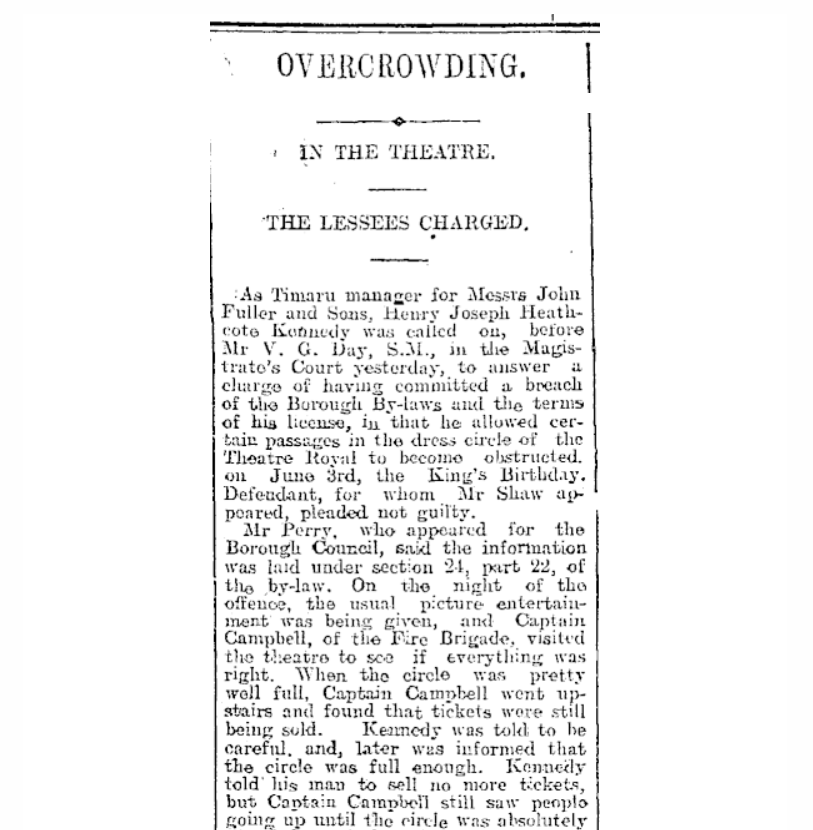
Timaru Herald, Volume XCIV, Issue 14493, 14 July 1911, Page 3 https://paperspast.natlib.govt.nz/newspapers/THD19110714.2.15
Before Harry Kennedy managed Timaru’s theatres, he was the boy sweeping the floors, selling tickets and showing people to their seats. His career would stretch from painted scenery and live performance to silent films, talkies and packed picture houses, but it began with the jobs most people never noticed...
Harry Kennedy and a lifetime in Timaru’s theatres
I found Harry Kennedy while reading Doug Shears’ Tales of South Canterbury: The Bay Hill.
Shears had included Kennedy’s 1971 obituary, and one detail sent me off on another side quest. Before Harry became the well-known manager of Timaru’s Majestic Theatre, he had worked at the old Theatre Royal as a cleaner, usher and ticket seller.
It is not the usual opening scene for a story about theatre... we tend to remember the architects, the leading actors and the big opening nights. Harry’s story begins further down the billing, with the person selling the tickets and sweeping up when everyone had gone home.
One job, several departments
Contemporary newspapers give his full name as Henry Joseph Heathcote Kennedy, although later records usually shorten it to Henry Joseph Kennedy. He was known as Harry.
His obituary said he began working at the Theatre Royal while still young. He cleaned the building, sold tickets and showed patrons to their seats.
Later, he became the custodian and Harry reportedly operated the stage and theatre-lighting switchboard, worked the spotlight, shifted scenery, posted advertising bills around town and cleaned the building.
He was working front of house, backstage, in lighting, advertising and maintenance, sometimes all within the same day.
It must have been one of the best possible educations for a future theatre manager. There was probably very little happening in the building that Harry had not already learned to do himself.
The Theatre Royal was already well established by then. The building began as a stone store before opening as a theatre on 16 July 1877. Heritage New Zealand describes it as Timaru’s first permanent entertainment venue.
Imagine arriving for a show in Harry’s early days. Someone had advertised the performance, prepared the stage, arranged the scenery, checked the lighting, sold your ticket and helped you find your seat.
Harry may have done most of it.
A possible turn on the stage
Kennedy’s obituary said he appeared in several plays organised by actor and theatrical manager Barrie Marschel around the turn of the twentieth century. It also reported that Harry won a gold medal for singing.
I have not found the medal or a surviving cast list naming him, so these details still need a little caution.
Marschel’s Timaru connection, however, is easy to trace.
Newspaper notices place him at the Theatre Royal in 1903, when a production of Arrah-na-Pogue had to be postponed because he was seriously ill. Nearly 30 years later, his own three-act comedy-drama, The Kid from Timaru, played at the same theatre before what the Timaru Herald called a large and appreciative audience.
The timing fits Harry’s obituary. What we need now is the programme with his name on it.
History has an annoying habit of leaving exactly the piece you want in someone else’s attic.
Kennedy’s obituary said he became manager after the Theatre Royal was rebuilt in 1913, but I also found an earlier newspaper report that stated On 14 July 1911, the Timaru Herald covered an overcrowding case involving the Theatre Royal. Henry Joseph Heathcote Kennedy was identified as the Timaru manager for John Fuller and Sons and appeared before the magistrate over passages in the dress circle that were said to have been obstructed.
It is not glamorous evidence, there are no velvet curtains, famous names or opening-night speeches. Just a crowded theatre, a borough bylaw and a manager being asked to explain himself.
But it proves that Harry was already managing the Theatre Royal by July 1911.
That was also the year in which the present auditorium, fly tower and dressing rooms were added. The work was designed by Henry Eli White, who would become one of Australasia’s best-known theatre architects.
So the later obituary’s 1913 date appears to be wrong, or at least too simple.
Harry was not appointed only after the rebuilding. He was already the Fullers’ Timaru manager while this major chapter in the Theatre Royal’s history was unfolding.
One ordinary court report had quietly rearranged the timeline.
From painted scenery to moving pictures
Harry’s career crossed a remarkable period of change. He began in a theatre world of touring companies, live music, painted scenery and stage machinery. Then moving pictures grew from a novelty into one of Timaru’s most popular forms of entertainment. Silent films were followed by the talkies. Theatre programmes became cinema sessions. Physical reels travelled between towns carrying romances, westerns, comedies, newsreels and glimpses of places most local audiences would never see for themselves.
By November 1929, advertisements for the Majestic Theatre were naming “H. Kennedy” as manager for Fuller-Hayward’s. The Majestic became the building most closely associated with the later part of his career. Another small court case helps place him there ten years later. In 1939, someone broke into the Majestic. Harry gave evidence as the manager, reporting damage to the office door and the theft of three shillings.
It was not exactly the crime of the century.
For a history hunter, though, it is extremely useful. The report records his full name, his position and the theatre he managed. Sometimes burglars leave better historical evidence than respectable citizens.
Three theatres at once
Kennedy’s obituary reported that, for almost three years during the Second World War, he managed the Majestic, Theatre Royal and Regent simultaneously. It also called this a New Zealand record.
Each building needed staff, programmes, advertising, maintenance, ticketing and cleaning. Film reels had to arrive at the right theatre at the right time. Projection equipment had to work. Audiences had to be seated and sessions started on schedule. Harry understood those systems from the ground up because he had begun inside them.
His obituary also named projectionist Horace Boardley and cleaner Sam Skudder as members of the Majestic team.
The manager’s name might have appeared in advertisements, but no theatre ran on one person. It needed projectionists, cleaners, ushers, ticket sellers and the people who quietly solved problems without the audience ever knowing there had been one.
Eleven and a quarter million visits
Harry retired as manager of the Majestic in March 1964. His obituary estimated that he had catered for about 11,250,000 patrons during 53 years in theatre management. It also claimed he had watched millions of feet of film pass through projectors and onto Timaru’s screens. (The number should be treated as an estimate rather than a precise audited total, but it captures the scale of the job.)
This was Timaru returning week after week. People came for romances, comedies, westerns and newsreels. Children filled Saturday sessions. Couples met for dates. Families queued for popular releases. During times of war, audiences watched news from the other side of the world flicker across a local screen.
Harry had started by selling one ticket at a time.
Over half a century, those small transactions became millions of visits. It became a family trade as the theatre connection continued into the next generation. According to Harry’s obituary, his son Noel managed picture theatres in the North Island, while his daughter Marge worked for New Zealand film distributors. For the Kennedy family, cinema became more than an evening’s entertainment. It became the family business.
Harry’s career had begun in a Victorian theatre and continued through silent films, talking pictures and the arrival of television. He had watched an entire industry change around him.
The final ticket
After retiring, Harry moved to Parnell in Auckland.
He remained a keen rugby follower and, according to his obituary, continued driving himself to Eden Park on winter Saturdays. He had also been a familiar figure at Timaru’s Fraser Park and was involved in presenting the Skinner Cup to the South Canterbury Rugby Football Union.
Henry Joseph Kennedy died in Auckland on 8 August 1971, aged 90.
Although he had made his home in Auckland, he returned to Timaru for burial. Council cemetery records show that he was interred at Timaru Cemetery on 14 September 1971, in the General Section, Row 55, Plot 900.
Harry Kennedy never became the famous face on the screen, but he was the friendly face at the door.
He was the boy behind the tickets, the man at the lighting switchboard and, eventually, the manager responsible for keeping Timaru’s theatres running.
For more than half a century, he helped generations of people find their seats, settle into the dark and wait for the show to begin.
Research note
This story began with Harry Kennedy’s obituary, published in the Timaru Herald on 10 August 1971 and reproduced by Doug Shears in Tales of South Canterbury, Vol. 3: The Bay Hill.
Details have been checked against contemporary newspapers, heritage records and the Timaru District Council cemetery database where possible.
Kennedy’s reported singing medal, appearances in Barrie Marschel productions, work in Dunedin and Invercargill between 1931 and 1935, claimed New Zealand record for managing three theatres, and estimated audience of 11,250,000 patrons have not yet been independently confirmed. They remain attributed to his obituary.
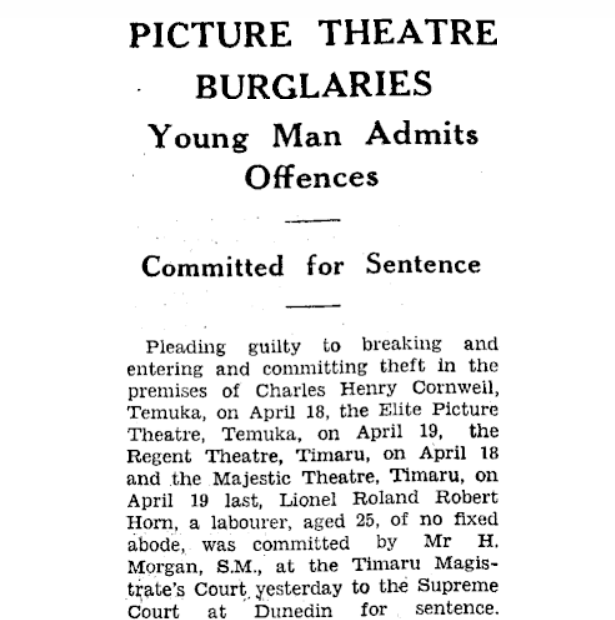
Timaru Herald, Volume CXLVI, Issue 21337, 5 May 1939, Page 11 https://paperspast.natlib.govt.nz/newspapers/THD19390505.2.99
Timeline
16 July 1877
The Theatre Royal opens on Stafford Street. The building had originally been constructed as a stone store. It later became Timaru’s first permanent entertainment venue.
About 1881
Henry Joseph Kennedy is born. His obituary described him as Timaru-born, while the official cemetery record gives his age as 90 when he died in August 1971. His exact birth date has not yet been confirmed.
Late 1890s or early 1900s
According to his 1971 obituary, Harry begins working at the old Theatre Royal as a cleaner, usher and ticket seller. He later becomes custodian, with duties including operating the lighting switchboard and spotlight, shifting scenery, bill posting and cleaning. This part of his early career has not yet been independently confirmed.
Around the turn of the twentieth century
Kennedy’s obituary says he appears in plays organised by Barrie Marschel and receives a gold medal for singing. A programme or newspaper report naming Kennedy in a production has not yet been found.
1903
Barrie Marschel is producing and performing at the Theatre Royal, confirming that he was active on Timaru’s stage during the period in which Kennedy’s theatrical career reportedly began.
1911
The Theatre Royal’s present auditorium, fly tower and dressing rooms are added. The auditorium is designed by theatre architect Henry Eli White.
14 July 1911
A Timaru Herald court report identifies Henry Joseph Heathcote Kennedy as the Timaru manager for John Fuller and Sons. He appears in court over alleged overcrowding and obstructed passages at the Theatre Royal. This is the earliest firm evidence currently found of his managerial career.
11 March 1929
The Majestic Theatre opens in Timaru. A contemporary advertisement announces its opening programme and the mayor’s involvement in the occasion.
20 November 1929
A Majestic Theatre advertisement names “H. Kennedy, Manager, Fuller-Hayward’s”, confirming his connection with the new cinema.
1931–1935
Kennedy reportedly leaves Timaru for several years to manage three theatres in Dunedin and Invercargill. This information currently comes from his obituary and still needs independent confirmation.
5 May 1939
A court report identifies Henry Joseph Heathcote Kennedy as manager of the Majestic following a break-in in which an office door was damaged and three shillings were stolen.
During the Second World War
Kennedy reportedly manages the Majestic, Theatre Royal and Regent simultaneously for nearly three years. His obituary described this as a New Zealand record, but the national-record claim has not yet been independently verified.
March 1964
Kennedy retires as manager of the Majestic. His obituary estimates that he had served about 11,250,000 patrons during 53 years in theatre management. The figure appears to be an estimate rather than an audited total.
8 August 1971
Henry Joseph Kennedy dies in Auckland, aged 90.
10 August 1971
His obituary is published in the Timaru Herald. Doug Shears later reproduces it in Tales of South Canterbury, Vol. 3: The Bay Hill.
14 September 1971
Kennedy is interred at Timaru Cemetery in the General Section, Row 55, Plot 900.
Sources
Doug Shears, Tales of South Canterbury, Vol. 3: The Bay Hill. Bay Hill Publishers, 2004. Aoraki Heritage Collection, accessed 23 July 2026. Includes a reproduction or transcription of Harry Kennedy’s Timaru Herald obituary of 10 August 1971.
https://aorakiheritage.recollect.co.nz/nodes/view/8185
Harry Kennedy
Timaru Herald, “Overcrowding: In the Theatre: The Lessees Charged”, 14 July 1911, page 3. Identifies Henry Joseph Heathcote Kennedy as the Timaru manager for John Fuller and Sons.
https://paperspast.natlib.govt.nz/newspapers/THD19110714.2.15
Timaru Herald, Majestic Theatre advertisement, 20 November 1929, page 1. Names “H. Kennedy, Manager, Fuller-Hayward’s”.
https://paperspast.natlib.govt.nz/newspapers/THD19291120.2.2.6
Timaru Herald, “Picture Theatre Entered”, 5 May 1939. Identifies Henry Joseph Heathcote Kennedy as manager of the Majestic Theatre.
https://paperspast.natlib.govt.nz/newspapers/THD19390505.2.99
Timaru District Council, cemetery record for Henry Joseph Kennedy. Records his death in Auckland on 8 August 1971 and his interment at Timaru Cemetery on 14 September 1971, General Section, Row 55, Plot 900.
https://www.timaru.govt.nz/community/community-and-culture/cemeteries/cemetery-search?BurialId=22819
Theatre Royal
Heritage New Zealand Pouhere Taonga, “Theatre Royal”, List No. 5393. Records the theatre’s opening on 16 July 1877 and the addition of the present auditorium, fly tower and dressing rooms in 1911.
https://www.heritage.org.nz/list-details/5393/Listing
Timaru District Council, Historic Heritage Item Record Form: Theatre Royal, 118–124 Stafford Street, Timaru.
https://www.timaru.govt.nz/__data/assets/pdf_file/0008/673883/Historic-Heritage-Assessment-Report-HHI60-Theatre-Royal-Category-B.pdf
Majestic Theatre
Timaru Herald, Majestic Theatre opening advertisement, 11 March 1929, page 1.
https://paperspast.natlib.govt.nz/newspapers/THD19290311.2.2.7
Robert Smith, “Majestic Days: Timaru’s Phantom Movie Theatre”, RNZ, 5 October 2024. A useful secondary account of the Majestic, its earlier Lyceum building and later memories of the cinema.
https://www.rnz.co.nz/news/top/529921/majestic-days-timaru-s-phantom-movie-theatre
Barrie Marschel
Timaru Herald, Theatre Royal notice concerning Barrie Marschel and Arrah-na-Pogue, 5 October 1903, page 1.
https://paperspast.natlib.govt.nz/newspapers/THD19031005.2.2.5
Timaru Herald, “‘The Kid from Timaru’”, 17 May 1932, page 7.
https://paperspast.natlib.govt.nz/newspapers/THD19320517.2.37
Timaru Herald, “Death of Mr Barrie Marschel: Author of ‘The Kid from Timaru’”, 11 July 1940, page 10.
https://paperspast.natlib.govt.nz/newspapers/THD19400711.2.77
National Library of New Zealand, “Marschel, Barrie, active 1890–1936”.
https://natlib.govt.nz/records/32194860
Important research distinction
The 1911 management role, 1929 Majestic connection and cemetery details are independently supported. Kennedy’s earliest jobs, stage appearances, singing medal, southern theatre appointments, three-theatre record and estimated 11.25 million patrons currently rely on the 1971 obituary reproduced by Doug Shears.