
Cemeteries are outdoor archives. Every headstone is a record: a name, a date, a family, a migration, a child, a soldier, a worker, a mother, a neighbour.
Some graves are visited often. Others have no family nearby anymore. People move away. Records get muddled. Family lines end. A stone can sit for decades, weathering quietly, until someone notices the name is disappearing under moss or lichen and thinks: should I clean this?
The answer is: maybe. But carefully... Headstone care is not about making an old grave look new. It is about doing the least harm.
First, check who is allowed to do what
This is general information only. It is not legal, conservation, health and safety, or professional stonework advice.
In New Zealand, cemetery land is usually managed by a council, trust, church, iwi, or other cemetery authority. Public cemetery grounds are generally maintained by the local authority, including mowing and general upkeep.
The headstone or memorial is usually the responsibility of the plot owner, family, next of kin, or authorised representative. In Timaru District Council cemeteries, memorials are the responsibility of the plot owner to erect and maintain. Timaru’s cemetery bylaw says headstones and other monuments should be kept in safe and proper repair by the purchaser of the plot, then the immediate family. If no one can be located after reasonable enquiry, Council may undertake necessary maintenance.
Picking up loose leaves or removing obvious rubbish is one thing. Cleaning, treating, repairing, repainting, re-lettering, lifting, straightening, replacing, or altering a headstone is another.
If the grave is not your family’s grave, ask first. If the cemetery rules are unclear, ask first. If the stone is damaged, ask first.
For urupā, churchyards, private cemeteries, military graves, heritage graves, or culturally significant graves, seek the right permission before doing anything.
Start with your eyes, not your brush... before you clean, look closely.
Is the headstone leaning? Is it cracked? Is the surface flaking, powdery, sandy or crumbling? Are pieces loose? Is the inscription painted, gilded, lead-filled or already fading? Are there ceramic photographs, tiles, shells, kerbing, ironwork or old grave ornaments?
Take a photo before you touch anything. Photograph the whole grave, then the inscription, then any damage.
If the stone looks unstable or fragile, do not clean it. Do not lean on it. Do not push it. Do not try to straighten it. Report unsafe memorials to the cemetery manager or council.
Sometimes the best care is simply recording the grave properly.
Use water first
For light dirt, clean water is usually enough.
Take:
- A bottle or container of clean water
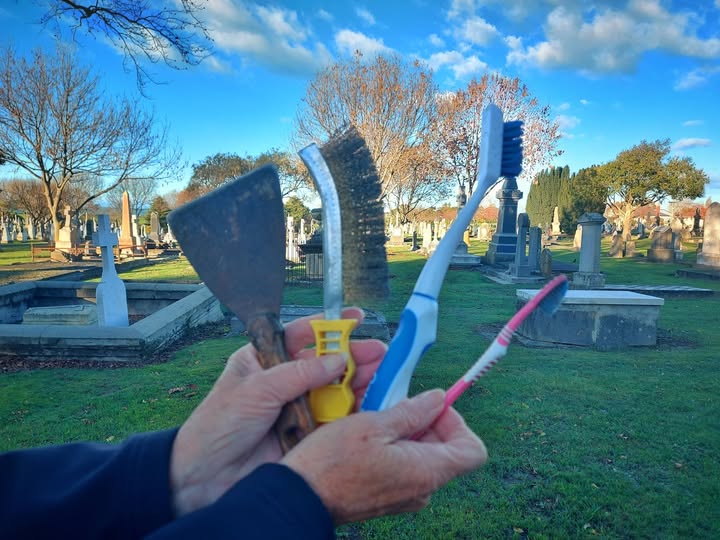
- A soft nylon brush
- An old toothbrush
- A soft cloth or sponge
- Gloves
- A bag for loose rubbish
- Your phone or camera
Wet the stone first. Gently loosen dirt with the soft brush or cloth. Keep the surface damp while you work. Rinse with clean water.
Do not scrub hard. Do not scrape.
Avoid:
Wire brushes
Scouring pads
Steel wool
Metal scrapers
Pressure washers
Water blasters
Bleach
Vinegar
Acidic cleaners
Ammonia
Salt
Abrasive powders
Harsh household cleaners
Do not rub chalk, flour, shaving cream or paint into inscriptions to make them easier to photograph. It may help the photo, but it can harm the stone.
Know the stone
Granite is usually the strongest common headstone material. Polished granite often needs only occasional washing with clean water and a soft cloth.
Marble is softer and more porous. Many older white headstones are marble. They can lose detail, stain and weather more easily.
Limestone and sandstone are softer again. If they are flaking, sandy, layered or crumbling, leave them alone and get advice.
Bronze plaques naturally develop patina. That colour change is part of the metal’s ageing process. Do not attack bronze with harsh polish unless the cemetery or plaque provider recommends it.
If you do not know what the material is, treat it as fragile.
Lichen, moss, mould and algae
This is where people are most tempted to scrub.
Do not pick lichen off with a knife. Do not blast it with water. Do not sand it back. The growth may be annoying, but the stone underneath may be weaker than it looks.
If the stone is sound, the grave is yours to care for, and the cemetery rules allow it, a suitable outdoor biological cleaner may be used. Products such as Bio-Shield or Wet & Forget are commonly used for moss, mould, algae and lichen. Follow the product label. Test a small area first. Avoid overspray onto nearby graves, plants, paths, grass, metalwork or fragile surfaces.
Bio-Shield’s own guidance says it is sprayed on and left, with no water blasting or scrubbing. Wet & Forget gives similar “spray and leave” advice for organic growth. These products work gradually. The growth dies and weathers away over weeks or months.
That slow result is safer than forcing a quick one.
Protect the inscription
The inscription is the most important part of the headstone.
A name might be the only public record left in that place. A date might be the detail a descendant has been searching for. A line of text might connect a family story.
Avoid scrubbing directly over fragile lettering, painted lettering, gilding, lead lettering, ceramic photographs or worn decorative detail.
Never repaint, re-cut, re-gild or fill lettering yourself. That is restoration work and needs the right permission and skill.
Respect the whole grave
A grave is more than the upright stone.
Kerbing, tiles, shells, ironwork, stones, surrounds, plantings and small objects may all be part of the grave’s history. What looks messy may still be meaningful.
Remove loose litter and obvious rubbish. Be careful with everything else.
Do not remove old grave surrounds, vases, plants, ornaments or historic materials unless you know you have authority to do so. Many councils also have rules about glass containers, loose ornaments and anything that creates a mowing or safety hazard.
If no family is nearby
This is common. Many South Canterbury graves no longer have family close enough to visit.
If you want to help care for an unattended grave, start with documentation.
Photograph it. Record the name, cemetery and plot location. Check the cemetery database if available. Share the information with family historians, descendants, the cemetery manager or a local heritage group.
For community cemetery working bees, get council or cemetery approval first. Agree on what volunteers may do, what products may be used, and what must be left to professionals.
A safe rule is:
Tidy gently.
Photograph first.
Use water first.
Ask before applying anything.
Leave damaged stones alone.
Call a monumental mason for repairs.
Quick checklist
Before cleaning a headstone, ask:
Is it my family grave, or do I have permission?
Have I checked the cemetery rules?
Have I photographed it first?
Is the stone stable?
Is the surface sound?
Is the inscription fragile?
Can I clean it with water only?
Am I using only soft tools?
Am I avoiding harsh chemicals and pressure washing?
Would a professional be safer?
If the answer is uncertain, stop.
The point of grave care
A headstone does not have to be spotless to be respected.
Some weathering belongs there. It shows age, exposure and time. The job is not to erase that. The job is to avoid making the damage worse.
Done well, gentle care can make a name readable again, protect family history, and help people find their way back to someone who might otherwise be forgotten.
Before you scrub, pause.
Read the name first.
Then choose the gentlest care.