
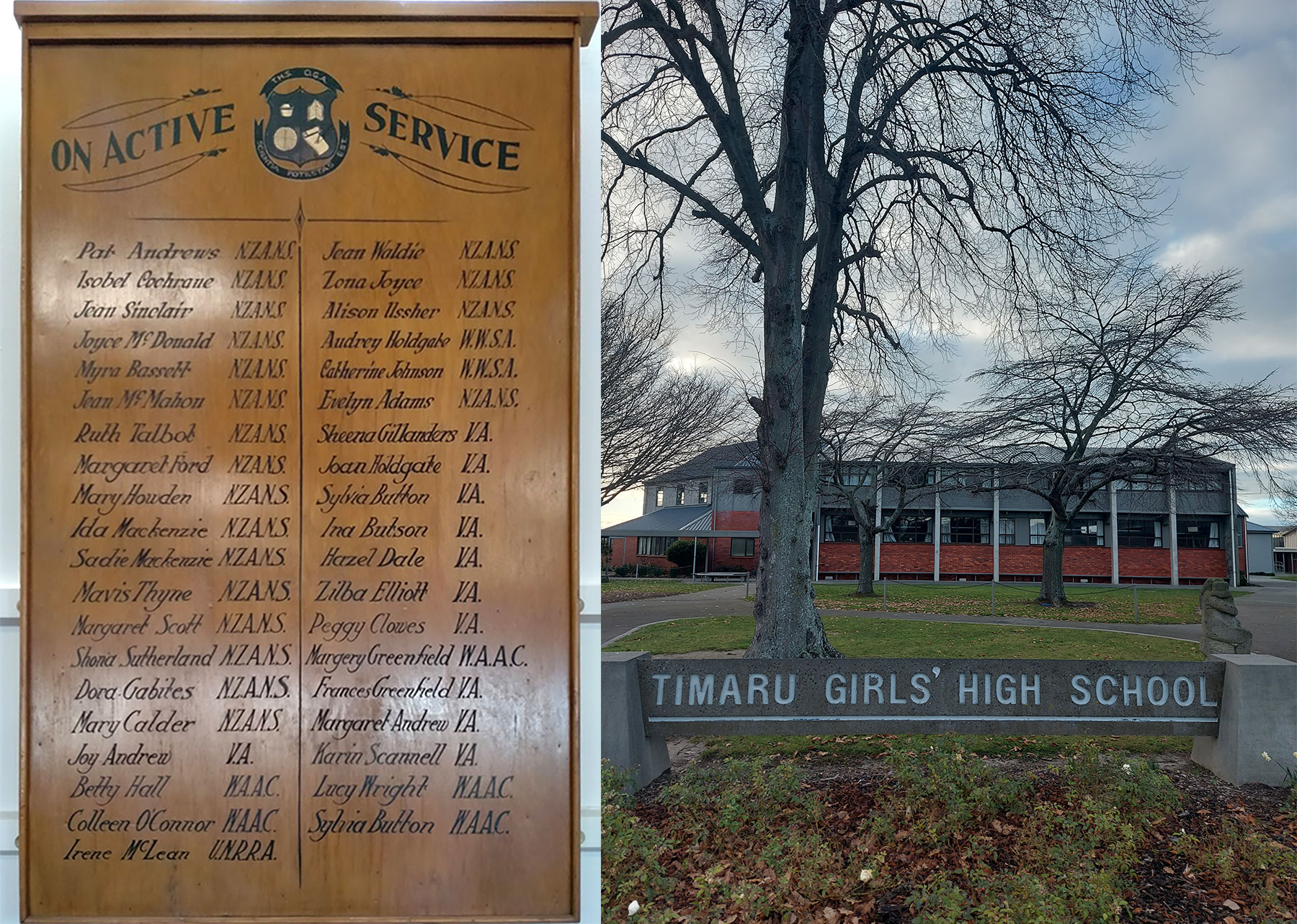
Location: Timaru Girls’ High School, 68 Cain Street
Access: School grounds/interior, by permission
Associated years: First World War and Second World War memory, school founded 1880, split into girls’ and boys’ schools in 1898
Associated people/groups: former pupils on active service, nurses, women’s auxiliary and home-front workers, Nora Dickie Hall
Timaru Girls’ High School is essential because women’s service belongs in this story. Aoraki Heritage records the school’s “On Active Service” honours board in Nora Dickie Hall, listing previous students who served during the Second World War. The same Aoraki Heritage school page records Timaru High School’s foundation in 1880 as a co-educational school, and the split into separate girls’ and boys’ schools in 1898.
This stop connects local women to a national and international war story.
Women served as nurses, auxiliary workers, clerks, drivers, signallers, medics, fundraisers, teachers, mothers, widows, workers and organisers.
The Caroline Bay panel for the Marquette also helps bring women into the story because New Zealand nurses and medical personnel died when the ship was sunk.
Around 40 'Old Girls' fropm Timaru Girls High School served overseas during the war, as nurses, VADs, and WAAC.
Find a WuHoo: As well as learning about which men served?, ask which women served, nursed, worked, organised, waited, grieved and remembered?
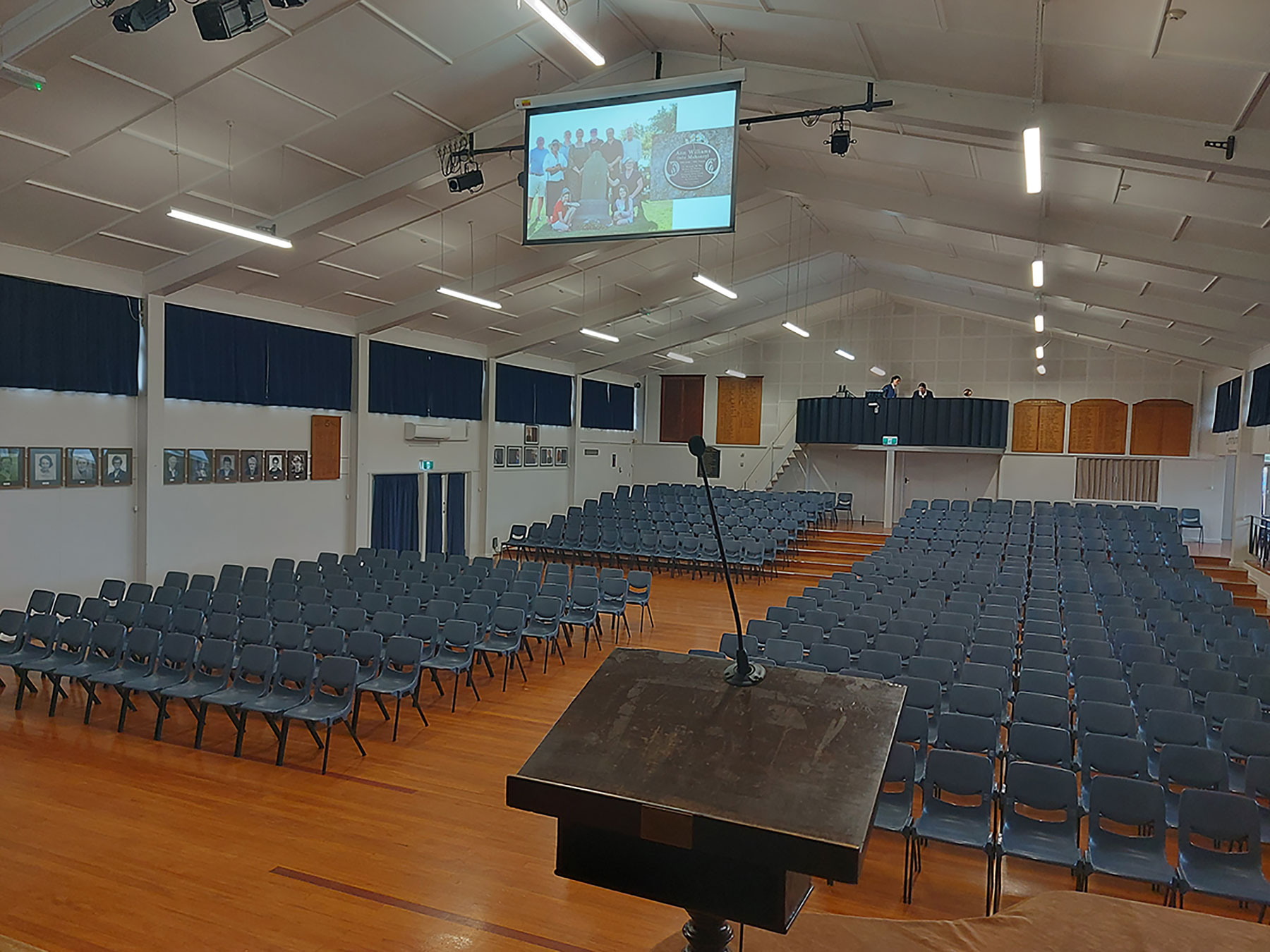
Timaru Girls' High School Hall. On the Wall by the main entrance hangs the On Active Service Board. - Photo Roselyn Fauth
A few blocks away at the Timaru Boys High School, they grieved the loss of 53 Old Boys who died in the First World War, and 132 more in the Second World War. In 1924, the Timaru Boys High School opened a Memorial Library in honour of those who died in the Great War. A wing was added in 1955 to commemorate those lost in the Second World War, and a stained-glass window was unveiled to mark their memory.

Timaru High School 1880-1955 (09 Apr 1955). Aoraki Heritage Collection, accessed 23/06/2025, https://aorakiheritage.recollect.co.nz/nodes/view/1727
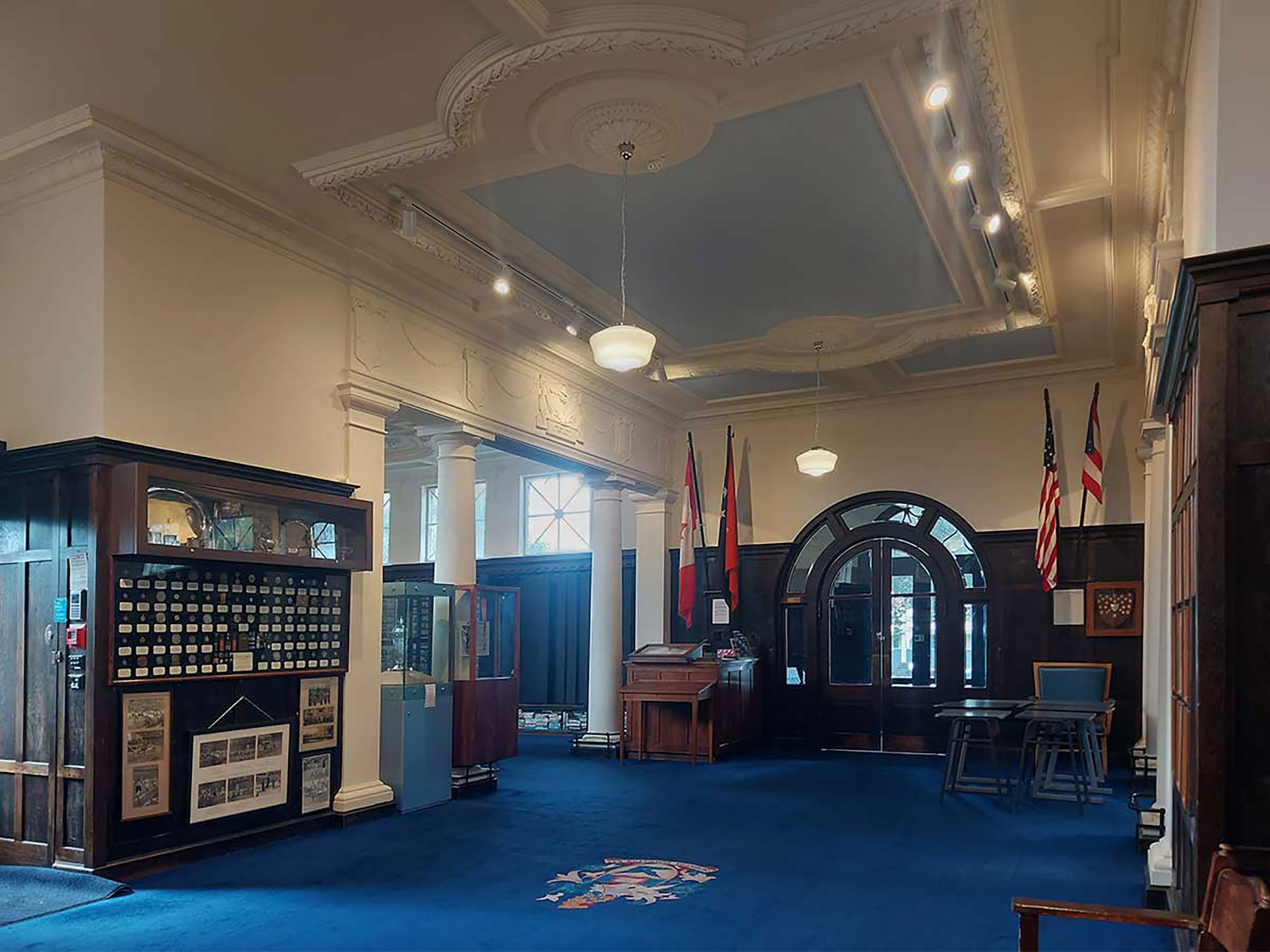
Inside the Timaru Boy's High School Memorial Library. The Doors were a gift from Timaru Girls' High School. Photo: Roselyn Fauth

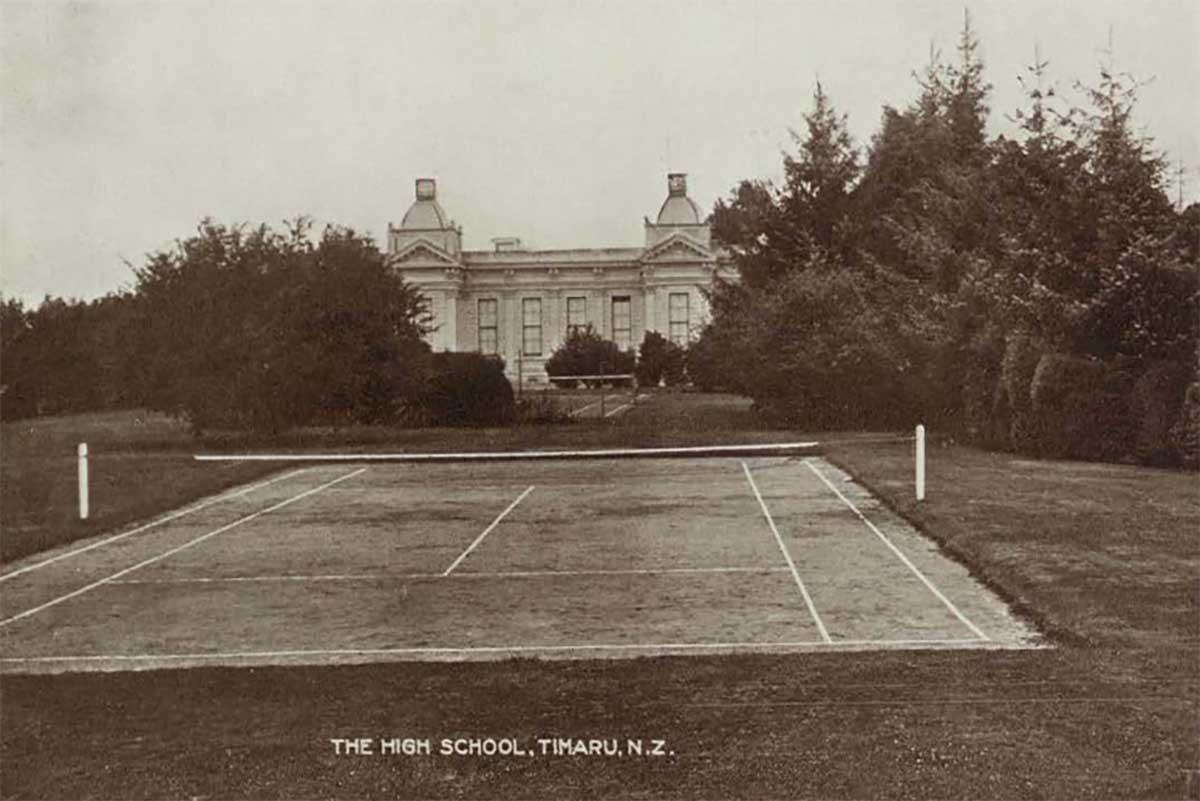
Timaru Girls High School around c1915 with girls posted in groups in front of the main school building. South Canterbury Museum 2009/108.01. The schools motto is Motto, Scientia Potestas Est (knowledge is power) as a common seal. This was taken from FrancisBacon’s “Religious Meditation’ 1597. It opened for lessons on Monday 2 February 1880 as a co-educational secondary school located on Cain and Hassall Streets. The day saw 35 girls and 28 boys. (Aged from 13 to 19 years old). Classes were to begin at 10am and finish at 4pm. The first school building constructed in 1880 for the considerable sum of 4 448 pounds by Mr James Gore of Dunedin.
Following a major fire in 1898, if officially split into two single-sex schools on the same site, with girls remaining at the original location. In 1913 Timaru Boys' High School moved to North Street. The school role was 76 years at the start of 1914.
The boarding hostel was added by 1920 to support rural students. Miss Mary McLean Principal for the Girls. She had also been a student of the school in the past.
The first Boarding House was established in a rented house, 100 North Street, known as ”Croomlea”. The house had been owned by Andrew MCKay. The first women to graduate from the School both studied medicine; Dr Elizabeth Gunn (Otago University) and Dr A Balfour from (Edinburgh University).
Post WWII saw a massive increase in roll and the buildings that were added to site were constructed. A lot of these buildings are buildings that we still have on site. Martins Field was nambed after AC Martin, who was the School Board Secetary for many years. In 1963, Timaru Girls’ High School became the largest girl's school in The South Island with a Roll of 771. (Source Timaru Girls High Archives)
The names on the role of honour board belonged to real girls and young women who once walked through TGHS just as students do today. They sat in classrooms, swam in school sports, planned careers, wrote letters home, and imagined their futures. Then war reached into their lives and changed them. For TGHS, the war connection was not only through the names on the honours board. Many old girls served overseas, and the school kept in touch with them through letters and parcels. At the same time, war reshaped daily life at school itself, bringing shortages, patriotic fundraising, first aid training, blackout rules, slit trenches, rationing in the hostel, and emergency planning on site. No school magazine was published until 1944 because of paper shortages, homework was written on tea packets, and exam questions were written on blackboards.
Timaru Girls’ High School's war stop in this tour reminds us the war was not something happening somewhere far away. It was felt in the routines of school life, in the anxieties of boarders, in the changing roll, and in the lives of old girls scattered across the world. The school roll fell during the war, as happened in many secondary schools, because family members were away at war and some teenagers were needed at home or went out to work. Some old girls returned to school while on leave and spoke to students, showing that the connection between TGHS and its former pupils remained personal and immediate.
Girls carried cork and cotton wool for air raid precautions. Boarders kept emergency supplies under their beds, including a mattress cover to be filled with straw, food rations, and utensils in case of evacuation. During alerts, they sometimes held impromptu concerts while waiting for the all-clear. Prize money was even given to the Patriotic Fund.
Tthe school kept its links with former pupils serving overseas. Letters were read out at assembly and parcels were sent from home. In October 1945, the TGHS Chronicle recorded women still serving overseas, women returning home, and Marjorie Monaghan’s release from an internment camp in North China. It also noted the school and Old Girls’ Association welcoming home former pupils who had returned to New Zealand from overseas service.
Then there are the stories behind the young women's names.
One old girl who stands out is Margery Greenfield. School records show she came to TGHS from Waimataitai School in 1928, took the domestic course, hoped to go into hairdressing, and appeared in school swimming results. That matters, because it reminds us that before she became part of wartime remembrance, she was simply a schoolgirl here in Timaru, with ordinary routines and ambitions of her own.
Three old girls serving in Italy — Pat Andrew, Jean Sinclair, and Joyce MacDonald — sent back two wrought-iron replicas of the school crest made by an Italian craftsman as thanks for parcels from home. Even from the other side of the world, they were still thinking of their school.
And when victory finally came, TGHS girls were part of the town’s response. On 9 May 1945, 150 girls took part in Timaru’s VE Day Victory Parade down Stafford Street. Even after the war ended, the school continued to help, sending food parcels through 1946 to Britain, including to Dr Barnardo’s Home, a welfare centre in Paddington, a children’s hospital in Bath, and a girls’ school in Wales.
So if you stop at Timaru Girls’ High School on a WuHoo war tour, pop into the schools reception and ask if you can see the honours board.
Look closely. It is not just a memorial. It is a sign into a much bigger story about service, separation, resilience, homesickness, duty, and the way a girls’ school in Timaru was connected to world events in very real ways. These were not just names on a board. They were TGHS girls too.
Elizabeth Catherine Gunn (1879–1963) was a pioneering New Zealand paediatrician and public health reformer who played a central role in advancing child health. Educated at Timaru Girls’ High and Otago Girls’ High Schools, she earned her medical degree in Edinburgh in 1903 and later trained in obstetrics in Dublin. Returning to New Zealand, she joined the School Medical Service in 1912 and served as a captain in the New Zealand Medical Corps during World War I. In 1919, she founded New Zealand’s first health camp for children, launching a nationwide movement to support the wellbeing of undernourished and vulnerable youth. As Director of the Division of School Hygiene from 1937 to 1940, she introduced innovations in school health education and parent engagement. Known for her strong will and dedication, she continued to practise medicine after retiring and was appointed MBE in 1951 for her services to child health.
Around 40 'Old Girls' from Timaru Girls High School served overseas during the war, as nurses, VADs, and WAAC, dided in a plane crash in France in 1945.
Joyce Guthrie, whose maiden name was Macdonald, grew up in Timaru and attended Waimataitai Primary School followed by Timaru Girls' High School. She trained as a nurse at Timaru Hospital and gained experience working in local hospitals before joining the New Zealand Army Nursing Service in 1941. For three years she served in military hospitals abroad, beginning in Egypt and the Middle East, and later following New Zealand troops to a hospital in Italy. She rose to the rank of lieutenant during this time. Her memoir, Away From Home, shows her strong dedication to the care of her patients, as well as a clear sense of adventure. While on leave, she travelled to places such as the Nile River, the Holy Land, Petra and Khartoum. One of these trips led to her being disciplined for returning late without permission. Joyce was particularly struck by the courage and resilience of the New Zealand soldiers she nursed, especially in the orthopaedic ward where she dealt with some of the most serious cases. After the war, she married, moved to Dunedin, and remained involved in community work through the Red Cross.

New Zealand. Dept. of Internal Affairs. Publicity Division. The 2nd New Zealand General Hospital in Italy where Joyce served later in her war [photograph]. Ref: DA-09235-F. Alexander Turnbull Library, Wellington, New Zealand. Retrieved from https://natlib.govt.nz/records/23028579
![New Zealand. Department of Internal Affairs. Publicity Division. The 2nd New Zealand General Hospital, Italy [photograph]. Ref: DA-09076-F. Alexander Turnbull Library, Wellington, New Zealand. Retrieved from <a href=](https://wuhootimaru.co.nz/images/mini_magick20250624-8-ngweby.jpg) https://natlib.govt.nz/records/22876366
https://natlib.govt.nz/records/22876366
LEFT: New Zealand. Department of Internal Affairs. Publicity Division. The 2nd New Zealand General Hospital, Italy [photograph]. Ref: DA-09076-F. Alexander Turnbull Library, Wellington, New Zealand. Retrieved from https://natlib.govt.nz/records/22876366 RIGHT New Zealand. Department of Internal Affairs. Publicity Division. An interior view of a New Zealand military hospital in Italy, showing nurses attending to patients [photograph]. Ref: DA-07530-F. Alexander Turnbull Library, Wellington, New Zealand. Retrieved from https://natlib.govt.nz/records/22446814

Timaru, New Zealand, circa 1910, Timaru, by William Ferrier, F.W. Hutton & Co. Gift of Lord Kitchener, 1960. Te Papa (AL.000566)
Page from the "Official Guide: Timaru and surrounding districts". Aoraki Heritage Collection, https://aorakiheritage.recollect.co.nz/nodes/view/8923
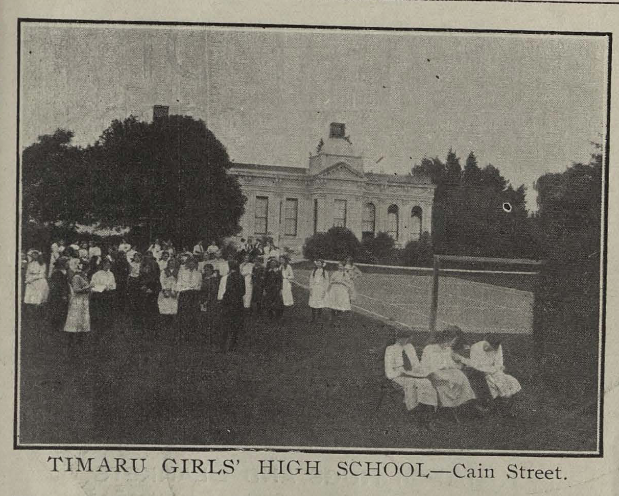
Page from the "Official Guide: Timaru and surrounding districts". Aoraki Heritage Collection, https://aorakiheritage.recollect.co.nz/nodes/view/8923