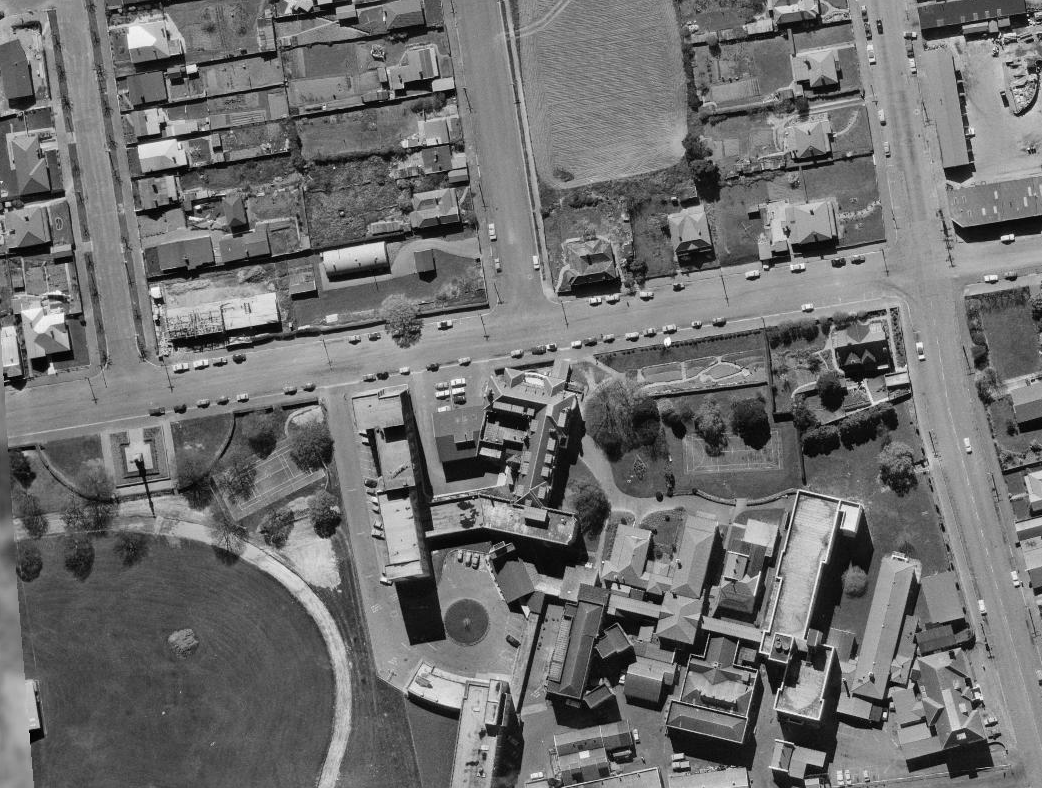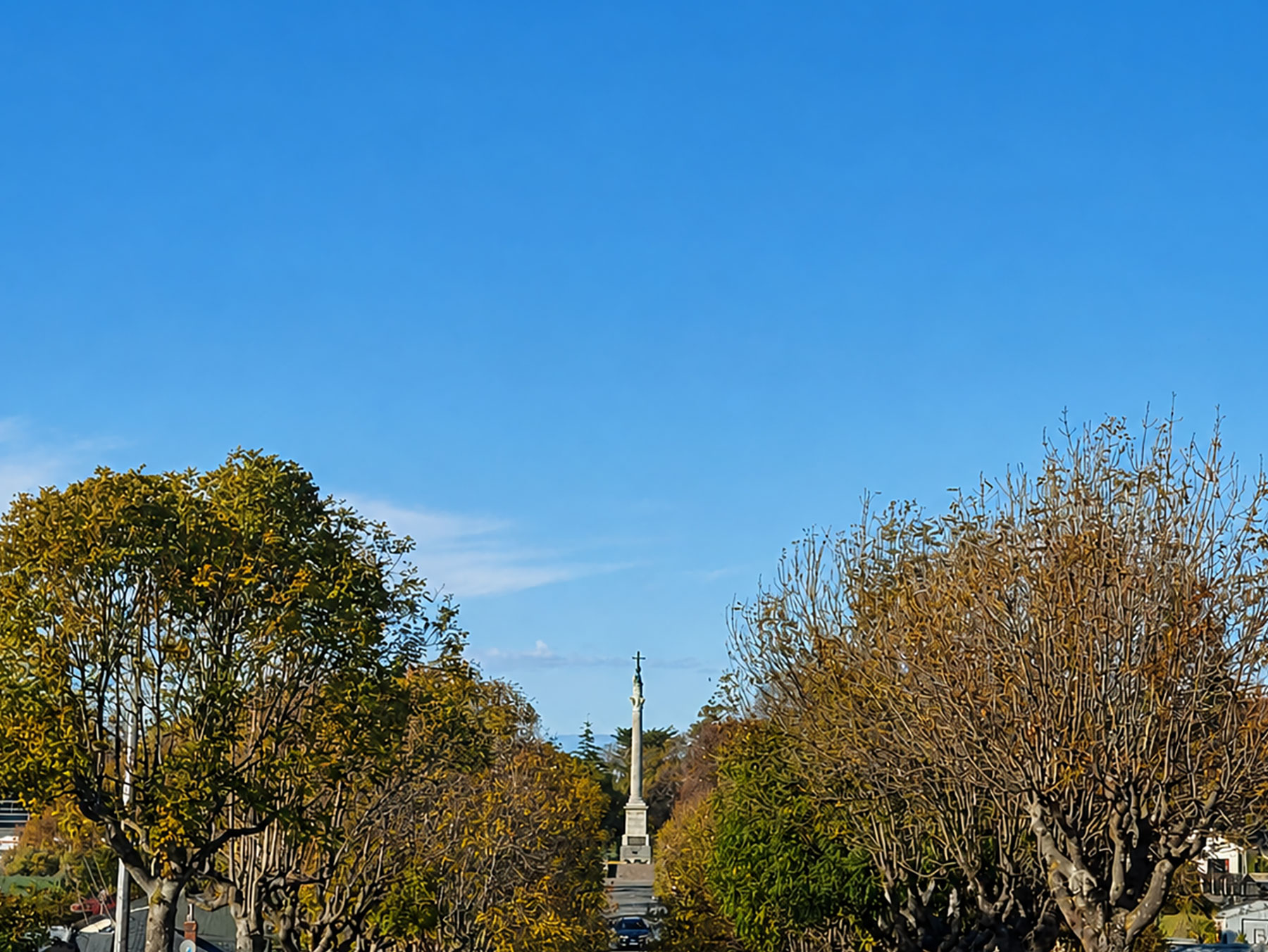
Location: Memorial Avenue, Timaru
Access: Public
Associated years: 1920 name change, 1926 memorial landscape
Associated people/groups: returned soldiers, South Canterbury RSA, Timaru District Council, Anzac Day participants
Memorial Avenue is not just a street. Poppy Places records that the name changed from Charles Street to Memorial Avenue in 1920 because veterans marched up the street to the memorial area. It is now marked as part of the Poppy Places Project, which recognises street names and places connected to New Zealand’s overseas military service.
This is a walking chapter in the tour. It physically links the South African War memorial, the civic war memorial landscape and the Botanic Gardens. It shows how Timaru turned remembrance into a route. A memorial avenue helps people move through memory, not just stand in front of it.
Find a WuHoo: Walk the avenue slowly. Notice how the street directs the eye and body towards remembrance.
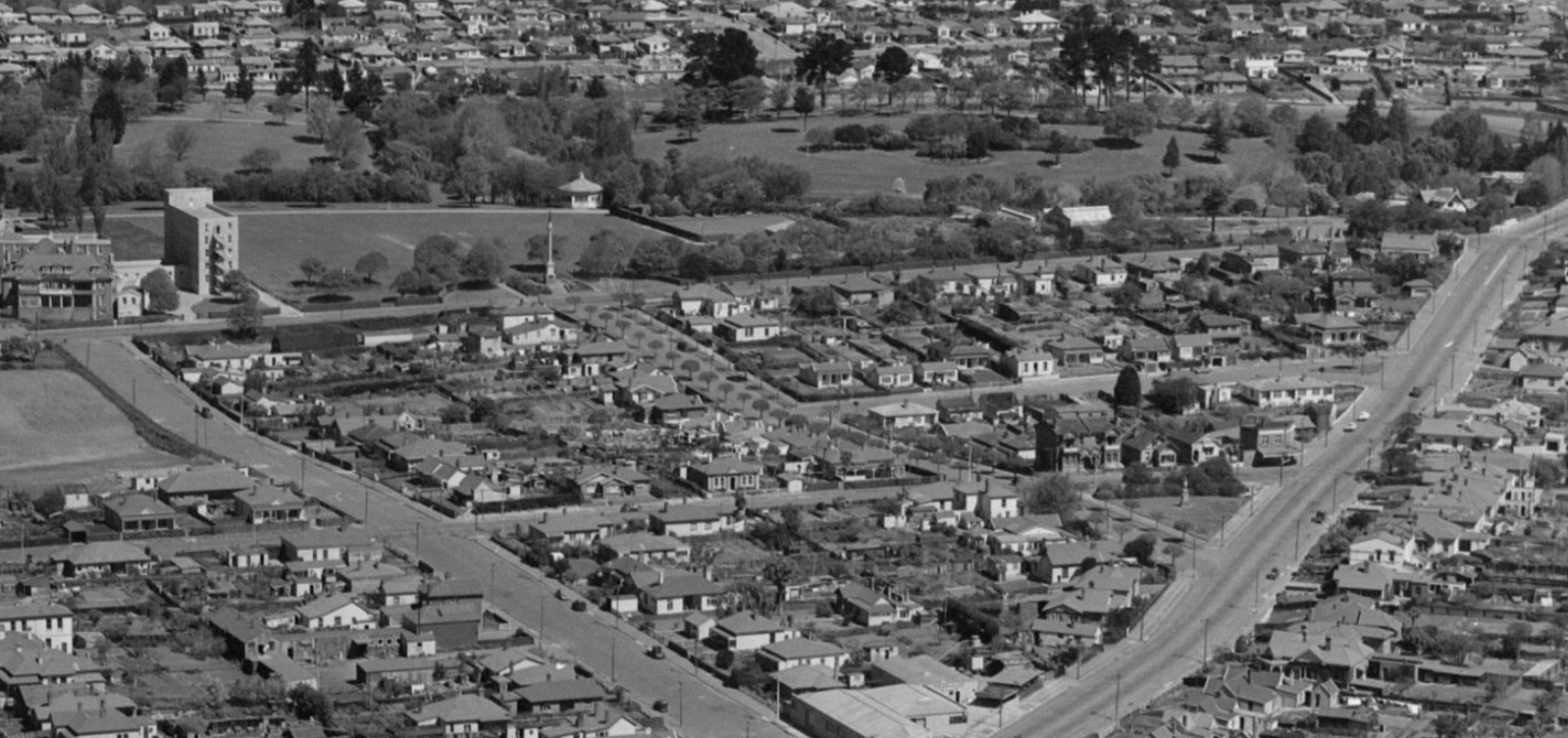
War Memorial and the Avenue - Oct 1956 crop from whites aviation survey photo https://tiaki.natlib.govt.nz/#details=ecatalogue.711006
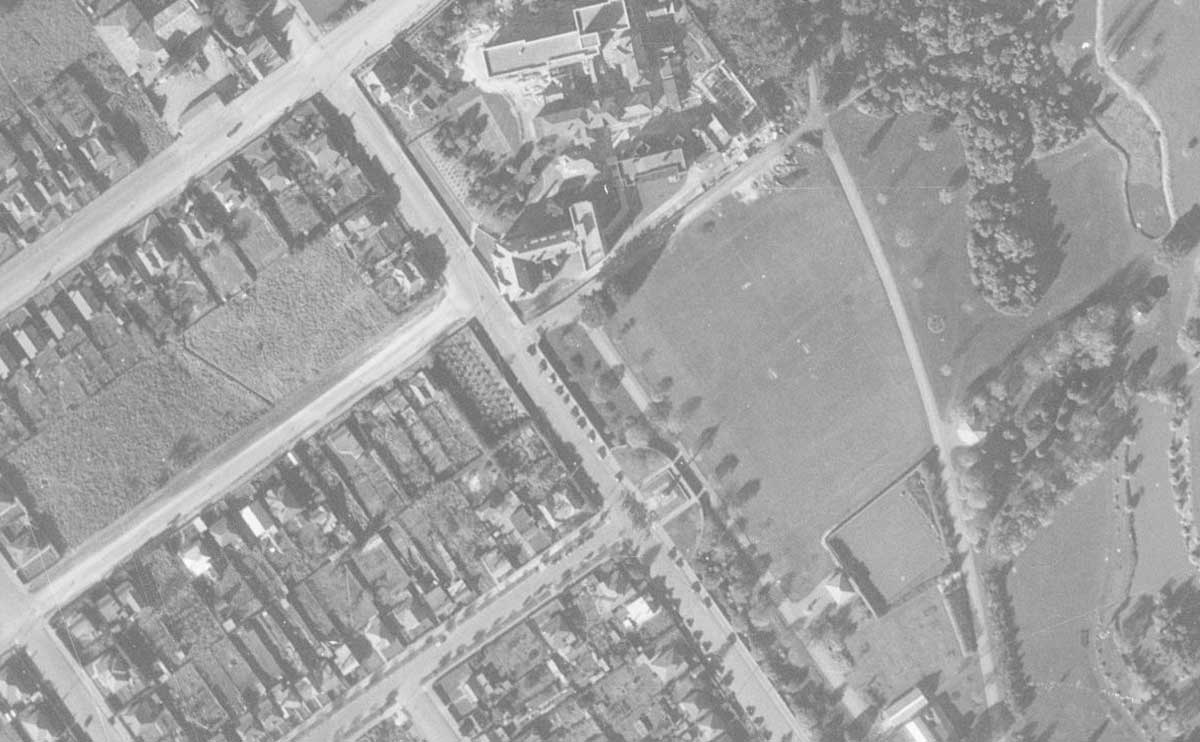
Section from a retrolens image 1938 showing the hospital and war memorial, and Memorial Avenue https://retrolens.co.nz/
Just by memorial avenue is a Nissen hut on 53 Edward Street, Parkside, Timaru. These were huts could be prefabricated, and packed up for transport. Wooden bearers laid on the ground, steel ribs bolted on, wooden joists screwed to the bearers and then the inner lining with corrugated iron was assembled followed by another layer on the outside. The semi-cylindrical corrugated-iron structure invented during the First World War. It was designed to be quick to erect, economical, transportable and adaptable. Importantly for this question, the official Nissen Hut history notes that there were specific wartime variants including a Hospital Hut, developed alongside the better-known Bow Hut design in 1916.
Timaru’s first public hospital was opposite the Basilica on Craige Ave, the gaol used to be a couple of blocks south. A second hospital was built on Queen Street around 1870, with the later hospital site developed over the years and connected to land near the Botanic Gardens/current Parkside area. A “temporary hospital building” evidence I found is from the 1918 influenza epidemic. The Timaru Herald reported in November 1918 that Timaru Hospital was under pressure but improving, with volunteers helping and a tent hospital in the Park operating for influenza patients. The report distinguishes between Timaru Hospital itself and the Park marquees, suggesting an emergency overflow arrangement rather than a permanent hospital building. https://paperspast.natlib.govt.nz/newspapers/THD19181119.2.20
By early December 1918, the position was improving, but the death toll was still grim. Another Timaru Herald report recorded one further death at Timaru Hospital, four admissions, two fresh cases, 20 patients in the convalescent home, and 60 cemetery burials in November compared with 14 in the same month the previous year. https://paperspast.natlib.govt.nz/newspapers/THD19181203.2.23
A 2023 audit describes Te Whatu Ora South Canterbury as serving around 61,500 people from the 135-bed Timaru site, with services including mental health and addictions, medical, surgical, assessment, treatment and rehabilitation, paediatrics, maternity and clinical support.

Survey Photography - 1956 Timaru Hospital. PA Group 00080 Whites Aviation Ltd Photographs. nlnzimage