
By Roselyn Fauth
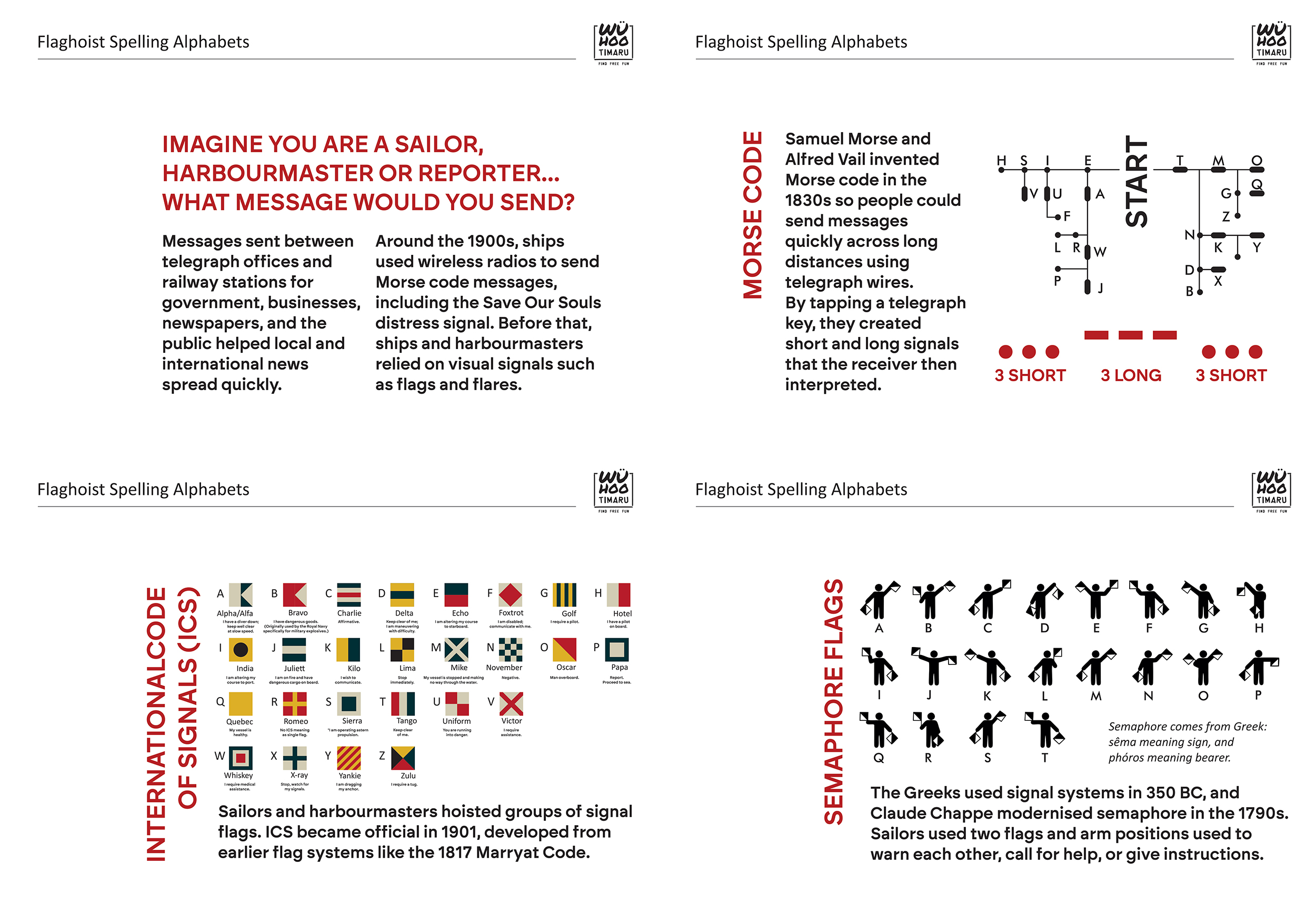
Long before modern radios and satellite navigation, sailors relied on a range of communication systems to share information, send warnings, and save lives. Timaru’s maritime history is closely tied to these methods, which carried news of shipwrecks, guided vessels into harbour, and connected seafarers across long distances. Three of the most important systems were Morse code, the International Code of Signals, and semaphore.

Morse Code: Messages Across the World
Morse code was developed in the 1830s by Samuel Morse and Alfred Vail. Using a combination of dots and dashes, it allowed messages to be transmitted quickly along telegraph wires or later by wireless radio.
By the mid 1860s, The Timaru Herald was sending and receiving Morse messages, which meant that reports of shipwrecks and maritime emergencies travelled rapidly. Stories from Timaru’s coast could reach readers far beyond the region within hours.
One of the best known Morse signals, introduced around 1900, was the SOS distress call. Its simple pattern of three short, three long, three short signals made it easy to recognise during emergencies at sea.

International Code of Signals (ICS): Communicating by Flags
Before radio became common, ships often exchanged information visually. The International Code of Signals formalised this in 1901, drawing on earlier systems such as the 1817 Marryat Code.
The ICS uses coloured flags to represent individual letters, numbers, and short standard messages. Ships could hoist single flags for basic instructions or fly groups of flags for more complex communication. Harbourmasters, pilots, and ship crews all relied on these signals to coordinate movements, request assistance, or warn of danger.

Semaphore: Communication by Arm Signals
Semaphore was another widely used visual system. Instead of flags on a mast, it relied on sailors holding two hand flags in specific arm positions. Each position represented a different letter of the alphabet. Semaphore was practical for communicating over moderate distances, especially between ships travelling together or between ship and shore.
It was commonly used to pass instructions, warn of hazards, or relay information when speaking or shouting was impossible due to wind and sea conditions.
These systems represent an important chapter in maritime communication. They helped save lives, guided vessels safely into harbour, and ensured that vital news travelled quickly. Although technology has advanced, the legacy of Morse code, signal flags, and semaphore remains deeply connected to coastal communities like Timaru and the sailors who once depended on them.

Telegraph messages made Timaru's news national and global.
Early reporting was crutial to how the nation viewed the viability of Timaru's Port. And our Ports viability was critical link for local exachange with national and international markets.

Timaru’s early communication helps us understand by stories of the Alexandra lifeboat and sea rescue history went global thanks to the role of the Timaru Herald, especially during the Kerr family’s long stewardship. By the 1880s the Herald was part of a fast, nationwide telegraph network that connected New Zealand newspapers to international wire services like Reuters through the United Press Association.
This is why news of the 1882 Benvenue and City of Perth wrecks travelled so quickly: eyewitness details were telegraphed out of Timaru the same day, printed across New Zealand within hours, and reached Australian papers within days. The Herald was known for technical innovation and for giving Timaru its own voice at a time when larger ports such as Lyttelton and Port Chalmers often dominated political debate.
Its reporting did more than inform. It also advocated for investment in the harbour, celebrated the Alexandra lifeboat and rocket brigade crews, shared sad stories of those who were injuried and died, and helped shape public understanding of local events.

Receiving news of Boer War. An image, identified on the verso, as "Telegraph of news 17th May 'The Relief of Mafeking' c 1900 (Baden Powell), being received at a Post Office by C.W. Keinan". Depicts two men at a bench transcribing the message while three others stand in the background. Telegraph offices, South Canterbury Museum 2681

Telegraph lines in Temuka, circa 1905, Dunedin, by Muir & Moodie. Te Papa (C.014351)
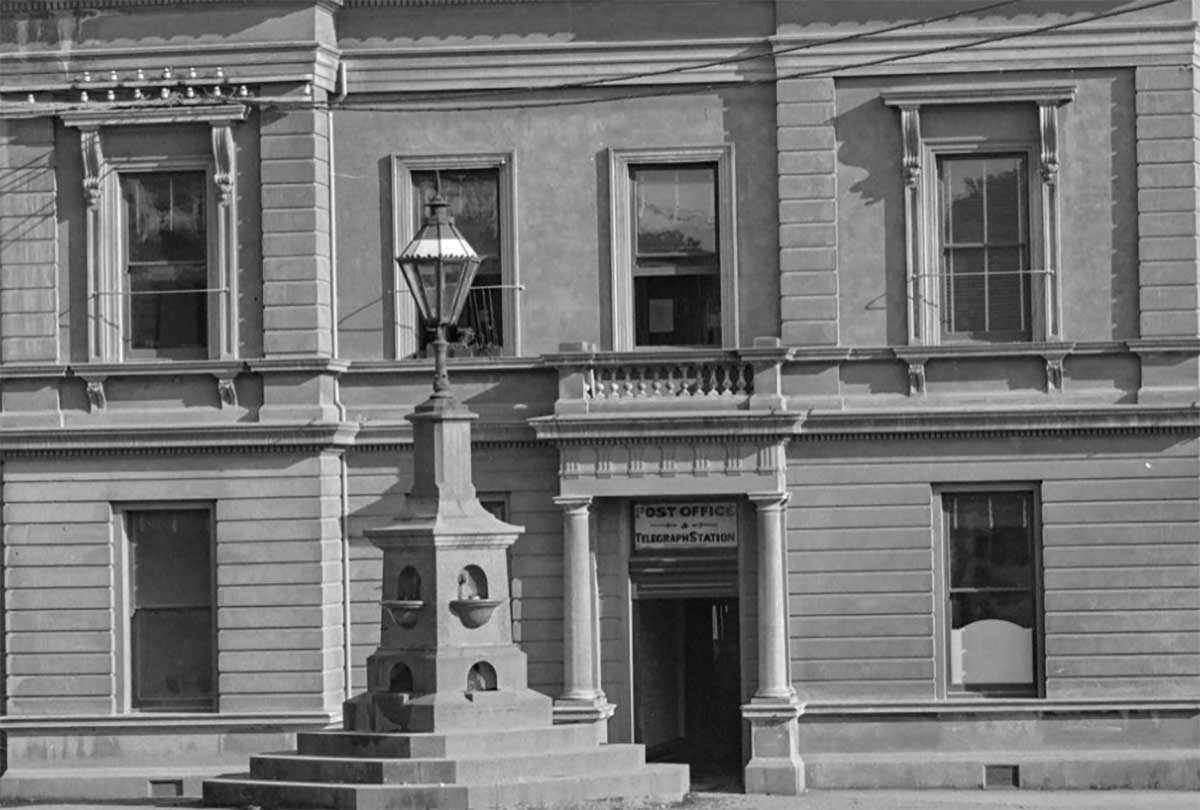
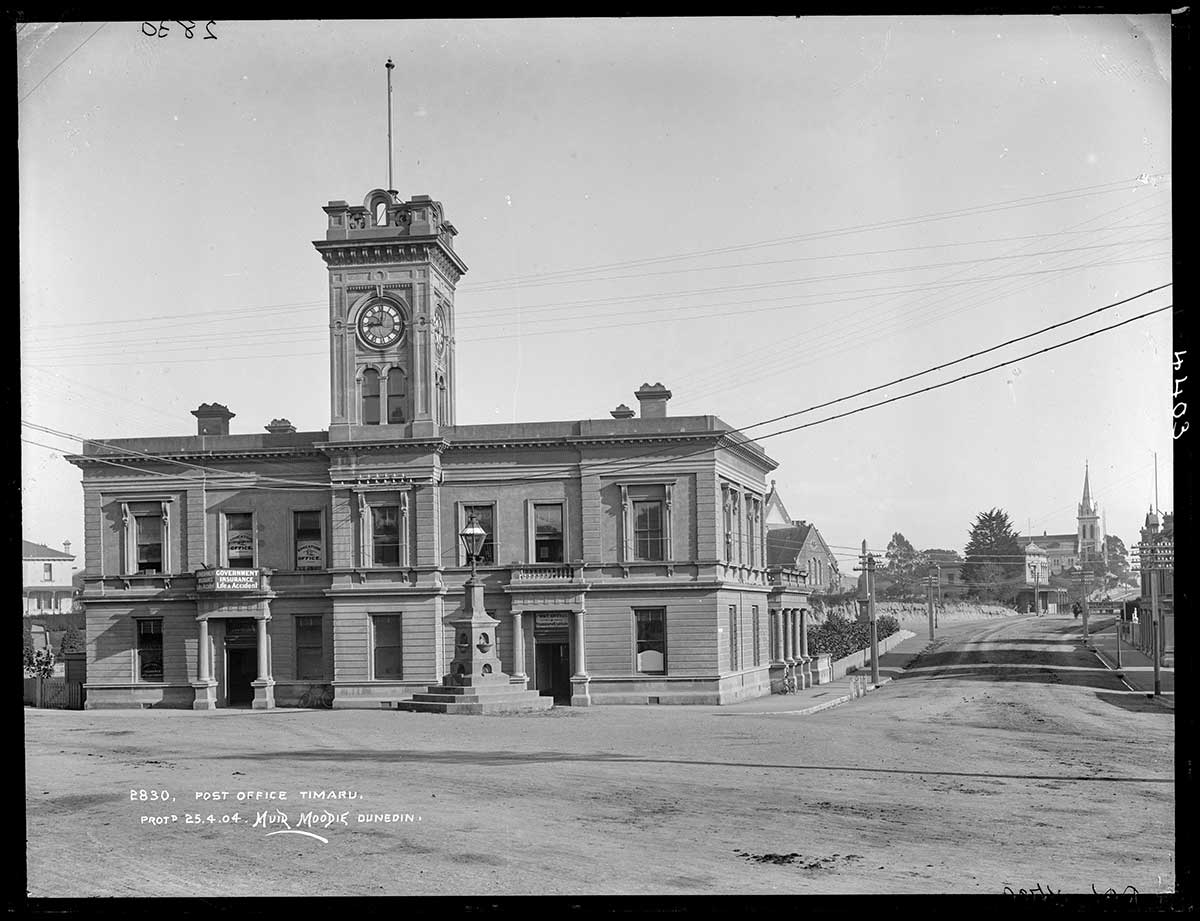
Post Office, Timaru, circa 1904, Dunedin, by Muir & Moodie. Te Papa (C.014403) Crop

The above scan is of the Illustrated Australian News. It reports the Benvenue Shipwreck and includes three illustrations. (1882, June 10). Illustrated Australian News (Melbourne, Vic. : 1876 - 1889), p. 85. Retrieved December 10, 2025, from http://nla.gov.au/nla.news-page5731583

Timaru Herald. 13 July 1928 Page 9 (Supplement). https://paperspast.natlib.govt.nz/.../timar.../1928/07/13/25

First edition of the Timaru Herald. It was printed in a small room, a detached kitchen in the George Street cottage on a hand press. It was printed once a week. At the time there was a "rough and ready" settlement of about 150 houses and 1000 people paperspast.natlib.govt.nz/THD19140611.2.64.10

First edition of the Timaru Herald from June II 1864 - Vol 1 No 1 was printed in Samuel Williams kitchen, a lean-to cottage at the foot of George Street.

-Timaru 1859-2009, Celebrating 150 years. Aoraki Heritage Collection, accessed 12/09/2024, https://aorakiheritage.recollect.co.nz/nodes/view/3330
"In the kitchen of a cottage in lower George Street, on June 11, 1864, The Timaru Herald was born. A respectable eight pages that cost sixpence (£1.1s for an annual subscription, payable in advance), the newspaper was to be produced every Saturday. In the first edition, the proprietor wrote of his hopes for the newspaper and what benefits he believed it would bring to the fledgling district. "The local newspaper," he wrote, "is the great agent for writing the history of the age and disseminating it amongst the people. It educates people by making education necessary to them. It is the guardian of liberty and of law, because both liberty and law can exist only where the acts of public functionaries are subject to publicity. Of the part which the newspaper press takes in guiding the public mind in its political and social movements, we say nothing; for that is rather accidental to the newspaper than an essential to it, especially to the local papers of remote districts. But as the organ and voice of the people, expressing their wants and urging their claims, the local journal is of the greatest use to the public. In starting The Timaru Herald, it is the intention of the proprietors to keep this mainly in view."
Situated in the midst of an immense district almost wholly unsettled, and with resources very partially developed, our primary task will be to keep the wants and claims of the district perpetually before the public and the Government. But it is not only in the leading articles of a newspaper that the public mind is reflected. The editor may mistake or misstate public feelings. As a corrective to such error, our columns shall be freely open to correspondents of all opinions, provided only that the language in which their opinions are couched is such as to cast no discredit on the journal which is the medium of publication."
When it was two years old, The Herald became a bi-weekly paper of four pages, and its price was reduced from sixpence to threepence. There were some further enlargements of sheet size and changes of format in the next few years, until The Herald attained the stature and prestige of daily production on New Year's Day, 1878. It was then priced at twopence, and there was a weekly supplement.
While the first edition was created in Sam Williams' kitchen, it is likely it was no more than a makeshift arrangement, for the press and the few cases of type were soon transferred to a building in another part of George St. The office then moved to Stafford St, next to the present site of Bar Xcel. There, plant and premises were wiped out in the Great Fire of December 7, 1868. Some cases of type were removed before the gale-driven flames took the printing shop, but little of value was salvaged. The hand press was damaged, yet an edition carrying a full report of the fire was printed after a break in publication of only two days. The Herald office was rebuilt in brick and stone.
The Sophia St office was built in 1884-85, but was transformed by subsequent changes, and The Herald moved to its present Bank Street offices in 1984."
- https://aorakiheritage.recollect.co.nz/nodes/view/3330?

Sketch map illustrating the early Canterbury pastoral runs, 1930.
Black and white map showing the extent of early Canterbury runs, drawn at an approximate scale of 1:380,160 (1 inch to 6 miles). Copied from The Early Canterbury Runs: First Series by L. G. D. Acland, published by Whitcombe and Tombs, Auckland, 1930.
Canterbury Cultural Collections, File Reference: CCLMaps 490414.

“New Zealand Shipping Company” (NZSCo) operated passenger and cargo services between Great Britain and New Zealand between from 1873 to 1973. The company was founded in 1873, by a group of Christchurch businessmen, and these were; Hugh Murray-Aynsley and John Coster. There were seven initial directors, including George Gould Snr, Coster, John Thomas Peacock, William Reeves, and John Anderson. The company gradually established a fleet of vessels, with each ship having been given a Maori name. As of 1875 the NZSCo ships new livery had black hulls, a white superstructure and slender tall yellow funnels. Then in 1882, the company’s ships were equipped with refrigeration and a frozen meat service commenced from New Zealand to England, which was a huge financial success.

View of a dirt road running through farmland from foreground into distance, there is a line of trees on left of road. Two men and a dog are herding several cows along the road. "Summer day, South Canterbury, N.Z., 1920s-1930s, Dunedin, by George Chance. Purchased 1999 with New Zealand Lottery Grants Board funds. Te Papa (O.020654)"
Visit the lifeboat shelter at Caroline Bay Timaru, and explore how communication moved from visual signals to telegrams to printed headlines, and how the Herald helped share Timaru’s stories with the world.
Here are some .pdf files that you could use to create your own codes at home, and then decode them with others at the bay. WuHoo - Maritime Communication - Code Breakers A4


The lifeboat Alexandra, manned by Waterside Workers for an unidentified parade, pictured on Sarah Street in Timaru, circa 1912. The lifeboat is shown harnessed to a team of Clydesdale horses and appears to be heading for or leaving a parade. Amongsat the flags flown are the American and Australian flags and the British ensign (among others), as well as a banner for "Timaru Waterside Workers". South Canterbury Museum 1543

The lifeboat Alexandra, manned by Waterside Workers for an unidentified parade, pictured on Sarah Street in Timaru, circa 1912. The lifeboat is shown harnessed to a team of Clydesdale horses and appears to be heading for or leaving a parade. Amongsat the flags flown are the American and Australian flags and the British ensign (among others), as well as a banner for "Timaru Waterside Workers". - South Canterbury Museum 1543

South Canterbury Jubilee dinner at Timaru, 1909. Shows guests at a dinner held in the Drill Hall, with men and women seated at long tables. Flags hang along a wall. A banner compares import, export, mutton, and wool statistics of 1859 and 1909. Photographer unidentified. Toned silver gelatin print. - natlib.govt.nz/338563


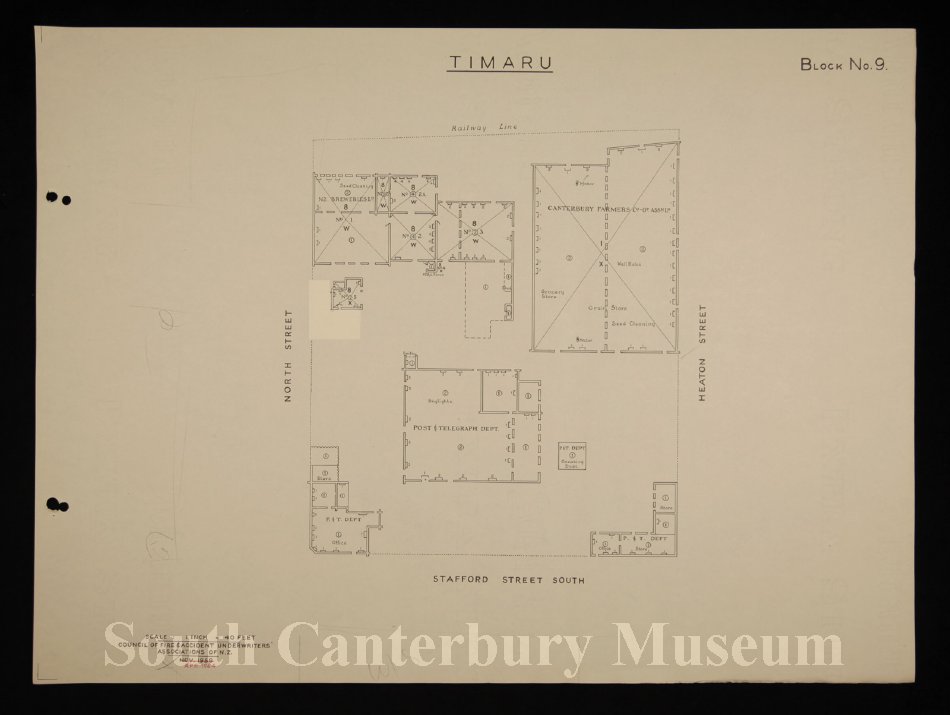
Post and Telegraph Department in the center - Fire and Accident Underwriters Association: block plans, Timaru township - South British Insurance Company: Block Plans by the Council of Fire and Accident Underwriters Associations of New Zealand, dated between 1959 and 1972. South Canterbury Museum 2002/005.06b