
By Roselyn Fauth and Geoff Cloake
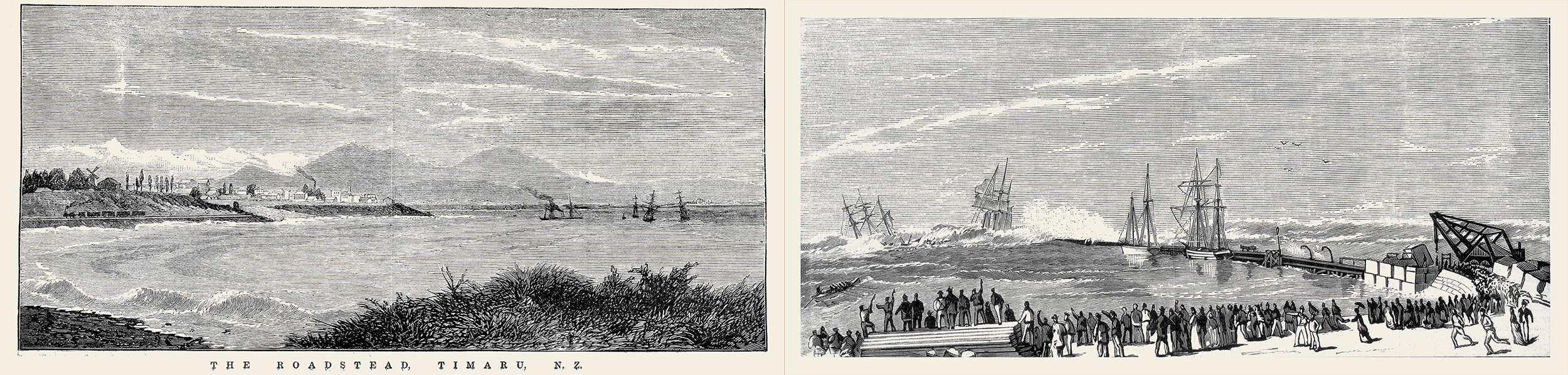
Before Timaru had roads or bridges, the sea was teh communities lifeline. Pretty much everything and everyone arrived through the restless Roadstead, where ships lay exposed to sudden squalls, dragging anchors in dangerous swells while small boats ferried people and cargo to shore. Wrecks were common, and rescue was left to those brave enough to race into the surf in open boats: Deal boatmen, the Rocket Brigade, and the crew of a wooden lifeboat built in 1862 and sent from Britain to serve this young port. Her name was the Alexandra.
For years she carried a mixed reputation. A fatal capsize in 1869 cast a long shadow, and by 1882 many considered her “laid up and ordinary”. Yet she was still cared for, still ready. And on Black Sunday, 14 May 1882, when a calm blue sky turned treacherous and three rescue boats overturned in heaving seas, the Alexandra proved why she had been built in the first place.
What followed became her finest hour. Before a stunned crowd of more than a thousand, the old lifeboat rolled and righted herself again and again as her crews fought to save the men scattered among wreckage from the Benvenue and City of Perth. Across three desperate missions in fading light, the Alexandra capsized four times and still returned to the surf, ultimately helping bring 43 men back from certain death.
It was a day of courage and heartbreak. Ten men were lost, yet dozens survived because volunteers refused to stop rowing. Timaru has never forgotten this moment. The Alexandra was later paraded through the streets as an emblem of gratitude and grief, and today she remains one of the oldest surviving lifeboats of her type in the world. Her story anchors a much larger one about a community shaped by the sea, and by those who chose to face it...

The Alexandra’s ‘Darkest Hour’
“The Roadstead, Timaru, N.Z. 1877.”) Published October 13, 1877 in The Illustrated Australian News by Ebenezer and David Syme. Wood engraving.
Before roads and bridges, overland travel was slow and difficult, so the sea was a vital link to the rest of the country and the world for transport and trade.
Many ships were wrecked and salvaged before the construction of Timaru’s breakwater began in 1878.
Many men risked their lives to rush to the rescue, saving lives, ships, and cargo.
Before the harbour was constructed, ships had to anchor offshore, and smaller vessels ferried people and cargo between ship and land.
Violent swells and storms could arrive with little warning. Some ships could not raise sail in time or tack into deeper water, dragging or losing their anchors and drifting into danger.
Several rescue services formed in the nineteenth century to manage these dangers: the Deal boatmen, the Alexandra lifeboat crews, and the Timaru Rocket Brigade.
The Alexandra lifeboat, built in 1862, arrived in 1863 from Britain to serve as Timaru’s rescue vessel.
The lifeboat was stored in a shed beside “Cain’s Landing Place” at the foot of Strathallan Street. The Government developed the landing service in 1864.
By 1870 the Alexandra lifeboat had helped save seven lives.
A fatal 1869 capsize of the lifeboat cast a shadow over its success, giving the vessel a reputation as “evil and unused”.
The lifeboat needed careful management and handling, so the crew were paid and trained, enabling them to be on standby.
The crew’s monthly £1 allowances was later cut and they were forced to volunteer. The Lifeboat Lodge was established, and women organised fundraising events.
The Rocket Brigade became the primary rescue service by 1877 and went on to rescue more than 100 lives. The lifeboat was not required for many years.
By ‘Black Sunday’, the Alexandra was still well housed and maintained even though some considered it to be ‘laid up and ordinary’.
Black Sunday, May 14, 1882
The breakwater had been constructed, but due to capacity, ships often had to anchor beyond the breakwater.
A violent sea struck on a windless day under a blue sky. The Benvenue’s ballast shifted and caused it to list.
The crew made it to City of Perth before the Benvenue snapped from its anchors and drifted across Caroline Bay. It wrecked at the cliff, where it was smashed to pieces.
Both crews then came ashore and the ship’s gig and ship’s lifeboat rowed out again for a whaleboat to try and save the City of Perth but it drifted towards the breakwater.
It was while they were rowing back to safety that the three boats capsized in 18–20 foot heaving seas. This became Black Sunday, one of Timaru’s most significant maritime events.
In 1862 the Canterbury Provincial Secretary ordered this lifeboat along with a launching carriage and provisions for 6 pulling oars and a steersman. It was crafted by the National Lifeboat Institution in the UK. The Alexandra served from 1863–85 and is one of the oldest examples of a lifeboat of its type in the world.
The Alexandra’s ‘Finest Hour’

WRECKS AT TIMARU, JUNE 10, 1882.
This illustration, along with the two below, was published in the Illustrated Australian News. State Library Victoria: 020458.
The Benvenue Memorial on the corner of Perth and Sophia Streets was built from 1883–85 and funded by City of Perth survivors to honour the lives lost. Many worked on this and other sea tragedies but remained unknown as individuals until recently.
The Alexandra was paraded through the streets before displayed as an object of remembrance. It is one of the world’s oldest surviving lifeboats. Today it holds the pride of place in the new heritage centre once cared for and maintained by the wives of the crew and an important part of Timaru’s maritime story.
A crowd of over 1,000 watched as the disaster of May 14, 1882 unfolded.
After a failed attempt to save the City of Perth, 19 people who had taken to a whaleboat, the ship’s gig, and the ship’s lifeboat, fought for their lives in swamped boats and wreckage, in a violent sea under a blue sky.
Volunteers rushed to the rescue in a surfboat and the 1862 Alexandra lifeboat.
The Alexandra rescued 11 men, capsizing and self-righting three times on the way back to shore.
The surfboat rolled and swamped its crew of 11 and the three men who had swam to it for rescue. It was unable to return to shore.
As darkness began to fall, another crew in the Alexandra rowed to the rescue. It rolled again, and two men didn’t make it back on board, including one who had clung to a buoy for two hours.
The Alexandra then returned for the remaining three men, saving them before their surfboat finally sank.
Across three missions over 4.5 hours, the Alexandra capsized four times, self-righting as it was designed to.
A total of 24 people were saved directly from the salvage disaster, and another 19 crew members reboarded safely onto its virtually unsinkable hull.
10 men died from the disaster, including:
• 5 in the initial boat failures.
• 2 during the Alexandra’s fourth capsize.
• Capt. Milne from exhaustion back on shore.
• 2 who died later from injuries.
The Alexandra saves 43 men from peril in an exceptionally dangerous sea.
Local women stepped up their fundraising efforts, inspired by Baroness Burdett Coutts, an English champion of lifesaving services.
After Black Sunday, the Harbour Board re-established a paid crew. The lifeboat service ended in 1885, when harbour improvements and the arrival of a tugboat made the old system redundant.