

Can you find original street lights?
The Stafford Street lighting used to be lit by hand. In 1871 Kerosene street lamps were installed and were soon credited with reducing the "menace of brothels' at Whales Creek".
For more than 100 years gas was piped from the gas works in Perth St to homes and businesses in the area between Hobbs St in the north, Broadway Ave in the west, Flinders St in the south, and throughout the inner-city area. In 1875 Timaru Gas Co was formed and nearly 9km of gas-iron pipes, the lights were converted to gas in 1876. The gas companies office was on George St where Mega Mitre 10 is today.
Electric light came in 1926. Before the streets were sealed, they would get very slippery and muddy when it rained, they would scoop the mud and put it along the side of the road, if you were not careful you could step knee deep into the mud in the dark.
Alpine Energy began in March 1906 when the Timaru Borough Council entered into a contract with Scott Brothers of Christchurch to light the town with electricity. The price for this contract was £750 per year for four hours of light per night – except when the moon shone. In 1915 the council purchased the Scott Brothers’ electricity generator and a year later another generator was installed and about 580 customers had been signed up. All electricity developments were in town until 1921 when a meeting of country delegates decided to form a South Canterbury Electric Power Board. The board set about forming a viable electricity supply enterprise across the province. The South Canterbury Electric Power Board and the Timaru Borough Council agreed for the power board to purchase the town supply. However, the town’s residents voted against the proposal. From that day, February 29, 1924, the Timaru Electricity Department and the power board continued on their separate paths. The Timaru Borough Council purchased all of its electricity from the SC Electric Power Board. This was from the Lake Coleridge power station supply which was made available at Temuka for distribution throughout Timaru and South Canterbury. The two organizations grew and developed in their separate franchise areas until the Government industry reforms of 1992 prompted the separate bodies to look again at the issue of amalgamation. Learn more
In 1970 Gas production from coal was stopped, and all gas will be produced by oil plants. This was located at Perth and Arthur Streets. At the time of demolition it was one of Timaru's tallest landmarks.
The former Timaru City Council-owned Municipal Electricity Department, which owned the pipes, merged with the South Canterbury Power Board to form Alpine Energy. Today Alpine Energy pays rent to the Council to have cable in about 10 kilometres of pipe between Pacific St and the southern end of King St. They range from 20 centimetres in diameter close to the old gas works, down to 3cm along smaller side streets. Learn more
Beside the two lights is a sculpture by Doug Neil. Rock of the Heartland. Basalt. 2008.

The Timaru Gas Works and Willen Mill on the Corner of Perth and Arthur Streets. The gas tank was complete in 1901. Learn more and here. - Alexander Turnbull Library G-8812-1/1

Detail showing a street light on Stafford Street, North, Timaru, 1905, Timaru, by Muir & Moodie. Purchased 1998 with New Zealand Lottery Grants Board funds. Te Papa (PS.001038)

Detail showing a street light on Stafford Street, Stafford Street, Timaru, circa 1910, Timaru, by William Ferrier. Te Papa (O.051436)


On the corner of Arthur and Butler Street Timaru are three old lamp posts - Photo Roselyn Fauth 2025
Timaru’s electric street lighting began in 1908. A report said the streets were lit “for the first time with electricity” on 8 June 1908, with Scott Bros. of Christchurch as contractors. The contract was agreed in March 1906 between Timaru Borough Council and Scott Bros. The price was £750 per year for about four hours of light per night, “except when the moon shone. Earlier, in 1905, the proposal was for Scott Bros. to install a plant to light the streets, supplying 24,300 candle-power. Before electricity, Timaru had kerosene lamps, then gas street lights from 1876. Stafford Street had powerful gas lamps by 1907, just before the electric changeover.
ELECTRIC LIGHT AT TIMARU.
Wairarapa Age, Volume XXXI, Issue 9110, 9 June 1908, Page 5


Detail showing a light at the Crown Hotel, Temuka, circa 1905, Dunedin, by Muir & Moodie. Te Papa (C.014351)

Lamp hangs near the entrance of the Grosvenor Hotel in 2025 - Photo Roselyn Fauth

Left: Post Office, Timaru, circa 1904, Dunedin, by Muir & Moodie. Te Papa (C.014403) Right: The drinking fountain was relocated to the Timaru Botanic Gardens sunken garden. - Photo Roselyn Fauth 2025
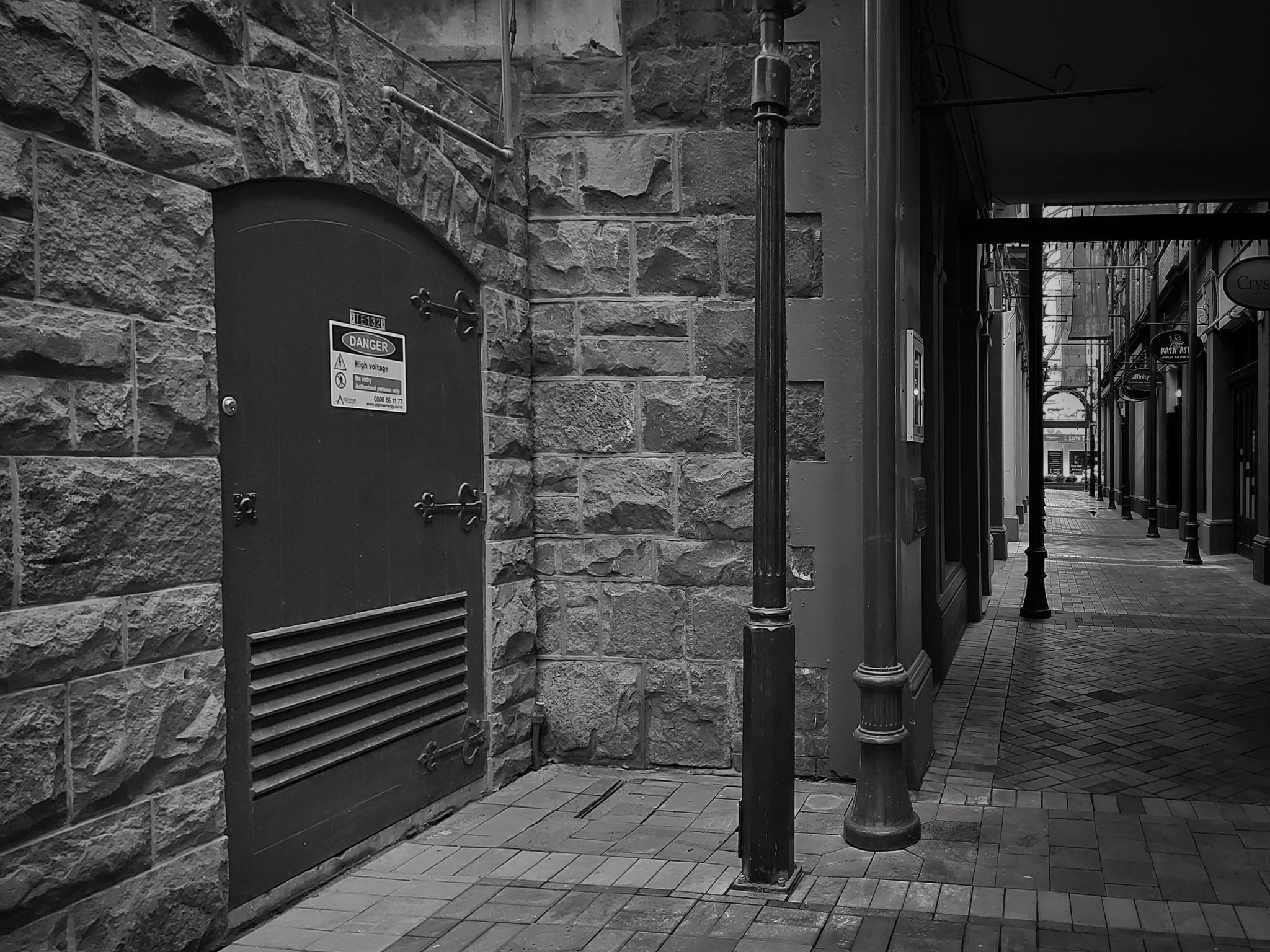
Timaru Royal Arcade - Strong Room behind bluestone - Photo R Fauth
The War Years, 1939 to 1945
By 1940, South Canterbury’s electricity network was beginning to show the strain.
The original lines had been lightly built, and for many years there had been no serious attempt to reconstruct them. There were a few reasons for this. One was the way electricity was used in South Canterbury homes. Because the district had a moderately cold winter climate, electric ranges were not taken up as quickly here as they were in other parts of New Zealand, especially in the North Island.
The figures tell the story. In 1930, electric ranges made up 15.56 per cent of domestic consumers in South Canterbury, compared with 9.14 per cent across New Zealand. But by 1950, South Canterbury had risen only to 27.73 per cent, while the national figure had reached 46.60 per cent.
Another challenge was financial. Timaru was not included in the Board’s retail distribution system, which meant the Board missed out on the advantages of supplying electricity within a more densely populated town area. Rural supply was more expensive to build and maintain, yet the Board was under pressure to keep its tariffs close to Timaru’s lower city rates.
By 1940, it was clear the existing lines would need to be upgraded to meet growing demand. But by then the Second World War had begun. Labour and materials were hard to obtain, and reconstruction on any realistic scale became impossible.
Wartime controls made the situation even harder. Supply authorities needed permission from the Electricity Controller before using construction materials, and the manufacture of many electrical appliances was restricted because raw materials were needed for the war effort.
By 1944, line losses had become a serious problem. Demand from consumers was increasing, but this created an even greater strain at the Grants Hill point of supply. Possible solutions included a second supply point near Studholme, perhaps a third between Temuka and Geraldine, and heavier electric lines.
But until the war ended, there was little that could be done.
ELECTRIC LIGHTING.
Timaru Herald, Volume XIIC, Issue 13646, 14 July 1908, Page 3
CONDITIONS OF SUPPLY.
The Timaru Borough Council spent an hour and a half last night in a discussion on the conditions upon which electric current is to be supplied to private consumers.
The Mayor introduced the subject, and said the conditions had been approved by Mr Armstrong, the Council’s expert, by Scott Bros., and by the Council’s solicitors. The Council, he said, could appoint an inspector at any time, to see that the work was done in accordance with the conditions.
An amendment suggested by the solicitors that the penalty for delay in payment for supplies should be reduced from 20 per cent., proposed to 10 per cent. was agreed to and adopted.
Councillor Raymond wished the charge for lift motors to be reduced. Clause 5 requires owners of lifts to pay a minimum charge as for a full load for 4 hours a day, the current used for a shorter time, and he asked that the minimum be made 2 hours, as the 4 hour charge would mean a day—£127 10s a year.
Cr Satterthwaite said it seemed that the contractors had drawn up the conditions themselves, and the Mayor said that was not the case. They were based on the rules of Christchurch and Dunedin, modified to suit the circumstances of Timaru.
Cr Satterthwaite urged that the two cases the Council had before them last Friday night should be dealt with before they adopted these conditions, for if the conditions were adopted first, those installations would be useless. They were put in, in good faith, before the conditions were framed, and the conditions should not be retrospective. The owner of the buildings wanted to have them up-to-date. He arranged with contractors to install wires, and it was not his fault that conditions were not available sooner. It would be a very great hardship if Mr Hay had to do all the work over again. Messrs Turnbull and Jones told the Council that they carried out the work according to the best conditions in use elsewhere, and it would be a hardship to penalise the owner in the circumstances.
The Mayor said it was their own fault. They went ahead and wired the buildings before the Council got a license and took the risk of the work being in compliance with the conditions of the license. It would not be fair to accept those installations and insist on other ones for other people.
Councillor Mullin said that Scott Bros. were putting electricity into the town altogether at their own expense and they must be considered. The only thing now was for the two parties to try to come to an agreement between themselves. He regretted that any hardship must fall upon Mr Hay, but he approved of Timaru setting an example of good work.
The Mayor: If the work had been done equal to the Christchurch conditions it would have been all right.
Councillor Mullin: The other party said it was so done, and that the inspector agreed that it was. It should be admitted that Turnbull and Jones wired the place in good faith, but the standard had been raised. With regard to the future, he did not think any firm’s work should be subjected to another firm’s inspector.
The Mayor: That can be dealt with. I mentioned that we can appoint an inspector.
Councillor Mullin: It comes to this, that if anybody wants to avoid trouble they must employ Scott Bros. to do their wiring.
The Mayor: If we adopt the conditions we can employ our own inspector, and if he passes it we can compel Scott Bros. to supply current.
Councillor Mullin reminded the Mayor that the other night Mr Scott said it did not signify how many inspectors the Council had, they must still inspect for themselves.
The Mayor: There was too much “energy” about that night.
Councillor Leathwick thought clause 9 covered the case.
Councillor Hawkey would agree that the conditions should apply to all future work, but they should not be retrospective. He would like to see an outside expert called in to report on the two Hays’ buildings. He understood that the installations had cost £100, and it would be a great hardship to insist on the work being pulled out and done over again. Mr Armstrong made some recommendations for effective safety, and these should be sufficient; but the Council should take no responsibility.
Cr Raymond proposed to move that Mr Armstrong be asked to report in what respects, if any, the installations were defective according to the Government license, which was all that concerned the Council.
Councillor Bowker concurred.
Councillor Leathwick said clause 9 said the Council must inspect.
Cr Satterthwaite asked that Mr Armstrong’s report be read and the town clerk read it. The report was of some length, and dealt with several technical details, mentioned a number of defects, recommended amendments, and suggested that consideration should be shown to the contractors for the installations because the Council had given them no instructions or advice as to the nature of the work required.
Cr Satterthwaite thought the Council should treat this report as the report of an arbitrator and act upon it, demanding only the alterations of detail specified in it, which Mr Armstrong said would make the installation fire-safe; and if Turnbull and Jones made those alterations they should be supplied.
The Mayor said it would not do; Mr Armstrong was wrong as to the voltage, and the alterations would not make the installation in accordance with the Government license.
A discussion took place on “voltage,” some asserting that Mr Armstrong said it was 220, others that Mr Scott said it was 440.
In reply to Councillor Sealey, the Mayor said that Messrs Turnbull and Jones would know what was required to be done if the conditions were adopted.
Councillor Hawkey said they wanted to act on Mr Armstrong’s report and the Council wanted them to act on the conditions, which were two very different things.
In reply to a suggestion of a compromise regarding the two buildings, Councillor Oborn pointed out that there was no provision for making an application for current, except in accordance with the conditions.
Mr Scott, who was in waiting, was asked to come in and explain the reason for charging four hours per day as a minimum for lifts (clause 5). Mr Scott explained that the supply of current to lifts was the least satisfactory, as each lift required 6 to 8 horse power, and this was put on and off suddenly, and the power had to be kept in reserve for it all day, whether used or not. It was customary everywhere to make a charge for that, and 8s per day was a very moderate charge.
Mr Scott remarked that his firm had been too easy altogether in making their contract; they had given way on every point that was pressed; they were limited in their profits, and they were not going to make a fortune out of it.
Regarding inspection, Mr Scott wished to explain what he meant when he said last Friday that they must inspect themselves no matter how many inspectors the Council had. Inspections were required for different purposes: by the insurance companies for fire risks only; by the Government for earth leaks and interference with their telegraph and telephone systems; and by the suppliers for the safety and smooth working of the whole system.
Electricity was not like water or gas. What went out of the power house must go back again, or there would be trouble, and a defect in a private installation might put out all the street lights. For that reason, they, as suppliers, must inspect to ensure the safety of their system. If the corporation liked to take the responsibility the firm would not object to it, but he warned the Council that it would involve a risk of action for damages. Not long ago the Shoreditch corporation had to pay £2000 to an insurance company for having connected with a faulty installation. That was one sort of risk the Council would have to take if it took all the responsibility of testing and inspection. Only recently his firm had had to take out 200 faulty joints in the wiring of a big new building in Christchurch, which had been passed by the underwriters’ inspector.
Councillor Hawkey: Then we ought to take the word “corporation” out of these conditions, and put in “Scott Bros.”
The Mayor: The work will be all right if done according to these conditions.
Councillor Hawkey asked Mr Scott whether there was any possibility of a compromise regarding those two buildings, otherwise the whole of the installations would have to be torn out.
Mr Scott said his firm did not want to be unreasonable, but they could not connect with faulty installations. As for the work being done prior to the making of conditions, most of his work had been done before the license was issued, and if he had done any of it not in accordance with the requirements of the license, he would have altered it, and said nothing about it. As for a compromise the installation was not safe, and he would not connect it. They had been willing to meet the other parties, but these had made no attempt to meet them; on the contrary had treated them with contempt. If his firm were approached in a reasonable way they would try to be reasonable too; they had surely shown that all along.
In reply to Councillor Mullin, Mr Scott said that wiring according to Christchurch conditions would not do for the Timaru system; in reply to Councillor Satterthwaite, that if the work were altered as suggested by Mr Armstrong, it still would not do, and in reply to Councillor Raymond, that the voltage was 440, not 220, and if 440 leads were taken into a building at all that made the installation 440.
Councillor Satterthwaite: If Scott Bros. had wired these buildings as they are wired, would you put in current?
Mr Scott: Certainly not, and Scott Bros. would never have dreamed of wiring a building as these have been done.
It was now eleven o’clock, and Councillors began to show impatience at the questioning, and Mr Scott was thanked for his attendance and explanations and withdrew.
Councillor Leathwick said it was not a bit of use dictating to men in Mr Scott’s position.
Councillor Bowker: No; be good boys and do as you’re told.
Councillor Schmidt reminded the new councillors that the Council had tried to avoid having anything at all to do with private consumers, but they could not help themselves. If they could have got out of it they would.
Councillor Mullin: The sooner the Council takes the whole thing over the better.
The Mayor moved and Councillor Rothwell seconded “That the conditions as revised by the solicitors be approved and adopted.”
Councillor Raymond moved an amendment that 2 hours be the minimum charge for lifts instead of four. This was put and lost.
The Mayor’s motion was then put and carried, Councillors Raymond, Satterthwaite and Mullin voting against it.
The Mayor asked some Councillor to move that a copy of the conditions be sent to Messrs Turnbull and Jones.
Councillor Satterthwaite: And that a copy be sent to every other electrical firm as a hint to stop away from Timaru.
The motion was moved by Councillor Leathwick and carried.
LETTER TO THE EDITOR.
To the Editor of the “Timaru Herald.”
Sir,—In reading your report of the special meeting of the Council held on Friday evening I wish to correct a statement made by Messrs Turnbull and Jones’s representative, Mr Stead. He says that not only in New Zealand but throughout the world, the Fire Office rules were used for electric wiring, the Underwriters’ inspector was accepted as sufficient guarantee and the Corporation was in most cases also represented by an independent inspector but he adds the absurd deduction that the firm supplying current must not be allowed to pass any work carried out by other firms. Having spent a good deal of my time in the Old Country I could mention at least half a dozen firms who not only supply current and carry out contracts themselves but test all installations for their own safety and protection. I do not know of any firm at Home who would concede so much to a Borough Council as Scott Bros. have done here and in making their own tests they are only doing what is right and proper. If it is true that Mr Stead has been to England it does not say much for his knowledge of electrical firms there. To a new arrival it seems absurd that a special meeting of Councillors should be called to decide a point of this kind, which should be settled amicably by the people concerned.—I am, etc.,
COMMON SENSE.
Cr Raymond wished to move his motion that Mr Armstrong be asked to report, giving particulars of defects in the installations in the Hays’ buildings, but the Mayor said the seconder, Councillor Bowker, said that it would be useless now that the conditions had been adopted.
Councillor Hawkey expressed surprise. He thought the conditions were not to apply to the two buildings, or he would not have voted for them. Would the Mayor take a resolution that the conditions be not made retrospective?
The Mayor said he could not, but he would do his best to mediate between the parties.
Mr H. A. Adley, secretary Canterbury Fire Underwriters’ Association, inquired what method of inspection the Council proposed for private electric supplies, so that installations may be tested and certified to by a responsible officer prior to the electric current being used.
The Mayor said the underwriters had their own inspector.
A letter from the Superintendent of Electric Lines stated that the existing license for electric supply referred only to supply within the borough, and if an extension to the county was desired a separate license must be had. The permission of the County Council must also be obtained before poles could be erected.
The Mayor explained that there had been several applications for electric light for dwellings in the suburbs. It was suggested that applicants for light should apply for the license.

50 years of electricity of South Canterbury. Aoraki Heritage Collection, accessed 15/05/2026, https://aorakiheritage.recollect.co.nz/nodes/view/8351